
Launching a first t-shirt collection is usually less about design volume and more about disciplined product planning. Many startup brands add too many fits, colors, and graphics too early, then run into higher MOQs, slower sampling, fragmented inventory, and difficult reorder decisions. A focused private label t-shirt line gives you a cleaner way to test demand, control production variables, and build a collection that is easier to sell and repeat.
That is why early product decisions should connect directly to manufacturing logic, not just mood boards. If you are mapping out private label t-shirt line development, it helps to understand how style count, fabric choice, decoration, and size planning work together before you confirm your first order. A more structured starting point usually leads to fewer costly revisions and a better path to scalable reorders.
Why a focused first collection works better
A small first collection is easier to sample, easier to price, and easier to restock. Instead of spreading your budget across many weak sellers, you can put more attention into a few styles that represent your brand clearly. This also makes it easier to compare fit comments, review fabric performance, and identify which combinations deserve a second production run.
For most new brands, the main risk is not launching too small. The main risk is creating too many SKUs before there is enough sales data to support them. Every added fit, color, and size multiplies complexity across sourcing, labeling, packing, storage, and replenishment.
Why t-shirt brands lose control of SKU count
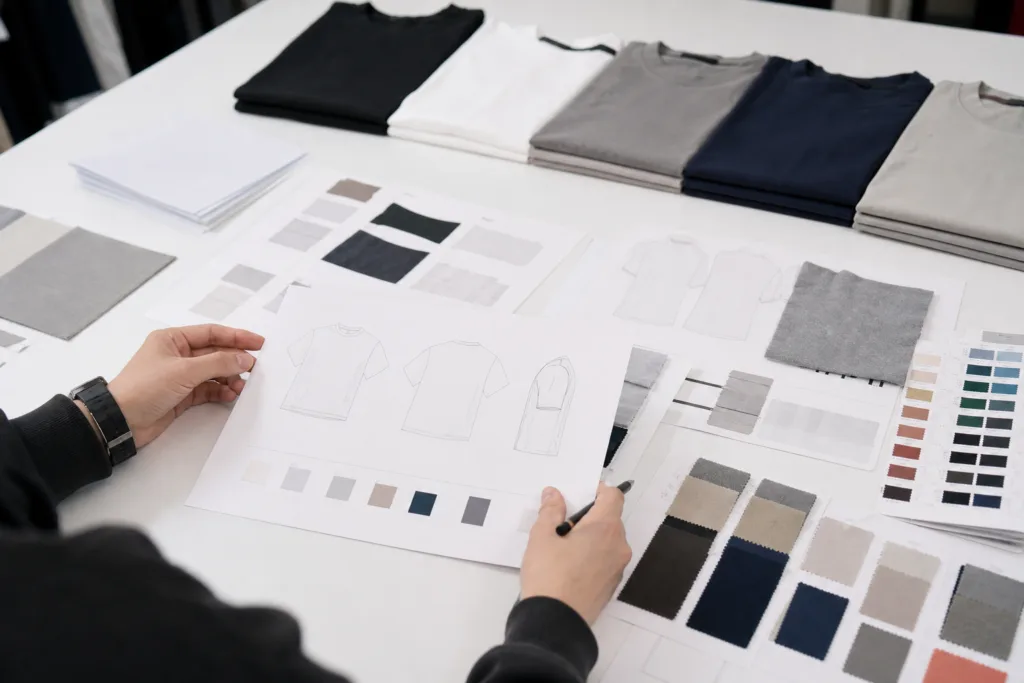
SKU growth often happens in small decisions that seem harmless on their own. One extra neck shape, two additional colors, a wider size range, and multiple logo placements can quickly turn a simple collection into dozens of separate production units.
- Each fit may require a separate pattern and fit review.
- Each color can affect fabric sourcing, dye lot control, and MOQ.
- Each decoration method may need different testing and approval steps.
- Each size expansion changes stock allocation and reorder logic.
The operational burden becomes heavier when the brand has not yet proven which products customers actually want. A lean range keeps testing practical and protects cash flow.
How many styles should a first private label t-shirt collection include?
For many first launches, two to four styles is a workable starting point. That may mean one standard fit, one oversized fit, and one slightly differentiated option such as a heavier weight premium tee or a garment-washed version. This is usually enough to express brand direction without forcing too many production decisions at once.
The goal is not to look minimal for its own sake. The goal is to make sure each style has a clear role. If two products target the same customer with nearly the same fit and fabric, one of them may only be increasing complexity rather than improving the assortment.
A simple way to define first-collection roles
- Core style: the most versatile t-shirt, designed for repeat orders.
- Brand style: the fit or finish that expresses your identity more strongly.
- Test style: a limited variation used to measure response without overcommitting.
This structure helps founders separate essentials from experiments.
Build a fabric platform before expanding the range
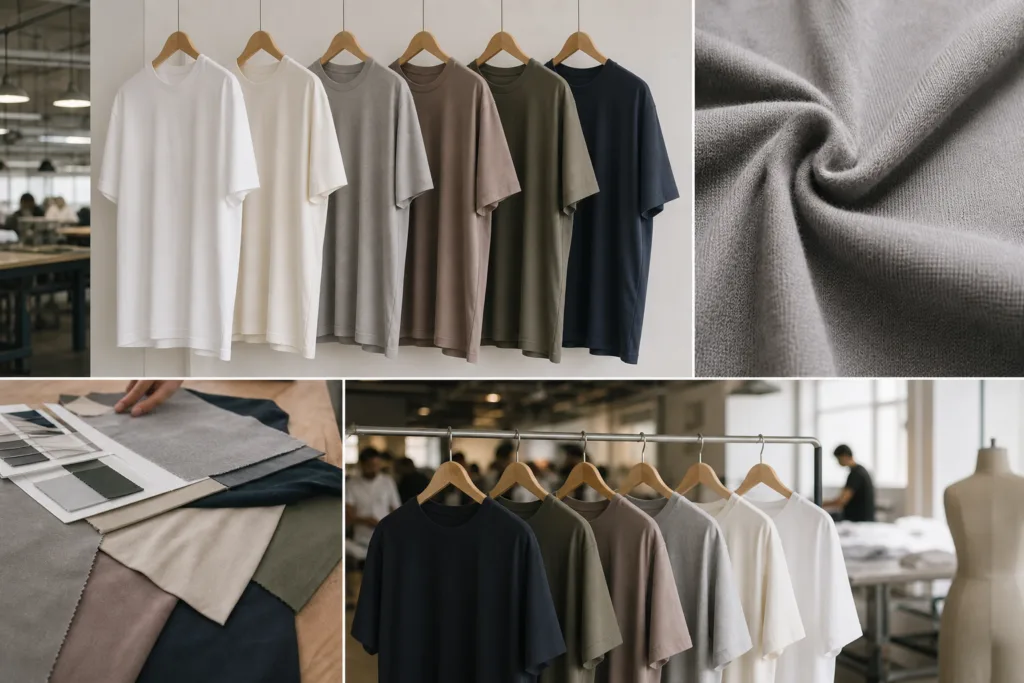
One of the most practical ways to control a private label t-shirt line is to standardize the base fabric first. A shared fabric platform reduces sourcing variation, simplifies color development, and improves fit consistency across related styles. It also makes later range expansion more efficient because you are not rebuilding the product from scratch every time.
Many small brands benefit from developing a clear fabric platform strategy before they expand into multiple silhouettes. When the fabric base is stable, it becomes easier to compare sampling results, estimate production costs, and decide whether a new variation truly adds value or just adds operational noise.
A fabric platform does not mean every style must feel identical. It means your collection has a controlled technical base, which is especially useful when your first goal is retail readiness rather than broad experimentation.
Use one core fabric for multiple color and style options
A single core fabric can support multiple outcomes if it suits your brand position. For example, a midweight cotton or cotton-rich jersey may be adapted into a regular fit tee, a boxier fit, and an oversized fit with pattern changes rather than fully separate sourcing programs. That approach keeps development tighter and usually improves reorder speed.
When buyers work with Ninghow Apparel, this kind of consolidation is often where cost control starts. Fewer fabric bases can make sampling more efficient, reduce approval confusion, and help brands compare style performance on a more meaningful like-for-like basis.
It is still important to confirm drape, shrinkage response, hand feel, and print compatibility. A fabric that works for a slim retail fit may not support a premium oversized look if the body collapses too easily or the surface is not stable enough for decoration.
Choosing between crew neck, oversized, boxy, and relaxed fits
Fit choice should reflect who you are selling to and how the product will be worn. A classic crew neck regular fit often works well as a dependable core item. Oversized and boxy fits can create stronger visual identity, but they need more precise measurement control because small grading changes are more visible to customers.
| Fit Type | Common Use | Planning Consideration |
|---|---|---|
| Regular crew neck | Core carryover product | Usually easiest for broad size selling |
| Relaxed fit | Casual everyday line | Needs balanced width and length |
| Boxy fit | Trend-forward or premium casual | Hem shape and shoulder drop matter more |
| Oversized fit | Streetwear or fashion-led offer | Requires clear measurement communication to avoid returns |
For a first collection, it is often smarter to choose one main fit family and create limited variation within it. That gives you stronger assortment logic than offering multiple unrelated silhouettes at once.
How color count affects MOQ, efficiency, and inventory risk
Color is one of the fastest ways to create SKU inflation. A brand may start with one style and think that adding six colors is a simple upgrade, but each color can carry separate production planning consequences. Depending on the factory setup and fabric route, more colors may increase sourcing coordination, dye approvals, stock splits, and the chance of slow-moving inventory.
A safer starting point is often three color roles: one proven neutral, one brand-signature shade, and one seasonal test color. This still gives merchandising range without making reorder decisions too complicated.
Brands planning a low MOQ collection planning approach should be especially careful here. A small order spread across too many colors can make unit economics weaker and reduce your ability to restock the winners quickly.
Create a practical size curve for your sales channel
Size planning should match both target customer and selling model. An online-first brand may need a broader size strategy supported by clear measurements, while a boutique wholesale program may begin with a tighter range if rack space and opening quantities are limited.
The key question is not simply how many sizes to offer. It is how your units should be distributed across sizes so that stock matches expected demand. A balanced size run usually matters more than headline size count.
Good clothing size curve planning helps prevent overbuying edge sizes while understocking the middle of the range. It also gives your manufacturer clearer packing ratios and makes replenishment decisions easier after the first sales cycle.
What to consider when building the size curve
- Your fit direction: slim, standard, relaxed, or oversized.
- Your channel: direct-to-consumer, wholesale, events, or uniform-style programs.
- Your target region and customer expectations for body measurements.
- Your budget for stock depth in each color and style.
How size range decisions affect replenishment
A wide size range may support inclusivity and sales reach, but it also creates thinner quantity per size if the total order volume is fixed. That can lead to early stockouts in core sizes and leftover units in less active sizes. For early-stage brands, a narrower but well-planned range can be more commercially stable than a broad range with weak depth.
Replenishment also becomes harder when size performance is unknown. If you open with too many size options and low quantities per size, your sales data may be noisy rather than decisive. A more controlled launch makes reorder patterns easier to read.
Choosing decoration methods for cost, durability, and positioning
Decoration affects not just appearance, but also cost structure, production flow, and product perception. A simple left-chest print, large back graphic, tonal embroidery, and heat transfer badge may all fit the same brand visually, yet they behave differently in sampling and bulk production.
When reviewing options, ask practical questions. Will the decoration stay consistent across fabric colors? Does placement need a tight tolerance? Will the method affect softness, stretch, or breathability? Is the design likely to repeat, or is it only for a short run?
Comparing common branding methods
| Method | Strength | Watchpoint |
|---|---|---|
| Screen printing | Efficient for repeat graphics and solid coverage | Setup can be less efficient for many small color variations |
| Embroidery | Strong perceived value and durability | May feel heavy on lightweight jersey |
| Heat transfer | Useful for detail and smaller test runs | Application quality and wash response must be checked carefully |
| DTF or digital print routes | Flexible for complex artwork | Surface feel and long-term wear should be reviewed |
Before approving artwork for bulk, it is worth reviewing t-shirt print durability testing so the chosen method aligns with the product’s intended lifespan and price point. Decoration that looks good at approval stage but fails after washing can damage brand credibility faster than a simpler, more stable application.
Plan the first sample around fit, fabric, and placement
The first sample should answer the biggest commercial questions, not just show that the garment exists. In most cases, those questions are fit balance, fabric behavior after washing, neck shape, body length, and whether decoration placement looks proportionate on the actual garment.
A useful sample review often includes:
- measuring the garment against the spec sheet
- trying it on the intended body type or fit model
- checking shrinkage or shape change after washing
- reviewing print or embroidery alignment
- confirming label, packaging, and finishing details
Changing too many things after the first sample can slow the process. Prioritize the decisions that matter most for repeatability.
Set up a first-order test strategy
Your first order should be built as a learning batch, not just an inventory commitment. That means deciding in advance what success looks like. For example, are you trying to identify the best-selling fit, the safest color family, or the most repeatable decoration method? If you do not define the test, the sales results will be harder to interpret.
A practical test strategy usually includes one core carryover style, limited color count, controlled size depth, and a reorder threshold based on actual sell-through patterns. This approach helps you use the first run to reduce uncertainty before scaling.
Common planning mistakes to avoid
- Launching too many similar styles without a clear role for each one.
- Using different fabrics too early, making quality comparison difficult.
- Adding colors that look good in concept but are risky in inventory.
- Offering a wide size range without enough units in core sizes.
- Choosing decoration based only on look, without wash and wear review.
- Skipping detailed communication on measurements, tolerances, and labeling.
Most of these problems are avoidable when the collection is planned around production logic from the beginning.
What to confirm with a private label t-shirt manufacturer
Before production starts, buyers should confirm more than just price and lead time. The essential details include fabric composition, target weight, measurement spec, grading logic, decoration method, color standards, label placement, packaging format, sample revision process, and reorder expectations.
It is also useful to ask how the supplier handles issues such as replacement panels, print variation, shrinkage review, and production approval checkpoints. Strong communication early in development reduces misunderstanding later, especially when the collection is expected to scale from a small first run into repeat production.
A lean, retail-ready first collection
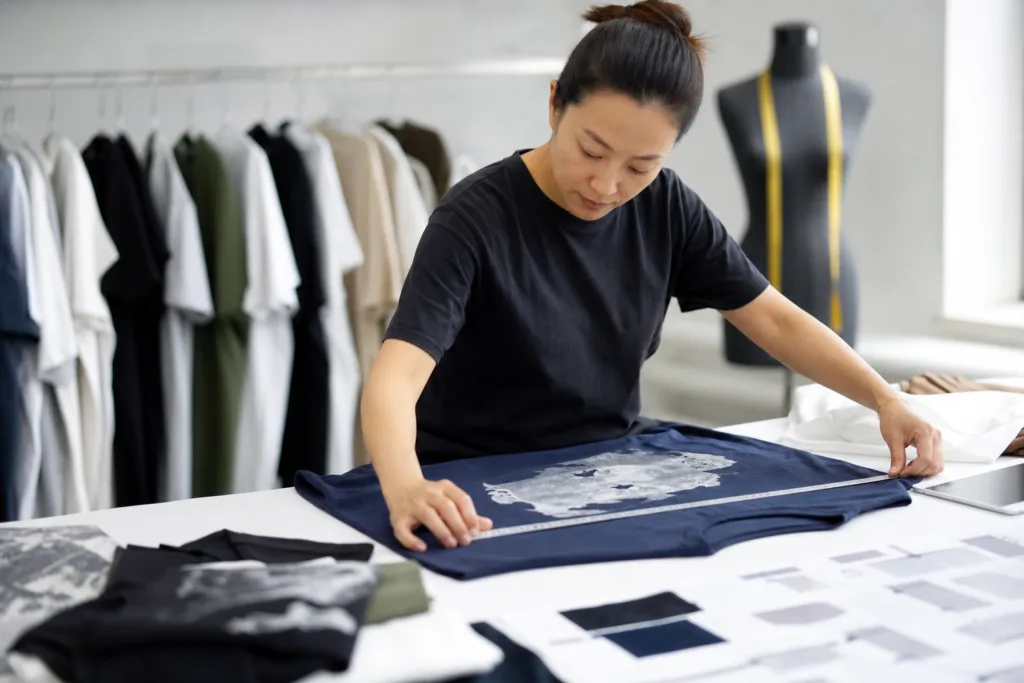
A strong first private label t-shirt line is usually built on fewer, clearer decisions. Keep the style count controlled, standardize the fabric platform where possible, limit colors to intentional roles, build a realistic size curve, and approve decoration based on both appearance and durability. That combination gives you a better chance of launching a collection that feels coherent on the sales floor and manageable in production.
The first collection does not need to answer every market opportunity. It needs to prove which products deserve deeper investment. When that discipline is in place, repeat orders become more confident, and range expansion becomes a decision backed by evidence rather than guesswork.
FAQ
How many styles should a first private label t-shirt line include?
For many startup brands, two to four styles is a practical starting range because it allows clearer testing without creating too many SKUs, fabric variables, or inventory splits.
Is it better to use one fabric across multiple t-shirt styles?
Yes, using one core fabric can simplify sourcing, improve consistency, and make reorders easier, as long as that fabric supports the intended fit, hand feel, and decoration method.
How many colors should I start with in a private label t-shirt line?
Many first collections work well with three color roles: a core neutral, a brand-signature color, and a limited test color to reduce inventory risk while still offering variety.
What is the biggest sizing mistake in a new t-shirt collection?
A common mistake is offering too many sizes with too little depth in the most likely sellers, which can cause early stockouts in core sizes and leftover stock in slower sizes.
Which decoration method is usually safest for a first t-shirt launch?
The safest method is the one that matches your artwork, fabric, target price, and wash expectations, but simple, well-tested applications are often easier to control than highly complex decorative effects.
What should I approve before bulk t-shirt production begins?
You should approve the final fit, measurements, fabric, color standard, decoration placement, branding details, packaging requirements, and any sample revisions before bulk production starts.