

Building a low MOQ clothing collection is less about ordering as little as possible and more about making the first production run do useful work. A well-planned small batch can test fit, demand, and brand direction while keeping inventory risk under control.
For many startup labels, the next step is deciding how that collection should be structured from the start. If you are evaluating private label clothing manufacturing for low MOQ collections, it helps to think beyond individual styles and look at the full collection architecture: fabric platforms, color depth, size curves, and repeatability all affect whether the line feels coherent or scattered.
Why low MOQ collection planning matters
Low MOQ planning is valuable because it forces a brand to prioritize. Instead of spreading budget across too many ideas, you can build a tighter assortment that supports a clear customer profile and a cleaner buying story. That usually means better control over sample rounds, fewer weak styles, and a more realistic path to replenishment.
From a manufacturer’s perspective, the strongest small-batch programs are not the ones with the most styles. They are the ones where each SKU has a reason to exist, shares production logic with other items, and can scale if sales prove the concept.
The most common mistakes brands make

The first mistake is treating low MOQ like a license to overcomplicate the line. Brands often add too many silhouettes, too many fabrics, and too many colorways at once, which creates fragmented production and makes it harder to judge what actually sold. Another common issue is designing pieces that only work as one-off samples rather than repeatable products.
The second mistake is underestimating how much small-batch clothing production depends on clear decisions made early. If the fit, decoration method, trim package, and color plan keep changing, the order becomes more expensive and less stable than expected.
Start with a product architecture, not a wish list
A professional low MOQ collection should begin with product architecture. That means deciding what role each style plays in the line: hero item, entry item, support item, or seasonal add-on. Once those roles are clear, it becomes easier to control fabric usage, color overlap, and inventory exposure.
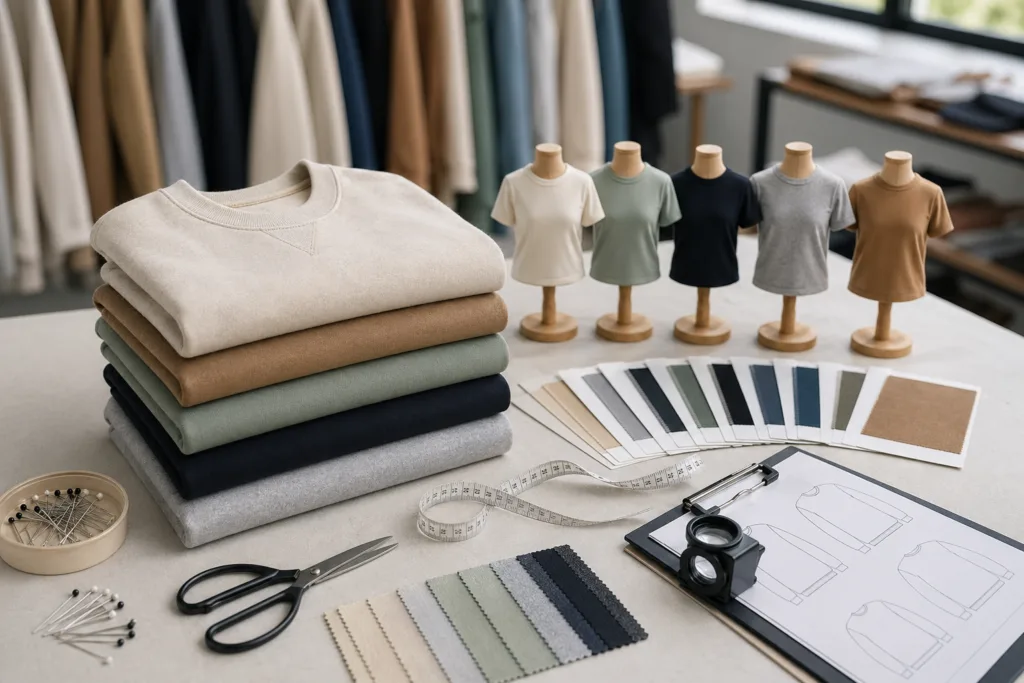
One practical way to reduce complexity is to use consolidating multiple styles around one fabric platform. This approach lets a brand build several garments from one material base, which can improve consistency and simplify sourcing without forcing every style to be identical.
How fabric platforms create flexibility
Using 1–2 core fabric platforms can make a low MOQ clothing collection feel more complete than it actually is. For example, a cotton jersey platform may support tees, tanks, and lightweight lounge styles, while a fleece platform may support hoodies, joggers, and shorts. This gives the collection range without multiplying the sourcing load.
The key is to choose fabrics that share performance logic. If the fabrics behave similarly in wash, drape, and print response, the collection will feel more consistent and the production process will be easier to manage.
Color strategy matters more than many brands expect
Color is one of the fastest ways to inflate small-batch cost and complexity. Each additional color can affect material minimums, dye logic, and sell-through risk, especially when the order size is already tight. In low MOQ planning, a stronger color strategy is usually better than a larger color palette.
It also helps to understand how color minimums shape small-batch collections. In many cases, a brand can protect cash flow by limiting core colors, using one seasonal accent color, and reserving more experimental shades for future replenishment.
| Planning choice | What it affects | Typical risk in small batches |
|---|---|---|
| Too many colors | Fabric sourcing, forecasting, inventory | Weak sell-through and leftover stock |
| Too few colors | Collection appeal, merchandising depth | Limited market testing |
| Core plus accent colors | Balance of control and variety | Usually the most practical starting point |
Size curves can make or break inventory balance
Small orders are especially sensitive to size planning. If the curve is too wide, the brand can end up holding sizes that move slowly or failing to stock the sizes that move fastest. If the curve is too narrow, the collection may look professional on paper but fail in the market because the size mix does not reflect real buyers.
When working with a manufacturer, it is worth reviewing size grading without losing fit consistency. Good grading helps a low MOQ collection stay true to fit as sizes scale up or down, which is especially important when the brand wants to maintain consistency across repeat orders.
Decoration and logo methods affect feasibility
In low MOQ production, the decoration method can change the economics of the entire order. Screen print, embroidery, heat transfer, applique, and woven labels each behave differently in terms of setup, complexity, and repeatability. A decoration choice that looks simple on a design board may be the most expensive part of the order once production details are finalized.
This is where a manufacturer’s perspective matters. At Ninghow Apparel, the discussion usually starts with whether the logo method fits the fabric, the garment purpose, and the order size before talking about visual appeal. That sequencing helps avoid small-batch decisions that look premium but create avoidable production friction.
Brands should also consider if a decoration method will still make sense in a replenishment order. A method that works at 300 units may not be the right choice if the goal is to reorder quickly in a larger run later.

How to structure the first order and replenishment cycle
The first order should be planned as a test with purpose. It needs enough depth to evaluate demand, but not so much depth that the business gets stuck with excess inventory if one style underperforms. A balanced first order usually gives the brand enough data to learn without overcommitting capital.
Once the first drop is live, replenishment should be designed around what actually moved. That means looking at sell-through by style, color, and size rather than assuming the original assortment should simply be repeated. The most efficient low MOQ programs build a repeat cycle that preserves what worked and trims what did not.
If the initial order is still uncertain, it may be worth reviewing when low MOQ surcharges are worth the cost. In some cases, a modest surcharge is easier to absorb than carrying dead stock from a poorly structured launch.
A practical capsule planning example
Consider a startup capsule built around a T-shirt, hoodie, and shorts. A smart low MOQ structure might use one jersey or fleece platform, two core colors, one accent color, and a controlled size curve based on target buyers. The T-shirt can serve as the entry item, the hoodie as the value anchor, and the shorts as the seasonal support piece.
This kind of assortment works because the styles feel connected even though they perform different jobs. It also gives the brand enough variety to merchandise a collection without creating too many separate production paths.
When to move beyond low MOQ production
Low MOQ is ideal for launch, learning, and early refinement, but it is not always the right long-term production model. Once a brand has repeat demand, clearer size data, and a proven best-selling style mix, larger-scale manufacturing can lower unit cost and improve production efficiency.
The transition should happen when the brand is no longer guessing. A good sign is when sales patterns repeat across seasons and the replenishment logic becomes more predictable than the initial test order.
What to look for in a manufacturer
A capable low MOQ apparel manufacturer should help you reduce complexity, not simply accept a small order. That means advising on fabric platforms, color count, size spread, decoration choices, and which styles are worth building into a first collection. The right partner will also be transparent about lead times, sample expectations, and where extra cost may appear.
For growing brands, the best supplier relationship is the one that can handle both the launch stage and the next stage. A manufacturer that understands small batch logic today should also be able to support broader collection growth later.
Conclusion
A strong low MOQ clothing collection is built on discipline, not volume. If the assortment is organized around a clear product architecture, a limited fabric base, a realistic color plan, and a controlled size curve, the brand can launch professionally without taking on unnecessary inventory risk.
The goal is not to make the smallest possible order. The goal is to create a collection that teaches the business something useful, protects margin, and creates a credible path to replenishment and scale.
FAQ
How many styles should a low MOQ collection include?
There is no fixed number, but most startups do better with a tight assortment that can be supported operationally. The right count is usually the smallest mix that still gives the brand enough variety to test demand across key categories.
Is one fabric platform enough for a first collection?
Yes, in many cases one strong fabric platform is enough to launch a professional collection. A second platform may help if the brand needs a different function or seasonality, but adding more too early often increases complexity without improving sales.
What is the biggest risk in small-batch apparel production?
The biggest risk is overcommitting to too many variations before the market responds. Too many styles, colors, or sizes can create dead stock and make it harder to identify what the customer actually wants.
Should a startup offer many size options right away?
Usually not. A startup should build a size curve that reflects its target customer and production reality, then expand based on sales data. Overexpanding sizes too early can leave the wrong inventory in the wrong quantities.
When are logo and decoration choices worth upgrading?
Decoration upgrades are worth it when they improve the product’s perceived value without creating unnecessary production risk. The best choice depends on the fabric, garment type, order size, and whether the method can be repeated efficiently in future runs.
When should a brand move from low MOQ to larger production?
A brand should move when demand becomes repeatable, best-selling styles are clear, and replenishment is more predictable than testing. At that point, larger production can improve cost efficiency and support more stable inventory planning.