

Building a private label apparel line works best when the production path matches the way the product will be sold. A line meant for e-commerce usually needs different development priorities than one built for retail shelves or recurring teamwear orders, and those differences affect everything from sampling to replenishment. If you are still mapping the structure of your range, private label apparel line planning is a practical starting point because the right setup depends on channel, MOQ, and how much control you need over fit, branding, and repeat production.
Manufacturers often see delays and extra cost not because the product idea is weak, but because the buyer asked for the wrong production model. A channel-first approach helps you decide whether to start with relabeling, semi-custom development, or a full OEM/ODM program.
Why one private label model does not fit every channel
Retail buyers, e-commerce founders, teamwear programs, and uniform accounts all measure success differently. Retail needs assortment and presentation. E-commerce needs strong conversion, fit consistency, and repeatable sizing. Teamwear needs logo flexibility and fast group fulfillment. Uniform programs need durability and stable replenishment.
That is why a single factory quote cannot answer the full question. Two buyers may request the same garment category, but if one is building a seasonal retail line and the other is ordering for clubs or staff uniforms, the production priorities are completely different.
Private label apparel for e-commerce brands

E-commerce brands usually sell through product pages, images, ads, and reviews, so visual appeal and fit consistency matter early. Returns can rise quickly if sizing is unpredictable, so sample approval should focus on measurements, hand feel, and how the garment photographs on body or mannequin.
For this channel, buyers should think in terms of repeat purchase potential. A clean core style in stable fabric often performs better than a highly complex product that is difficult to reorder. If you want a broader view of how materials and development choices affect production, private label clothing manufacturing basics can help you frame the first development conversation with a supplier.
Many e-commerce brands also benefit from a tighter color palette and a controlled size range at launch. That keeps inventory simpler and makes it easier to learn which fits sell before expanding the line.
Private label apparel for retail
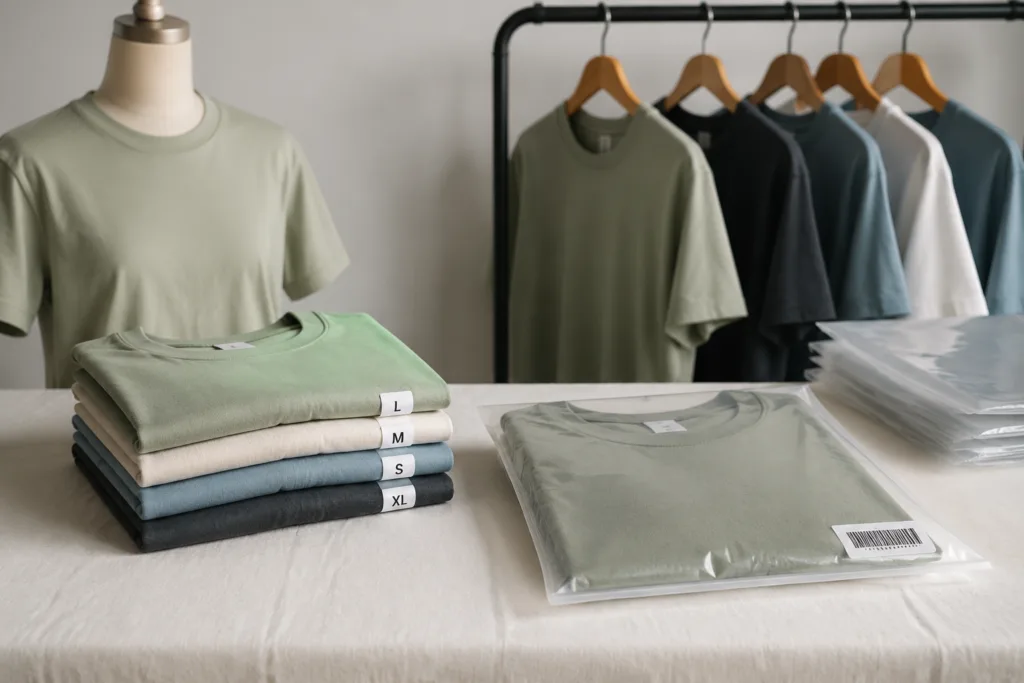
Retail programs bring a different set of requirements. Products may need barcodes, hangtags, fold standards, carton labeling, and packaging that looks ready for shelf display. Buyers also tend to plan assortments in advance, so production timing and pre-season samples matter more than in many direct-to-consumer launches.
Retail lines should also be checked for compliance readiness. Even when the garment itself is simple, the packaging, labeling, and documentation can determine whether the product is acceptable for a store program. For buyers planning a smaller starting range, low MOQ collection planning can help clarify how assortment size and order volume affect launch strategy.
Retail sourcing is rarely only about the garment. It is about the complete presentation system, from finish and labeling to how efficiently the factory can repeat the same spec in later seasons.
Private label teamwear and group orders
Teamwear buyers usually care most about logo application, size coverage, durability, and delivery timing. The garment may need to support multiple player sizes, multiple printing or embroidery placements, and quick restocking during a season.
Because team programs are often reorder-driven, consistency matters as much as first-sample approval. Teams, clubs, schools, and organizations do not want small variations between shipments, especially when uniforms are meant to look unified. That is why the sample stage should include decoration tests, placement checks, and wear considerations, not just fabric selection. If you want to understand how that approval process should be managed, the apparel sample approval process is worth reviewing before you lock in production.
For these orders, a supplier should be able to plan around standard sizing blocks, decoration methods, and reorder timing without turning every restock into a new development project.
Private label workwear and corporate uniform programs
Uniform and workwear programs tend to prioritize wash durability, comfort, professional appearance, and predictable replenishment. These garments are worn repeatedly, often under practical conditions, so fabric behavior after washing and the stability of trims are important.
In this channel, buyers should look beyond surface appearance. A polo or jacket may look suitable in sample form, but if the collar collapses, the color fades quickly, or the trim distorts, the program will create more long-term cost. Uniform buyers also need clear communication about size tables, embroidery placement, and whether future stock will be matched to the original specification.
How MOQ expectations change by channel
MOQ is not just a factory number. It reflects how the product is built, how many colors or sizes are involved, and how much setup is needed before production can begin. Retail programs often need broader size and pack structures. E-commerce may launch with fewer styles but deeper size coverage. Teamwear may need flexibility in decoration, while uniform programs may need stable repeat orders rather than large first buys.
The most efficient MOQ is usually the one that fits the sales model. Over-ordering can trap cash in the wrong colors or sizes, while ordering too little can make the line feel unstable or limit your ability to test demand.
| Sales channel | Typical production priority | MOQ logic |
|---|---|---|
| E-commerce | Fit, imagery, repeatability | Smaller launch range with controlled colors and sizes |
| Retail | Packaging, assortment, compliance | Needs planning for shelf-ready presentation and broader distribution |
| Teamwear | Logo application, durability, sizing | Often driven by size coverage and decoration setup |
| Uniform | Durability, comfort, replenishment | Best when the factory can repeat the spec reliably |
Choosing the right product mix
Most private label lines should not start with too many product types. A smarter structure is usually a mix of core basics, seasonal styles, and a few channel-specific pieces. Core basics help establish brand consistency. Seasonal items create freshness. Channel-specific pieces support the exact way the product will be sold.
For example, an e-commerce brand may launch with a tight set of tee, hoodie, and jogger styles. A retail buyer may add packaging requirements and colorway planning. A teamwear program may focus on polos, training tops, or track sets. A uniform buyer may need stable fit blocks and repeatable fabric platforms.
That product mix should be selected before sampling begins, not after, because each decision changes how the factory structures material sourcing and production sequencing.
Stock relabeling, semi-custom production, or full custom development
Not every private label apparel line needs to start from a blank sheet. Stock garment relabeling can work when speed matters and the buyer mainly needs branding control. Semi-custom production is useful when you want some design changes without a fully new development cycle. Full custom development is better when fit, branding, or channel differentiation needs to be more distinct.
The right path depends on how much control you need and how quickly you need to sell. If you are deciding between faster entry and deeper product ownership, it helps to compare each option against your sales channel, not against abstract design preference.
For manufacturers, these differences are also tied to how the factory communicates with you before production starts. how to communicate product needs before production is useful because unclear instructions often create more delay than the manufacturing process itself.
How customization affects cost, lead time, and flexibility
Every added customization step changes the production profile. Screen print, embroidery, woven labels, special packaging, custom trims, and unique fabric development can all increase cost or extend lead time. That does not mean customization should be avoided. It means it should be chosen deliberately.
For high-volume or repeat-order programs, deeper customization can build stronger brand identity. For small launches, simpler customization often protects margin and keeps inventory manageable. A factory can usually support a better outcome when it knows whether the priority is speed, brand control, or scale.
What to tell a manufacturer before requesting samples or quotes
The most useful quotation requests are specific. A manufacturer needs to know your target customer, sales channel, price point, expected order volume, sizing needs, packaging requirements, and whether the product is for a one-time launch or ongoing replenishment. Without that context, the sample and quote may not reflect the real business model.
This is where a clear product brief saves time. Include the intended use, decoration method, target season, and where the line will be sold. If you already know your preferred supplier communication approach, how to communicate product needs before production can help you structure the request more effectively.
Factories respond better when the buyer explains the commercial logic behind the garment. That makes it easier to recommend the right fabrics, construction choices, and MOQ structure.
Common mistakes when launching a private label clothing brand by channel
One common mistake is using the same specification for every channel. Another is choosing a product only because it looks good in a sample room, without checking whether it fits the channel’s pricing and replenishment model. Buyers also sometimes underestimate packaging, labeling, and size consistency because those details are not as visible as the garment itself.
Another issue is over-customizing too early. A line with too many trims, fabric changes, or special finishes can become hard to reorder and difficult to manage across seasons. In many cases, a cleaner first launch creates better learning and a more stable production foundation.
How Ninghow Apparel fits different private label paths
From a manufacturer perspective, Ninghow Apparel typically supports buyers who need OEM/ODM development, private label sourcing, and bulk production planning across different channel requirements. The practical value is not only in making garments, but in helping buyers align the production model with the way the product will actually be sold.
That means an e-commerce brand may need help with sampling and fit consistency, while a retail account may need packaging and repeatability, and a teamwear buyer may need faster order handling and decoration readiness. The most efficient manufacturing partnership is the one that understands those differences before the first sample is approved.
Conclusion

A strong private label apparel line starts with the sales channel, not the garment alone. Retail, teamwear, uniform, and e-commerce programs all require different production priorities, different MOQ logic, and different levels of customization. When the production path matches the channel, the line is easier to launch, easier to reorder, and easier to scale.
If you want the line to perform commercially, define the channel first, then select the product mix, customization level, and supplier process around that decision.
FAQ
What is the first decision to make when building a private label apparel line?
The first decision is the sales channel, because retail, e-commerce, teamwear, and uniform programs need different production priorities. Once the channel is clear, it becomes much easier to choose the right garment structure, MOQ, and customization level.
Can one private label style work for both e-commerce and retail?
Sometimes, but the packaging, labeling, and assortment plan usually need adjustments. E-commerce may focus more on fit and photography, while retail often needs shelf-ready presentation and compliance readiness.
How do I know whether to choose stock relabeling or full custom development?
Choose stock relabeling when speed and lower complexity matter most. Choose full custom development when you need stronger brand control, specific fit requirements, or a more distinct product identity.
Why does MOQ vary so much between product types?
MOQ varies because different products require different setup work, materials, sizes, and decoration methods. A simpler style with fewer color and trim changes is usually easier to launch at a lower MOQ than a highly customized item.
What should I include in my first quote request to a factory?
Include your target customer, sales channel, price point, quantity, sizing plan, packaging needs, and whether the line must be reordered later. The more context you provide, the more accurate the sample and quote process will be.
How can I reduce launch risk for a new private label apparel line?
Start with a focused product mix, approve samples carefully, and keep customization aligned with the channel. A simple and repeatable first launch is usually easier to manage than an overly broad collection.