

In apparel manufacturing, apparel quality tolerance is what helps buyers separate acceptable variation from true defects. No bulk order is perfectly identical, so the real goal is to define the limits clearly enough that both sides know what is acceptable before production begins.
That is why many buyers start by aligning factory communication with apparel quality tolerance standards early in development. When those rules are discussed before cutting and sewing start, it becomes much easier to avoid disputes later about measurements, color shifts, print placement, or small construction differences.
Why identical garments are not a realistic production standard
Apparel is made from materials that naturally vary. Fabric can stretch, shrink, relax, or react differently during cutting, washing, printing, and finishing. Even when a factory follows the same process, small variations still happen because many steps are handled by people, machines, and textile lots.
The practical question is not whether variation exists, but whether it stays within a range that still looks and performs correctly for the customer. Buyers who define this range early usually get fewer surprises in final inspection.
What apparel quality tolerance means in manufacturing and QC

In simple terms, apparel quality tolerance is the acceptable difference between the approved standard and the production result. It can apply to measurement, color, placement, stitching, labeling, or packaging.
Good tolerance rules protect both the brand and the factory. They prevent minor natural variation from being treated as a defect, while still giving buyers clear grounds to reject items that fall outside the agreed range.
Size and measurement tolerance buyers should define early
Measurement tolerance is one of the most important parts of apparel QC because fit affects customer satisfaction more directly than many other details. Buyers should define the target measurement, the acceptable plus or minus range, and the points that matter most for fit or appearance.
A useful way to think about it is to separate critical measurements from less sensitive ones. Chest width, body length, sleeve length, waist, and inseam often deserve tighter control than secondary details such as pocket position or collar spread.
| Measurement point | What usually matters | Common buyer focus |
|---|---|---|
| Chest width | Fit, comfort, and silhouette | Keep the range tight for core styles |
| Body length | Appearance and wearability | Prevent a garment from looking too short or too long |
| Sleeve length | Fit consistency and balanced proportions | Important for tops, jackets, and uniforms |
| Waist or inseam | Wear fit and size stability | Critical for bottoms and performance wear |
For pattern-driven styles, it also helps to understand how grading and cutting affect results. If you need more background on factory variation at the pattern stage, pattern tolerance in garment production explains why the same approved size can still show small shifts in bulk output.
Clothing measurement tolerance examples buyers can use
There is no universal tolerance number that fits every product. A relaxed T-shirt, a fitted polo, a tailored jacket, and athletic bottoms will all have different expectations. The more fitted the garment, the more important it is to control variation.
Instead of writing vague instructions like “fit must be good,” buyers should identify which measurements are most important and which variation is acceptable. The factory can then measure the right points consistently during in-line and final inspection.
- Chest: usually a key fit measurement for tops and outerwear.
- Length: important for style balance and customer perception.
- Sleeve: critical when a garment has a fitted or structured look.
- Waist: essential for bottoms, activewear, and uniforms.
Color tolerance and shade variation
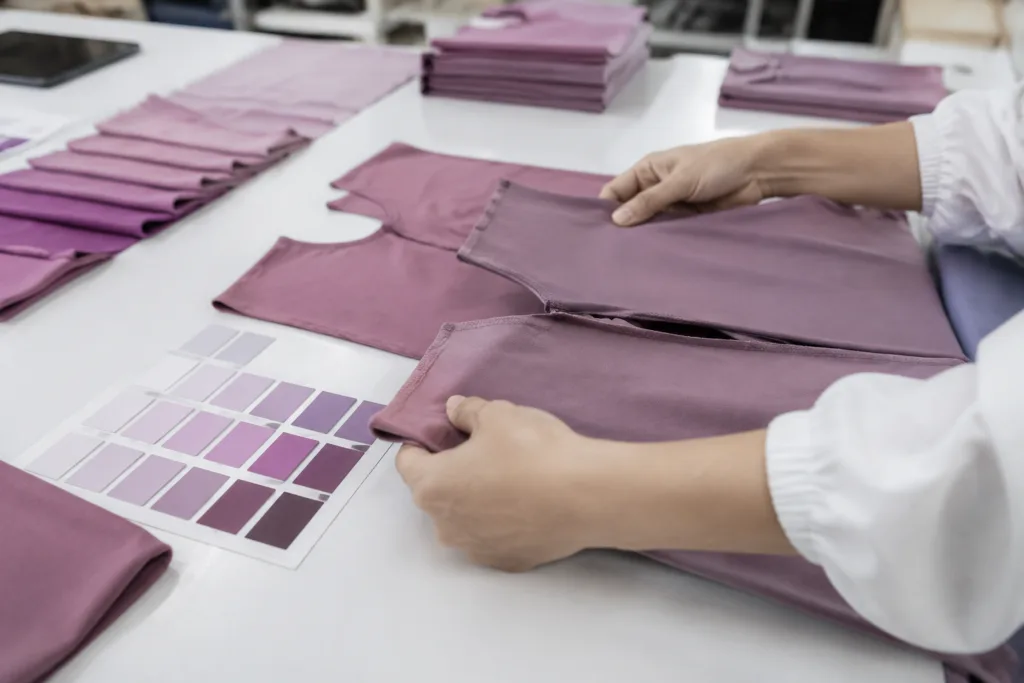
Color variation is common because fabric lots, dye houses, finishing methods, and print curing can all affect the final shade. A small difference may be acceptable if it is not obvious in normal wear, but visible mismatch between panels or garments is usually not acceptable.
For buyers, the main decision is where the line should be drawn. One shade variation may be acceptable across separate fabric lots, but it may not be acceptable within the same garment, especially in color-blocked styles, uniforms, or premium brand programs.
Shade tolerance becomes even more important in repeat orders, because reorders often use new lots. If consistency across seasons matters, it is worth setting the rule before production instead of trying to settle it afterward.
Print and embroidery placement tolerance
Decoration issues are often visual rather than technical. A logo can be stitched correctly but still look wrong if it sits too high, too low, or slightly off-center. That is why placement tolerance should be defined in a way that reflects how the garment will be judged by the end customer.
For logo work, buyers should decide what matters most: center alignment, distance from neckline or placket, size, or symmetry between left and right sides. The more prominent the logo, the less room there is for visible deviation.
When discussing decoration standards with a manufacturer, it helps to pair those requirements with clear stitching and finish details. That gives the factory a better understanding of where visual issues are acceptable and where they are not.
Sewing quality issues that cross the line into defects
Not every sewing issue is a rejection reason. Short loose threads, slight seam waviness, or small finishing differences may be acceptable on some product types if they do not affect durability or appearance. But skipped stitches, open seams, broken stitches, and obvious seam imbalance usually move into defect territory.
A good QC standard should distinguish between cosmetic variation and structural failure. A small loose thread may be trimmed easily, but a seam that opens under normal stress is a functional defect.
Common sewing issues to assess
- Loose threads that can be cleaned without damage
- Skipped stitches that weaken the seam
- Uneven seam allowance that affects appearance or strength
- Puckering that changes the garment silhouette
- Broken or open seams that create a clear failure
Stains, holes, damage, and contamination
Some issues should be treated as automatic rejects because they are visible, irreversible, or unsafe. Stains, holes, tears, oil marks, contamination, and damage from handling or packing generally do not belong in acceptable tolerance rules.
Buyers should also define what counts as contamination. In practice, this may include foreign fibers, visible dust buildup, residue, or packaging debris that affects presentation. The rule should be written clearly enough that factory and buyer inspectors apply the same standard.
Packaging tolerance matters more than many buyers expect
Packaging issues often seem minor, but they can influence how the customer perceives product quality at first sight. Folding, polybag condition, size sticker placement, hangtag alignment, barcode readability, and carton integrity all contribute to that impression.
If the apparel is meant for retail, e-commerce, or wholesale distribution, packaging tolerance should be written alongside the garment QC standard. A clean garment in damaged packaging still creates a problem for receiving, storage, or resale readiness.
How AQL fits into apparel quality tolerance
AQL is a sampling method used in final inspection, but it does not replace product standards. It tells the buyer how many units to inspect and how many defects are allowed in the sample before the lot fails. The actual tolerance rules still need to be defined elsewhere.
In other words, AQL answers how many defects can be found before rejection, while apparel quality tolerance answers what counts as a defect in the first place. Buyers who confuse the two often end up with gaps in their inspection system.
If your team uses outside inspection support, it also helps to compare your internal rules with third-party inspection for apparel QC. External inspectors can only work well when the buyer’s acceptance criteria are specific enough to apply consistently.
How samples set the tolerance standard before bulk production
Buyer approval samples, pre-production samples, and golden samples are the reference points that help everyone judge the bulk order. Without them, even a well-written spec sheet can still leave room for interpretation.
The sample should confirm construction, fit, color direction, decoration placement, and finishing expectations. Once approved, it should be stored as the shared benchmark for later inspection.
At Ninghow Apparel, production teams often treat sample approval as the point where vague preferences become measurable requirements. That is why the approval stage matters so much for any custom program with multiple materials, trims, or decoration steps.
For a deeper look at how factories and buyers structure that stage, the apparel sample approval process shows how approvals reduce ambiguity before bulk cutting begins.
How to write tolerance requirements clearly in a PO, tech pack, or QC sheet
The best tolerance rules are specific, measurable, and easy for the factory to follow. They should tell the supplier what to measure, where to measure, how much variation is allowed, and what happens if the item falls outside the range.
A practical tolerance sheet usually includes the target measurement, acceptable range, color reference, decoration placement rules, packaging expectations, and the rejection conditions for visible defects. If a rule cannot be checked by an inspector, it is usually too vague to be useful.
- State the reference sample or approved standard.
- List the exact measurement point and acceptable range.
- Define visible defects versus acceptable variation.
- Explain packaging and labeling expectations.
- Confirm who makes the final approval decision.
Common buyer-manufacturer disputes and how to avoid them
Most disputes happen when expectations were assumed instead of written. A buyer may think a small shade shift is unacceptable, while a factory may consider it normal lot variation. The same problem can happen with stitching, logo placement, folding, or size tolerances.
The easiest way to reduce conflict is to make decisions before bulk production, not after delivery. Clear written tolerances, approved samples, and consistent inspection language help both sides resolve issues without unnecessary back-and-forth.
Buyers also benefit from documenting the construction level they expect. If your team needs a clearer way to specify that detail, stitching and finish details can be translated into practical QC language for production teams.
A practical tolerance checklist before bulk production starts

Before you approve bulk manufacturing, make sure your tolerance rules answer the questions below. If any point is unclear, the order is more likely to run into avoidable issues later.
- Which measurements are critical for fit?
- What measurement range is acceptable for each point?
- What level of shade difference is acceptable between lots or panels?
- How much logo or print movement is acceptable?
- Which sewing issues are minor and which are rejectable?
- What packaging problems are acceptable, if any?
- Which sample is the final reference for inspection?
- How will AQL be used alongside product-specific rules?
When these rules are defined early, apparel quality tolerance becomes a useful manufacturing tool instead of a source of argument. That clarity helps brands protect quality, reduce inspection disputes, and scale repeat production more smoothly.
FAQ
What is apparel quality tolerance?
Apparel quality tolerance is the acceptable range of variation in measurements, color, placement, stitching, or packaging that still meets the buyer’s standard.
What defects should buyers usually reject?
Buyers usually reject holes, stains, contamination, open seams, broken stitching, major shade mismatch, and decoration that is visibly off-position.
How do measurement tolerances affect fit?
Measurement tolerances affect fit by controlling how much a finished garment can vary from the approved size before it becomes too tight, too loose, too short, or uneven.
Is AQL the same as quality tolerance?
No. AQL is a sampling and acceptance method, while quality tolerance defines what variation is acceptable in the product itself.
Why do approved samples matter so much?
Approved samples create the visual and technical reference for bulk production, which reduces disagreement about what is acceptable later.
How can buyers reduce tolerance disputes with factories?
Buyers can reduce disputes by writing clear measurement ranges, approving samples, defining defect levels, and confirming packaging and decoration standards before bulk production starts.