

Repeat orders should be easier than the first run, but in apparel manufacturing they often become more fragile because the original approvals, materials, and production settings are no longer in front of the team every day. For brands that rely on stable reorders, the process is really about control: keeping the approved standard visible, documented, and repeatable through each new production cycle, including private label clothing manufacturing for repeat orders.
Once a style starts selling, the sourcing challenge changes. The first run may have been built with close attention from sampling through bulk approval, while the second or third run depends on how well those decisions were recorded, communicated, and protected.
Why repeat orders are often harder to control than first orders
The first production run usually benefits from more hands-on review. Buyers and manufacturers are looking at sample development, fit approval, and bulk approval at the same time, so issues are easier to catch before they scale. In a repeat order, teams often assume the style is already proven and move faster, which is exactly when small changes in fabric, fit, or trim can slip through.
Repeat order clothing manufacturing is not simply a rerun of the same job. It depends on whether the factory can recreate the same inputs and the same decision logic, even when a different fabric lot, a new dye batch, or a different operator is involved.
What changes between the first production run and a repeat order

Several things can shift between runs even when the style code stays the same. Fabric mills may send a new lot, color standards may be interpreted differently, and cutting or sewing teams may work from updated files rather than the exact approval set used in the first order. If the brand has not locked the standard, the repeat order quietly becomes a new version of the product.
That is why repeat production needs more than memory. It needs a controlled record of what was approved, what was measured, what was signed off, and what must remain unchanged.
How fabric lot variation changes the feel of the garment
Fabric lot variation is one of the most common reasons a repeat order feels different on delivery. Even when the fiber content is the same, different lots can affect handfeel, shrinkage behavior, surface smoothness, drape, and overall weight. A shirt may look similar on the hanger but wear differently on the body if the fabric structure has changed.
For knitwear, activewear, and other performance categories, the difference can be even more noticeable. A slight shift in stretch recovery or fabric density can alter fit perception, not just comfort.
To reduce this risk, buyers should ask for a clear record of the approved fabric reference, including composition, construction, finish, and any agreed tolerance window. When a style depends on a precise handfeel or weight, the repeat order should not rely on a verbal description alone.
Use approved pre-production references before bulk material release
Before bulk cutting begins, a practical manufacturer will compare the new material against the approved standard and confirm that the order is still within acceptable range. For repeat styles, this is where how PP samples protect bulk consistency becomes especially relevant, because the PP stage acts as the bridge between approval and repeat execution. If the sample, fabric, and specs are not aligned, the problem usually grows in bulk.
The color lot issue that buyers underestimate
Color is often where repeat orders disappoint first. A shade can be technically correct but still look noticeably different if the dye lot has changed, the fabric base has changed, or the garment is viewed under different lighting. The problem is not always that the manufacturer made a mistake; sometimes the standard was never defined tightly enough to survive a second production run.
Buyers should keep both the approved lab dip and the bulk-approved color reference, then make sure the factory knows which standard is primary if they conflict. For darker shades, heathered effects, and tone-sensitive fashion colors, a small difference in saturation may be enough to make the repeat order look off.
When the product line includes multiple colorways, minimum color quantities can also affect how consistently each shade is produced. If the order is spread too thin, color control may weaken across the run, which is why many sourcing teams review minimum color quantities and shade consistency before confirming the next production cycle.
Why fit and size specs drift in repeat production
Fit drift usually starts with missing or outdated reference points. A factory may receive the same style name, but if the approved measurement chart, grading rules, or pattern revision are not clearly attached, the repeat order can slowly move away from the original fit block.
This is especially important for apparel sold in size ranges where consumers expect consistency across seasons. If the chest, body length, sleeve opening, or inseam shifts too much, the brand receives complaints even though the style technically “matches” the older order.
Good repeat order control means using the exact measurement standard from the approved run, then checking where tolerances are allowed and where they are not. In many cases, the most useful control is not just the sample itself, but the pattern logic behind the sample.
Lock the pattern before the next order starts
Manufacturers that want stable reorders often review the pattern history before cutting new bulk. This is where setting pattern tolerance to control fit drift helps reduce interpretation errors, especially when a style has been revised more than once. If pattern tolerance is unclear, the same garment can arrive with enough variation to affect the customer experience.
How decoration consistency breaks down
Decoration is another area where repeat orders can look inconsistent even when the garment body is correct. Print placement can shift a few millimeters and still feel wrong. Embroidery may move slightly off-center. A logo might be resized without anyone noticing until final inspection.
This happens because decoration instructions are often less detailed than fabric and fit instructions. If the first run relied on a one-time setup note instead of a preserved standard, the next run may depend on a different operator reading the artwork differently.
To control this, brands should keep the approved artwork file, placement measurements, stitch count or print method notes, and any visual reference from the approved sample. For embroidery, exact position matters more than many buyers expect because even a small shift can make a garment look inconsistent across a display rack or team order.
Use TOP samples to verify the first production output
A strong repeat-order workflow includes a TOP review before the remainder of the run is released. This is where TOP samples and bulk quality checks help catch misalignment in decoration, labeling, or finishing while there is still time to correct the order. For repeat styles, the TOP is often the last practical checkpoint before the factory commits to the full run.

The role of master samples and production records
Master samples and sealed samples are the memory of the first order. Without them, teams end up relying on photos, emails, or old approvals that may not show the exact standard. A sealed sample is useful because it gives both buyer and manufacturer a physical reference to compare against bulk production when questions arise.
Production records matter just as much. A repeat order should carry forward the approved tech pack version, color standard, measurement chart, material information, decoration placement notes, and inspection results from the previous run. Ninghow Apparel often treats these records as the starting point for repeat work, not an afterthought, because consistency depends on what is preserved between orders.
What buyers should keep from the first order
The most reliable repeat orders are built on a complete document set. Buyers should retain the tech pack, approved samples, color standards, measurement specs, and QC reports from the first run. If possible, they should also keep photos of the approved sample under consistent lighting, because visual references can help resolve shade and placement disputes later.
It also helps to record what changed during the first order. If the factory had to adjust shrinkage, trim sourcing, stitching density, or labeling position to reach approval, those lessons should be carried into the repeat order file so the same issue is not solved twice.
| Item to keep | Why it matters | Repeat order risk if missing |
|---|---|---|
| Approved tech pack | Defines the version to reproduce | Style drift and spec confusion |
| Sealed sample | Physical reference for fit and finish | Approval disputes |
| Color standard | Guides shade matching | Lot-to-lot color inconsistency |
| Measurement chart | Protects size repeatability | Fit drift |
| QC report | Shows past problem areas | Repeated defects |
How a manufacturer should run repeat order QC
A repeat order QC process should begin before production starts and continue through incoming materials, in-line checks, and final inspection. The factory should confirm that the right fabric, trims, and decoration files are being used, then compare the first cut or first output against the approved standard. If the setup is off, the issue should be corrected before the order becomes difficult to recover.
For brands, the value of this approach is simple: the earlier a difference is found, the cheaper and faster it is to correct. Repeat order clothing manufacturing works best when the factory treats the old order as a controlled benchmark rather than assuming the next run will naturally match it.
Common mistakes brands make with repeat orders
One common mistake is treating a reorder as a low-risk admin task. Another is sending only a style name or old invoice and assuming the factory will infer the rest. Brands also lose consistency when they approve a one-off sample correction and fail to update the master record, which means the next order may return to the wrong baseline.
Another frequent issue is poor communication about acceptable variation. If the brand wants exact shade matching, the factory should know that the tolerance is tight. If a slight handfeel change is acceptable but fit must not move, that priority must be written down clearly.
Finally, brands sometimes change suppliers, mills, or decoration vendors without realizing how many linked variables they have disrupted. Repeat orders are not just about price continuity; they are about process continuity.
A practical repeat-order supplier workflow
For long-term clothing consistency, the supplier workflow should stay simple and repeatable. Start with the previous approval file, confirm whether the fabric and trim sources are unchanged, verify the approved sample against the new order details, and make sure the pattern, measurement chart, and decoration placement notes are still current. Then review the material and color standards before production begins.
When brands need to scale a style over multiple seasons, they should expect the manufacturer to maintain version control and production traceability. That is especially important for categories with recurring reorders, where even a small shift in fit or shade can affect the customer’s trust in the product line.
Protect the approval chain before bulk starts
Strong repeat-order control also depends on production-stage discipline. A useful way to reinforce that discipline is through reviewing a tech pack before production, because unclear documents create hidden variation before the order even reaches the factory floor. If the tech pack is incomplete, the repeat order becomes harder to manage at every later step.
How Ninghow supports repeat order consistency
At Ninghow Apparel, repeat order clothing manufacturing is approached as a documentation and control problem as much as a production task. That means keeping approval records organized, checking against the prior standard, and tracking the details that most often change between runs. This is especially useful for private label buyers who need the same garment to return season after season with minimal variation.
In practical terms, that support includes production tracking, approval control, and a structured review of fabric, fit, and color before bulk work moves ahead. The goal is not just to make another order, but to make the next order match the one that already worked.
Conclusion: the checklist brands should use before the next run
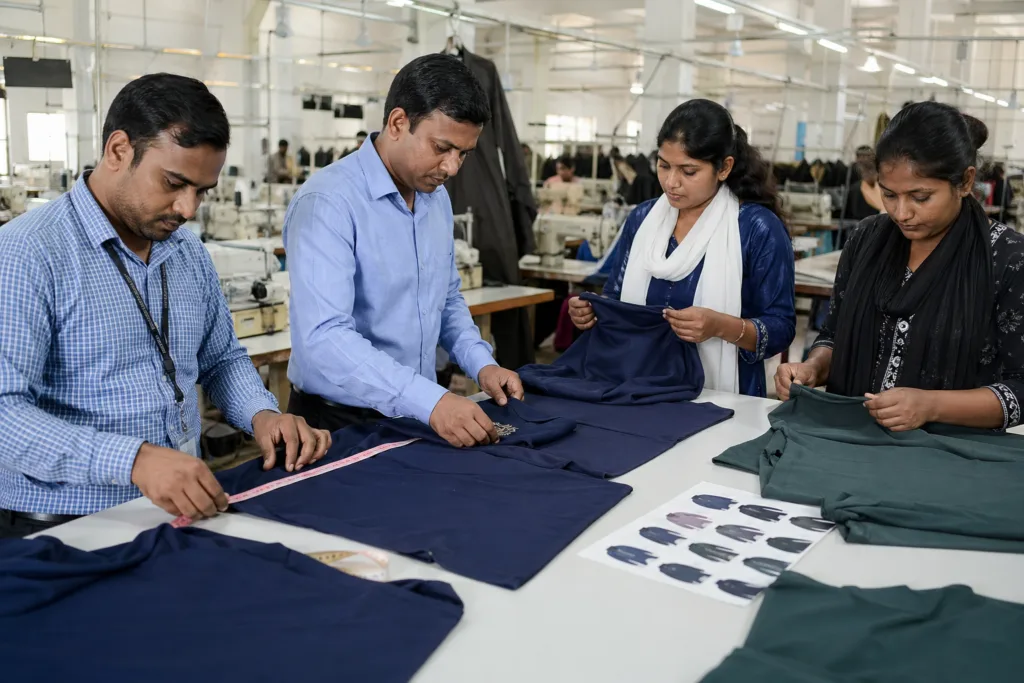
Before confirming a repeat order, brands should verify the approved sample, confirm the current tech pack version, check the fabric lot and color reference, review the measurement chart, and make sure decoration placement is still locked. If any of those elements are missing or outdated, the reorder is exposed to avoidable variation.
The best repeat orders are not the fastest ones. They are the ones that preserve the standard clearly enough for the factory to reproduce it with confidence.
FAQ
Why do repeat apparel orders often look different from the first run? Repeat orders can change because fabric lots, dye batches, pattern files, or decoration settings are not carried forward exactly from the first approval set.
What is the most important document to save for repeat orders? The approved tech pack is usually the most important, but it should be kept together with the sealed sample, measurement chart, color standard, and QC report.
How can brands reduce fit drift in repeat production? Keep the approved measurement chart and pattern record, then confirm that the factory is using the same grading logic and tolerance limits as the first run.
How do buyers protect color consistency on reorder styles? Keep the approved lab dip or bulk color standard, clarify which reference controls the order, and confirm the new fabric lot before bulk production.
What should a manufacturer check before releasing a repeat order to bulk? The factory should verify incoming materials, confirm the approved sample set, review artwork and placement files, and check the first output against the original standard.
How can a brand avoid decoration errors in repeat orders? Save the approved artwork, print placement notes, embroidery position measurements, and any visual reference from the first approved run.