

Getting a first custom t-shirt order approved is only part of the job. The harder challenge for many apparel brands and sourcing teams is keeping the second, third, and fifth reorder aligned with the original standard. Small shifts in fabric batches, dye lots, print settings, measurement tolerance, or file handling can turn a previously successful style into a costly inconsistency problem.
That is why buyers should evaluate not only price and capacity, but also how a custom t-shirt manufacturer manages repeatability over time. A supplier that can explain sample retention, fabric controls, print documentation, and reorder recordkeeping usually gives buyers a stronger foundation for long-term consistency. When reorder planning starts early, brands are far less likely to face avoidable surprises in hand feel, shade, fit, or branding details.
Why repeat orders often cause more problems than first runs
Initial orders usually get more attention because everyone is focused on development, comments, revisions, and approval. Reorders can become riskier because teams assume the style is already settled. In practice, repeat production still depends on raw material availability, operator consistency, machine settings, updated files, and clear reference standards.
Common reorder failures include:
- Fabric sourced from a different batch with a different hand feel
- Color variation caused by a new dye lot or missing approved standard
- Print output changes because the factory does not have the original settings
- Size differences caused by untracked tolerance drift
- Trim or label differences due to incomplete BOM records
- Team changes on the buyer or factory side that break communication continuity
For growing brands, these issues often begin during early private label t-shirt line planning, when decisions are made quickly and documentation is still thin. The earlier the brand treats repeatability as part of product development, the easier it becomes to maintain a stable style over multiple seasons or replenishment cycles.
How fabric batch variations affect hand feel and color accuracy

Fabric is one of the biggest drivers of reorder inconsistency. Even when the fiber content looks identical on paper, a new batch can behave differently because of yarn source, knitting tension, finishing method, compacting, enzyme wash, or dye process. The result may be a shirt that still matches the SKU description but feels slightly softer, stiffer, heavier, or less stable than the approved run.
Buyers should pay close attention to:
- Fiber composition and yarn specification
- Fabric weight range and acceptable tolerance
- Knitting structure and shrinkage behavior
- Finishing process that affects drape and surface appearance
- Dye lot consistency for both body fabric and rib
A reorder brief should never say only “same fabric as before.” It should reference the exact approved construction, target weight, finish, and bulk approval point. If the fabric cannot be sourced from the same mill or batch family, the buyer should ask for a comparison review before bulk starts.
Weight control matters here as well. If your team needs a clearer framework for evaluating material continuity, this guide on GSM explained how fabric weight affects your garment is useful because it connects fabric weight changes to feel, drape, opacity, and production outcome rather than treating GSM as a simple number on a spec sheet.
Practical fabric control checklist for reorders
- Keep the approved bulk fabric swatch with date and PO reference
- Record target GSM and acceptable tolerance range
- Note the fabric mill if continuity matters to your program
- Store shrinkage test results from the approved run
- Confirm whether the rib, neck tape, and body fabric must match the original lot standard
The critical role of preserving approved samples for reorders
Approved samples are the closest thing to a physical truth source. Without them, many reorder discussions become subjective. One person remembers the hand feel as soft, another remembers it as structured, and a third only has photos that do not show fabric recovery or actual print texture.
For reorders, buyers should preserve at least one sealed reference sample from the approved bulk or pre-production stage. Ideally, both the buyer and factory keep the same reference set. That sample should be labeled with style code, color, fabric specification, print method, approval date, and any known exceptions.
The most useful sample hierarchy is:
- Approved fit sample for measurements and silhouette
- Approved lab dip or color standard for shade review
- Approved strike-off for print appearance
- Approved pre-production sample for total garment confirmation
- Approved bulk swatch or retained top sample from production
If this system is missing, reorder quality becomes harder to defend. A reliable apparel sample approval process is not only for launch-stage development; it is also the reference framework that protects repeat orders months later when memories, staff, and material sources may have changed.
How to document and replicate print parameters for consistent results
Print consistency is often lost because buyers retain the artwork but not the production conditions. A vector file alone does not preserve ink deposit, underbase choice, screen mesh, curing temperature, pressure settings, placement tolerance, or wash response. That is why two runs using the same artwork can still look visibly different.
For each approved print, factories should record:
- Artwork version and date
- Print method used, such as screen print, heat transfer, or DTG
- Ink system and color references
- Screen mesh, underbase, and print sequence where relevant
- Curing conditions or heat press settings
- Placement measurements from fixed garment points
- Special finish details such as puff, discharge, or high-density effect
Buyers should also save approved strike-offs and close-up production photos under neutral lighting. If a reorder involves new fabric or a darker shade, print behavior can change even when the artwork remains identical. Good recordkeeping allows teams to compare rather than guess.
Ensuring size tolerances carry over across all reorders
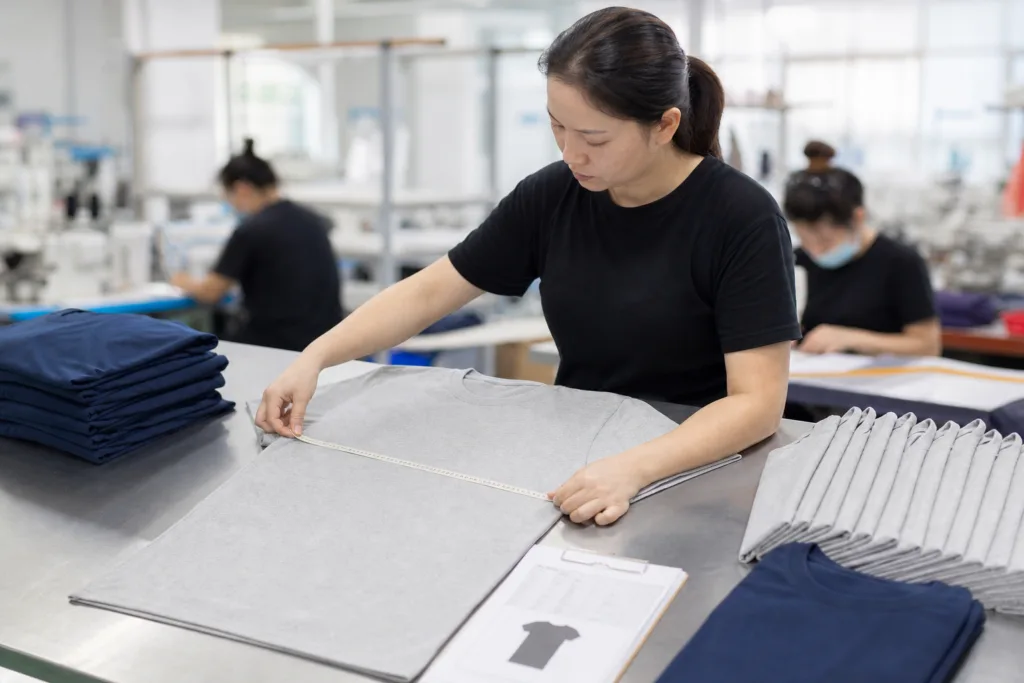
Fit problems on reorders are usually caused by one of three gaps: the original graded spec was incomplete, shrinkage assumptions changed, or the factory used a newer production pattern without properly cross-checking the approved standard. This is especially common when brands scale quickly and move from one small run to larger replenishment orders.
To manage size consistency, the buyer should retain:
- The final approved measurement spec with points of measure clearly defined
- Grading rules by size
- Tolerance limits for each critical point
- Shrinkage expectations after wash if applicable
- Fit comments made during pre-production approval
A useful control method is to identify a short list of non-negotiable points, such as chest width, body length, shoulder width, sleeve opening, and neck drop. These points should be checked first during each reorder review. If the garment changes at these control points, the style often feels different to the customer even if other measurements remain technically within tolerance.
From a manufacturer perspective, Ninghow Apparel and similar production partners can build stronger repeatability when measurement standards are frozen early and linked to the exact approved sample rather than being passed around as disconnected spreadsheets with unclear revision history.
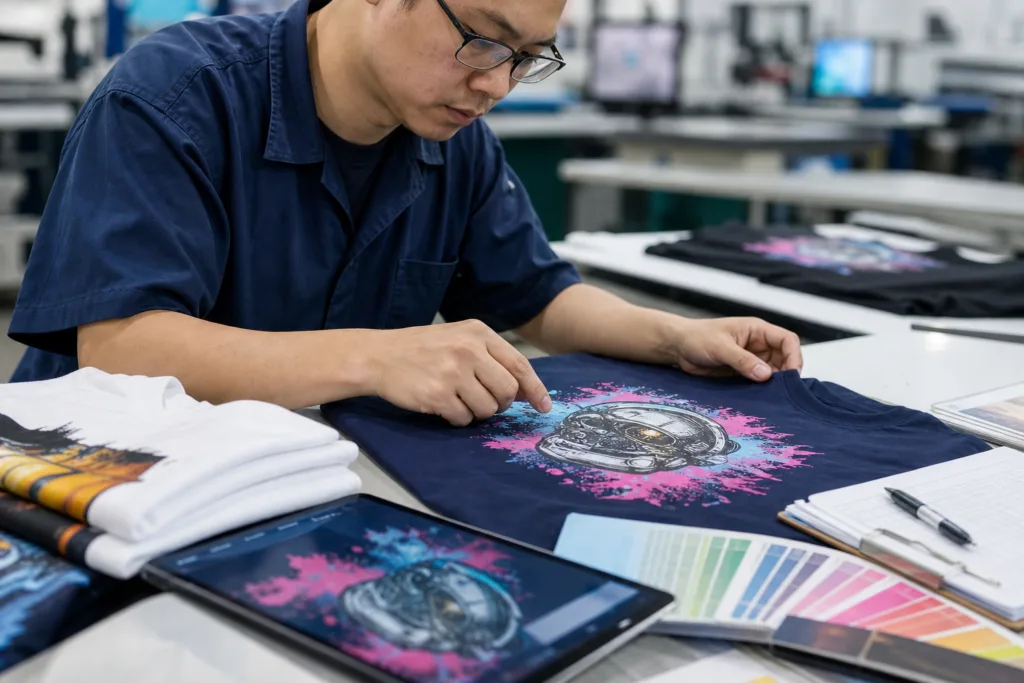
Managing color standards, lab dips, bulk fabric swatches, and repeat orders
Color is one of the most sensitive reorder issues because even a small shift is obvious in retail, teamwear, or brand-uniform programs. Buyers should distinguish between three separate checkpoints: color target, lab approval, and bulk confirmation. Treating them as the same step often creates confusion later.
A stronger process usually looks like this:
- Define the target with Pantone reference, physical swatch, or approved previous fabric
- Approve a lab dip or color submit before bulk dyeing
- Review a bulk fabric swatch from the actual production lot when needed
- Retain a cut swatch from the approved run for future comparison
This is particularly important for black, navy, red, olive, washed shades, and melange fabrics, where visual differences can become more pronounced under different light or finishing conditions. Neck rib, body fabric, and printed ink should also be evaluated together, not independently, because a close match in isolation can still look off on the final garment.
Questions buyers should ask before approving reorder colors
- Is the factory matching to Pantone, a prior swatch, or a retained garment?
- Is the body fabric coming from the same mill or a replacement source?
- Will rib, tape, and label components be reviewed against the bulk shade?
- Are there known wash or finish effects that may change perceived color?
- Who signs off bulk color if the first sample and final lot differ slightly?
What documents and files buyers must retain for seamless reorders
Many reorder delays happen because key files are scattered across email threads, chat apps, and personal computers. When the original merchandiser or designer is unavailable, the next team starts rebuilding the style from fragments. That is slow, risky, and often unnecessary.
At minimum, buyers should keep a reorder pack containing:
- Final tech pack with revision date
- Approved BOM and trim list
- Measurement spec and grading
- Artwork source files and print approval version
- Color approvals, lab dips, and bulk swatches
- Approved sample photos and comments
- Packing requirements and carton ratio details if repeated
- PO history and actual production notes from prior runs
A practical way to think about this is to manage the style from first order to reorder as one continuous production record rather than separate transactions. When brands use a central file structure with locked naming conventions and approval dates, they reduce dependence on memory and improve handoff quality between sourcing, design, and operations teams.
How factories build reliable repeat-order production records
Strong factories do not rely on memory alone. They create internal reorder history using production files, retained approvals, operator notes, QC comments, and issue logs from prior runs. This matters because the best predictor of reorder consistency is often not what the style is supposed to be, but what the factory documented when it was actually made.
Useful factory-side records include:
- Approved sample archive by style and color
- Fabric and trim sourcing history
- Print or embroidery setup sheets
- Pattern version control and grading record
- Inline and final QC results from earlier orders
- Known defect points and corrective actions
- Packaging and labeling records tied to the SKU
When evaluating a supplier, ask how reorder records are retrieved, who owns version control, and how production changes are approved. A factory that can quickly reference prior runs is generally easier to work with on replenishment business than one that treats every repeat order like a restart.
Recommended long-term reorder management mechanisms
The most effective way to improve custom t-shirt reorder consistency is to build a repeatable control system rather than solving issues one by one. That system does not need to be complicated, but it does need to be disciplined.
Recommended long-term mechanisms include:
- A master style file with controlled revisions
- Retained approved garment and swatch library
- Locked measurement spec and tolerance sheet
- Print parameter records attached to artwork files
- Standard reorder checklist used before PO release
- Named approval owners on both buyer and factory sides
- Post-production review notes after every run
For brands with repeat-demand programs, it also helps to forecast replenishment earlier. Better planning gives more options for fabric reservation, trim continuity, and production timing, which lowers the risk of forced substitutions later.
Conclusion
Custom t-shirt reorder consistency is not the result of luck or a good memory. It comes from preserving approved standards, documenting what was actually produced, and building a process that links fabric, color, fit, print, and files across every repeat run. Brands that treat reorders with the same discipline as first developments usually see fewer disputes, smoother replenishment, and better end-customer confidence.
For sourcing managers and apparel brand owners, the key takeaway is simple: every approved order should create a stronger reference system for the next one. If your current process depends on inbox searches, verbal recollection, or unverified substitutions, reorder inconsistency will remain hard to control.
FAQ
Why do custom t-shirt reorders look different from the first production run?
Reorders often change because fabric batches, dye lots, print settings, or measurement control are not matched closely enough to the approved run, even when the style name and artwork stay the same.
What sample should be kept for future t-shirt reorders?
The most useful reference is an approved pre-production or bulk-confirmed garment, supported by retained fabric swatches, color approvals, print strike-offs, and the final measurement spec.
How much color variation is normal on repeat orders?
Some variation can occur between dye lots, but buyers should define an approval standard in advance and review lab dips or bulk swatches so acceptable differences are controlled before production starts.
What files are most important for maintaining reorder consistency?
The essential files are the final tech pack, approved BOM, measurement spec, artwork source files, print approval notes, color standards, sample comments, and prior production records.
How can buyers reduce sizing problems on repeat t-shirt orders?
They should lock the approved spec, define critical points of measure, track tolerance limits clearly, and compare reorder samples against the original approved garment instead of relying only on written measurements.
What should I ask a factory before placing a repeat t-shirt order?
Ask what approved samples and records they retain, whether fabric and trims can be matched to prior runs, how print settings are documented, and how production changes are flagged before bulk begins.