

End use should shape custom apparel manufacturing decisions from the start, because a garment built for repeated uniform wear is not the same as one meant to sell in a retail package or hand out as branded merch. The right approach affects fabric selection, sizing, decoration, QC, packaging, and how much reordering flexibility you need.
For buyers comparing category options, a polo shirt supplier for different end uses can be a useful reference point because polos often sit between uniform, merch, and retail programs. They show how one style can shift in fabric, finish, and production priority depending on where and how the garment will be used.
Why end use changes the production brief
Manufacturers do not treat every apparel project the same way. A garment that will be washed weekly, worn in front of customers, photographed for ecommerce, or distributed at an event each has different priorities. If the brief does not reflect actual use, the result is often avoidable cost, poor fit decisions, or quality issues later in production.
That is why the first job is to define the business context clearly. A good manufacturer can then recommend whether the program should lean toward durability, decoration efficiency, shelf appeal, or performance consistency.
Uniforms, merch, teamwear, and retail apparel

These four product types can overlap in style, but their manufacturing priorities are different. Uniforms usually emphasize repeatability and service life. Merch usually emphasizes branding and cost control. Teamwear needs identity plus performance. Retail apparel usually needs better finishing, fit consistency, and presentation.
| Use case | Main priority | Typical production focus |
|---|---|---|
| Uniforms | Durability | Wash resistance, stable sizing, repeat orders |
| Merch | Brand visibility | Decoration flexibility, cost control, fast turnaround |
| Teamwear | Performance and identity | Logo placement, numbering, sizing spread |
| Retail | Presentation and margin | Fabric handfeel, fit consistency, packaging |
Uniform production: built for repeated use
Uniform programs need fabrics and constructions that hold up under frequent wear and washing. Buyers should think about abrasion resistance, color stability, shrinkage control, and replacement planning. A uniform order also needs a wider size coverage strategy because teams and staff populations are rarely uniform in body shape.
If your program includes recurring replenishment, it helps to set expectations early with the factory about shade consistency, size matching, and restock timing. That is where planning size ratios for uniforms and retail becomes especially useful, since poor ratio planning can create shortages in core sizes and excess in slow-moving ones.
Branded merch apparel: faster, simpler, more decoration-led
Merch apparel is often built around a logo, event, campaign, or promotional message. In that setting, the visual impact of the decoration may matter more than premium fabric handfeel. Buyers often want a balance between speed, acceptable comfort, and a controlled unit cost.
Because merch orders are usually tied to launches or event calendars, turnaround time can be more important than complex construction details. That makes decoration method, fabric availability, and packaging simplicity major decisions.
When the goal is a clean production brief with less back-and-forth, how to prepare a stronger apparel RFQ can help buyers give the factory the right details the first time.
Retail apparel production: presentation matters more
Retail garments need to look and feel ready for the shelf, not just functional on the body. That usually means tighter attention to drape, handfeel, stitching finish, label presentation, and carton or polybag packaging. Buyers also tend to care more about consistency across repeated production runs because the item is part of a brand promise.
Retail sourcing also needs more care around fabric selection. Stock fabric can speed up development, while custom-dyed fabric may be better when color identity is part of the brand story. The right choice depends on margin, lead time, and how critical color control is to the collection.
For that decision, choosing stock fabric versus custom-dyed fabric can clarify where each option makes sense in a retail program.
Teamwear production: performance and group ordering complexity
Teamwear combines identity, performance, and logistics. The garment may need moisture management, stretch, breathability, and durable decoration, while also handling mixed sizes and last-minute roster changes. Numbering, names, and logo placement also need accuracy because errors are visible and difficult to fix after production.
Teamwear projects often involve clubs, schools, and organizations where the real challenge is order coordination, not just garment construction. If the buyer cannot define approvals, numbering logic, and size distribution clearly, delays usually follow.
How fabric selection changes by end use
Fabric choice should follow the garment’s job. Uniforms may need stronger knits or stable woven options. Merch may use simpler fabrics to keep costs down. Teamwear often benefits from performance fabrics that manage movement and moisture. Retail apparel may prioritize softness, drape, or surface quality.
The key question is not just what fabric looks good, but what fabric can survive the use environment. A fabric that works for a one-day event may fail in a daily work setting, and a premium fashion fabric may be unnecessary for a giveaway shirt.
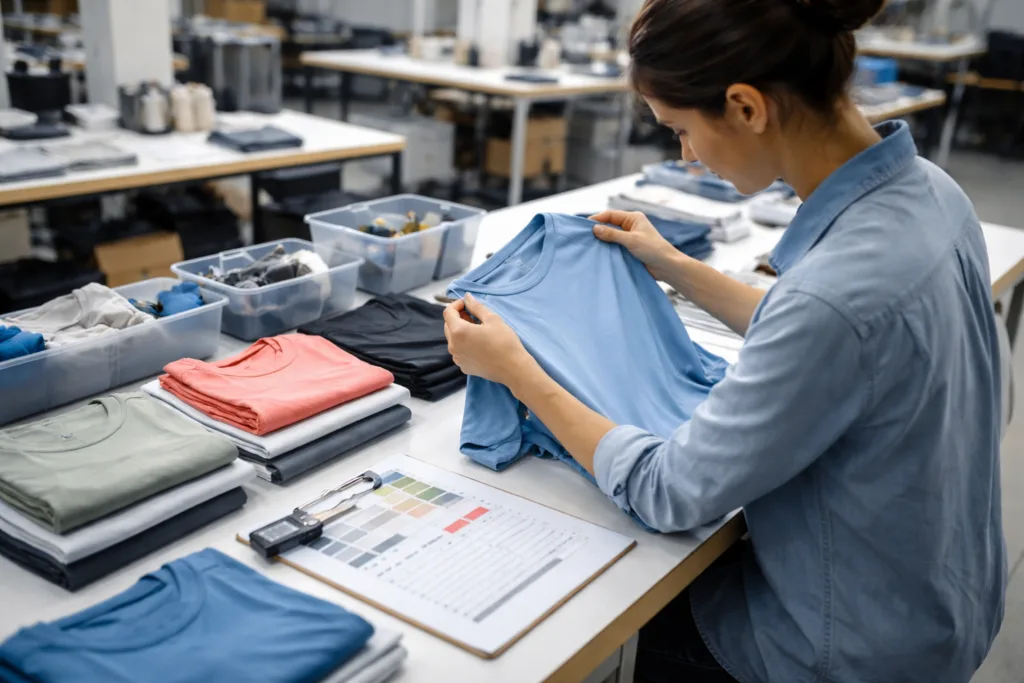
Typical fabric decision logic
- Uniforms: durability, wash performance, and color retention
- Merch: cost control, print or embroidery compatibility, speed
- Teamwear: stretch, breathability, and movement support
- Retail: handfeel, drape, and brand presentation
Quality control priorities change by use case
QC for apparel is not one-size-fits-all. Uniforms need consistency and durability checks. Merch needs decoration accuracy and acceptable overall finish. Teamwear needs print, numbering, and fit checks across size runs. Retail needs tighter inspection of stitching, measurements, labels, and packaging appearance.
Before production starts, it helps to agree on what is critical and what is acceptable variation. That is where setting quality tolerances before production can reduce disputes and help the factory inspect against the right standard.
MOQ, sampling, and lead time differences
Minimum order quantity depends on how complex the garment is and how specialized the materials or decoration are. Uniform and merch programs may be easier to scale in repeatable structures, while retail can require more sampling and presentation work. Teamwear often sits in the middle but may add customization steps for names and numbers.
Sampling is also different by use case. Retail samples may go through more fit and appearance rounds. Uniform samples may focus on wear testing and size stability. Merch samples may prioritize logo placement and print quality. Lead times follow the same logic: more complexity usually means more checkpoints.
How to brief a manufacturer correctly
A strong brief should explain who will wear the garment, how often it will be worn, where it will be used, and whether the order is a one-time program or a repeat line. If the factory understands the end user, it can recommend a more suitable construction, fabric, and QC approach.
At Ninghow Apparel, the most useful project briefs are the ones that explain business context instead of only sending a design file. That helps the manufacturer align the production approach with the actual use case, not just the artwork.
Common mistakes buyers make
One common mistake is using retail standards for a merch project, which can inflate cost without improving the buyer experience. Another is under-specifying uniforms, which often leads to poor wear life or inconsistent replacement orders. A third is treating teamwear like generic blanks, even though logo placement and sizing coordination matter more.
Buyers also sometimes assume the same fabric, size ratio, and QC method should work across all programs. In practice, each end use has its own risk profile, and that is why one production strategy rarely fits every category.
A simple decision framework
Start with four questions: how the garment will be used, how often it will be reordered, how important appearance is, and how much variation the buyer can tolerate. If durability and replacement planning matter most, the program is closer to uniforms. If decoration speed and cost matter most, it is closer to merch. If performance and group identity matter most, it is teamwear. If presentation and margin matter most, it is retail.
Once that is clear, the manufacturer can narrow the right fabric, fit, MOQ, sampling path, and packaging method. That is the fastest way to reduce revision cycles and avoid building the wrong product for the wrong use.
Conclusion: choose the process based on real use

The best custom apparel manufacturing decisions come from understanding how the garment will actually be used. Uniforms, merch, teamwear, and retail apparel may share a similar silhouette, but they do not share the same production priorities. When buyers match the manufacturing strategy to the end use, they usually get better quality, fewer surprises, and a cleaner path to reorder.
That is also why manufacturers ask so many practical questions before quoting. The more clearly the end use is defined, the more accurately the factory can build the right result.
FAQ
Why does end use matter so much in apparel manufacturing?
End use determines the priorities for fabric, fit, decoration, QC, packaging, and reorder planning. A garment for daily workwear needs different decisions than one for retail display or promotional distribution.
Are uniforms and teamwear produced the same way?
Not usually. Uniforms focus more on durability and repeatability, while teamwear adds performance, logo placement, numbering, and group ordering complexity.
Is merch always lower quality than retail apparel?
No. Merch is simply optimized differently. It may use simpler materials or packaging to control cost and turnaround, but quality should still match the intended use.
How does end use affect MOQ?
More customized or more presentation-heavy programs often need more sampling and setup work, while simpler repeatable programs may be easier to scale. MOQ also depends on fabric, decoration method, and size spread.
What should I tell the factory first when requesting a quote?
Tell them who will wear the garment, how it will be used, the expected order frequency, target price range, and any must-have details like logos, numbering, or packaging.
Can one style work for uniforms, merch, and retail?
Sometimes, but the production settings usually need to change. The same style can be built with different fabrics, trims, decoration methods, and QC standards depending on the end use.