

Corporate polo shirts often look simple on the surface, but procurement teams usually discover the real complexity when they start comparing quotations, reviewing samples, and planning repeat orders. The right decision is not just about color or logo appearance. It also depends on who will wear the shirts, how often they will be washed, what fit range is needed, and whether the supplier can keep future reorders consistent.
That is why many buyers start by evaluating what a reliable corporate polo shirt supplier should be able to confirm before production begins. A useful supplier discussion should cover fabric behavior, branding methods, sizing logic, reorder control, and delivery handling, not just unit price. When those points are clarified early, procurement teams can reduce approval delays and avoid problems that only become visible after bulk delivery.
What Corporate Polo Shirts Are and How They Differ from Promotional Polo Shirts
Corporate polo shirts are usually designed for repeated use as part of a working uniform system. That means the buying decision should prioritize wear performance, consistency, and long-term replenishment rather than short-term event visibility. In practice, procurement teams often need shirts that can hold shape, maintain logo appearance, and stay presentable across regular washing cycles.
Promotional polos, by contrast, are often selected for one-off campaigns, temporary staffing, trade shows, or giveaway programs. Those projects may accept lighter fabric, simpler construction, or broader size tolerance because the garment is not expected to function as a daily uniform. For procurement teams, mixing these two use cases can create avoidable problems, especially if a low-cost event polo is ordered for employees who will wear it every week.
Before requesting pricing, it helps to define whether the project is truly uniform-focused or promotion-focused. That single distinction influences fabric weight, collar construction, shrinkage expectations, embroidery suitability, and the likelihood of future repeat orders.
Identify the Wearing Scenario Before Choosing the Shirt

Wearing scenario should drive the specification. An office receptionist, a retail floor associate, a warehouse supervisor, and a field technician may all wear polo shirts, but they do not need the same fabric, fit, or construction details. Procurement teams that try to solve every department with one generic shirt often create trade-offs that satisfy no one particularly well.
Office and front desk teams
For office-facing roles, appearance usually comes first. Buyers often prefer cleaner silhouettes, stable collars, softer handfeel, and branding that looks neat at close distance. Excessively heavy or sporty fabrics may feel out of place in these environments.
Sales and client-facing staff
Sales teams often need a balance between polish and mobility. The shirt should look professional during meetings but still remain comfortable during travel or long days on the move. In these cases, wrinkle resistance, breathability, and fit consistency matter more than purely promotional styling.
Warehouse and field service roles
More active jobs typically require higher emphasis on abrasion resistance, ease of movement, and wash durability. A procurement team may decide that reinforced seams, more forgiving fit tolerance, or performance-blend fabric is worth prioritizing over a softer luxury feel.
Event staff
Event use can be broader. Some teams need only short-term image consistency, while others reuse the same shirts over multiple events. Buyers should decide early whether the shirts are disposable campaign garments or part of a longer-term branded uniform stock.
Choose the Right Fabric Based on Job Function, Climate, and Wash Frequency
Fabric is one of the most important decisions because it affects comfort, durability, appearance, and cost at the same time. Procurement teams should avoid selecting fabric only from a swatch card or a generic description such as “cotton polo” or “performance polo.” Those labels are too broad to predict real-world use.
For a more specific comparison of fabric choices for office and work polo shirts, it helps to review how cotton, polyester, and blended options behave under different workplace demands. A shirt for air-conditioned office use may perform well with a softer cotton-rich fabric, while warmer climates or higher-activity roles often benefit from moisture management and quicker drying. The correct answer depends less on trend and more on the daily working environment.
| Fabric direction | Often suitable for | Main watchpoints |
|---|---|---|
| Cotton-rich pique or jersey | Office, reception, light-duty brand uniforms | Can feel comfortable and natural, but may shrink more and dry slower |
| Poly-cotton blend | General company uniforms across multiple departments | Often balances durability and comfort, but handfeel varies by blend ratio |
| Performance polyester or technical blend | Field service, active teams, warm climates, frequent laundering | Check pilling, odor retention, and whether the look fits the brand image |
Wash frequency matters just as much as job role. If employees receive two or three shirts and wear them repeatedly through the week, the fabric must tolerate heavy laundering. That includes color stability, surface appearance, and collar recovery after repeated washing and drying.
Build an Accurate Size Breakdown Before Requesting Samples or Quotations
Procurement problems often begin with vague size planning. A supplier can provide size charts and samples, but the buyer still needs a realistic breakdown by size, gender category if relevant, and any special fit requirements. Estimating too loosely can create overstock in slow-moving sizes and shortages in the sizes teams need most.
One practical way to reduce that risk is to review size ratio planning for employee uniforms before finalizing quantities. Procurement teams usually get better results when they combine historical staff data, department head input, and sample try-ons instead of relying on guesswork. This becomes even more important when ordering for mixed departments, regional offices, or growing teams.
Sample review should not focus only on chest measurement. Buyers should also check body length, sleeve opening, shoulder comfort, and whether the fit works for the actual dress expectation of the workplace. A shirt that technically fits may still be rejected by employees if it looks too tight, too long, or too casual for the role.
- Confirm whether the project needs unisex, men’s, women’s, or mixed fit blocks.
- Ask whether measurement tolerance is acceptable for your internal approval process.
- Plan for new hires, staff turnover, and size replenishment after launch.
- Decide whether optional extended sizes are required at the start or only on reorder.
Confirm Logo Placement, Branding Standards, and Decoration Methods
Logo execution can change the perceived quality of a uniform more than buyers expect. Even when the garment itself is acceptable, poor logo scale, incorrect placement, or unstable decoration can make the finished result look inconsistent across departments. Procurement teams should treat branding standards as a technical approval item, not a late-stage artwork detail.
When reviewing logo placement and embroidery quality, buyers should confirm exact placement position, maximum artwork size, thread color matching expectations, backing requirements, and whether embroidery, print, or patch application is the most suitable method. A small chest logo for corporate reception wear may work well in embroidery, while a large event graphic may require a different decoration route.
Branding approval should cover more than the digital file. It should include an actual sample or strike-off whenever possible, especially if the logo contains small text, gradients, or precise brand colors. Procurement teams also need to confirm whether the same logo method can be repeated reliably in future top-up orders.
Set Quality Expectations for Daily Wear, Not Just Sample Appearance
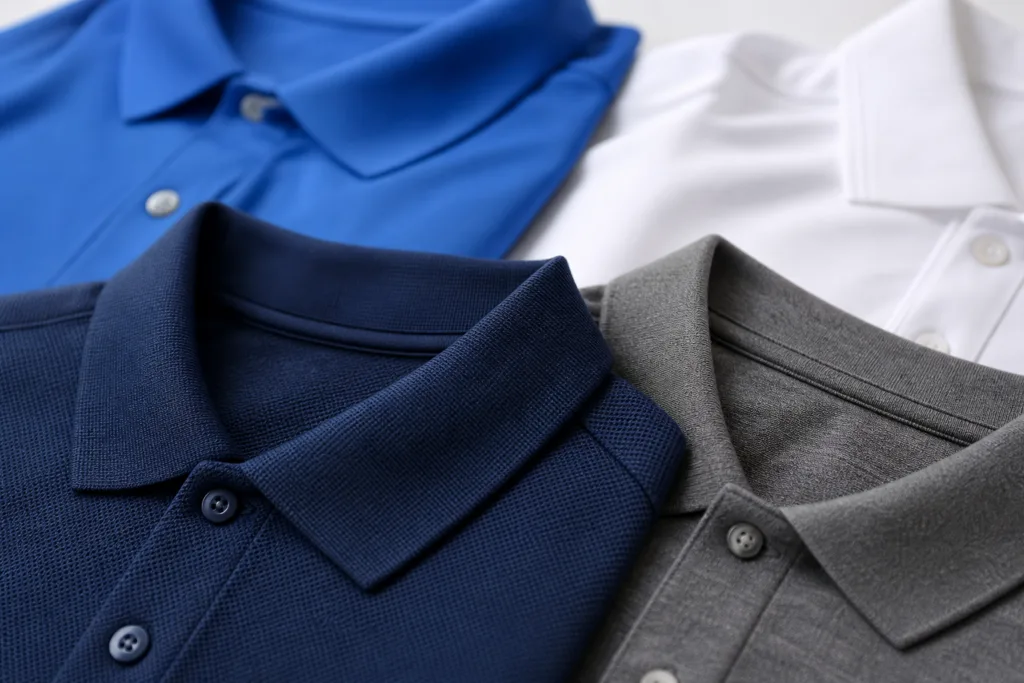
A good-looking sample is only the starting point. Bulk orders succeed when the quality expectation is defined in terms of daily use. Procurement teams should clarify what matters most: collar stability, seam neatness, color fastness, pilling resistance, shrinkage control, placket shape, button security, and overall presentation after repeated laundering.
This is where a manufacturer perspective becomes useful. Teams such as Ninghow Apparel usually see that many disputes come from undefined expectations rather than obvious production failure. If the buyer does not specify what level of surface variation, measurement tolerance, or shade variance is acceptable, approvals can become subjective after delivery.
Useful quality conversations often include:
- What stitching areas are most visible and should be checked more closely.
- Whether color consistency between body fabric, collar, and placket is important.
- How the garment is expected to perform after repeated wash-and-wear cycles.
- What issues are considered minor variation versus unacceptable defect.
It is also sensible to ask how the supplier handles bulk inspection, sample sign-off, and correction of recurring issues. Procurement teams do not need unnecessary technical detail, but they do need a clear shared standard before production starts.
Define the First Order Quantity, Reorder Process, and Stock Buffer
Initial order planning should reflect more than headcount. A first order usually needs to account for fitting replacements, new hires, damaged units, seasonal changes, and the practical cost of producing top-up quantities later. Ordering too tightly may reduce initial spend but create higher operating friction within a few months.
Procurement teams should define whether the supplier can support future top-ups in the same fabric, color, and logo standard, and under what conditions. Reorders are easier when the original order uses stable materials, approved trims, and documented specifications. If the buyer expects rolling replenishment, that expectation should be discussed before the first PO is placed.
A useful internal planning step is preparing a stronger apparel RFQ for uniform orders so first-order quantity logic, reserve stock, and future reorder assumptions are written clearly. This helps the supplier quote more accurately and reduces back-and-forth after the initial price comparison.
Review Lead Time, Packaging, Department Sorting, and Delivery Requirements
Lead time should be reviewed as a production and distribution issue, not just a date on a quotation sheet. Procurement teams often need to coordinate approvals, logo confirmation, sample feedback, purchase order release, manufacturing, and final delivery to one site or multiple sites. Any unclear step can push the launch timeline.
Packaging also deserves more attention than it usually gets. Some companies only need standard bulk carton packing, while others require individual polybags, barcode labels, size stickers, or department-level assortment sorting. If uniforms are being distributed across locations, clear packing instructions can save significant internal labor after receipt.
It helps to confirm:
- Sample lead time versus bulk lead time.
- Whether approval delays affect the production window.
- Whether cartons must be sorted by department, location, or employee issue list.
- How partial deliveries or replacement units will be handled if needed.
Common Mistakes Procurement Teams Make When Ordering Company Polo Shirts
Most ordering issues come from missing decisions rather than catastrophic errors. The following mistakes are common and avoidable.
- Choosing by price alone: A lower unit cost may create higher replacement cost if fabric performance or fit acceptance is poor.
- Using one specification for every department: Different roles may need different fabric or fit priorities.
- Approving artwork without garment context: Logo size and position should be checked on the actual shirt, not only on screen.
- Skipping structured size planning: Poor size distribution creates waste and employee dissatisfaction.
- Not defining reorder expectations: A uniform program is rarely a one-time purchase.
- Leaving packaging details too late: Operational sorting problems often appear only after goods arrive.
Procurement Checklist Before Requesting a Quote
Before asking suppliers to quote, procurement teams should prepare a decision-ready brief. That does not need to be complicated, but it should be complete enough to reduce assumptions and keep quotations comparable.
- Intended use case by department or role.
- Preferred fabric direction and climate considerations.
- Estimated size breakdown and fit categories.
- Logo files, placement positions, and branding rules.
- Quality priorities for daily wear and washing.
- Initial order quantity and likely reorder plan.
- Packing, labeling, and delivery requirements.
- Approval process and target timeline.
When these points are defined early, suppliers can respond with more useful recommendations instead of broad estimates. That gives procurement teams a better basis for comparing capability, not just price.
Conclusion

Ordering corporate polo shirts well means translating workplace needs into a clear production brief. Procurement teams that confirm wearing scenario, fabric behavior, sizing, branding, quality expectations, reorder logic, and delivery requirements before bulk approval usually face fewer surprises later. The strongest buying decisions come from practical clarity at the start, especially when the shirts are expected to support a long-term uniform program rather than a short-lived campaign.
FAQ
How many samples should a procurement team review before approving corporate polo shirts?
Most teams should review at least one fit sample and one branded sample, because fit approval and logo approval often reveal different issues.
What fabric is usually safest for mixed-use corporate polo shirts?
For many mixed office and light-duty work environments, a balanced poly-cotton blend is often a practical starting point because it can combine comfort, easier care, and reasonable durability.
Should all departments wear the same corporate polo shirt?
Not always, because front-desk staff, warehouse teams, and field service employees may need different fabric performance, fit, or durability priorities.
What is the biggest sizing mistake in uniform polo orders?
The most common mistake is estimating size quantities without staff data or sample try-ons, which often leads to shortages in core sizes and excess stock in slower sizes.
Why is reorder planning important when buying company polo shirts?
Reorder planning helps maintain color, fabric, and logo consistency over time and reduces the risk of treating later top-up orders as separate products.
What should be included in a uniform polo shirt quote request?
A useful quote request should include garment use case, fabric preference, size breakdown, logo details, quantity, quality expectations, packaging needs, and delivery timing.