
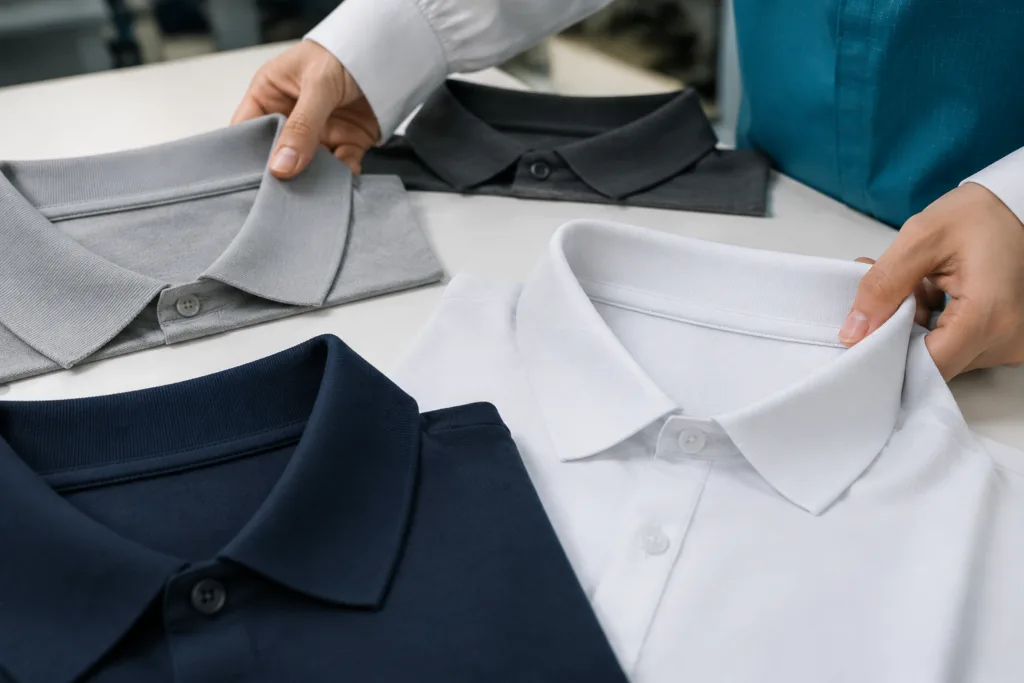
Polo buyers often notice collar problems before almost anything else. A body panel can look acceptable at first glance, but a collar that curls at the edge, twists after washing, or collapses at the neckline makes the whole garment feel lower quality. For brands, that means polo shirt collar quality is not a small trim issue. It is a visible construction and performance issue that affects fit perception, brand positioning, and return risk.
When sourcing polos, it helps to evaluate polo shirt supplier quality considerations early, especially around collar structure, wash behavior, and consistency from sample to bulk. A supplier may show a clean-looking development sample, but the real question is whether the collar will keep its shape after repeated wear, pressing, packing, and laundering. That is why collar quality should be reviewed as a technical performance topic, not just a styling detail.
Why polo shirt collars are often the first quality problem buyers notice
The collar sits close to the face, frames the neckline, and stays visually prominent whether the polo is worn for workwear, golf, school, or casual use. Even minor deformation becomes easy to spot. Curling edges, wavy collar seams, uneven collar points, and necklines that refuse to lie flat immediately change the perceived grade of the product.
Unlike a side seam or inside finishing detail, a collar is constantly handled. It is folded during packing, pulled during wear, and stressed during washing. Because of this, the collar exposes weaknesses in yarn quality, stitch balance, shrinkage control, and finishing faster than many other garment parts.
What polo shirt collar quality really means in manufacturing
Good polo shirt collar quality means more than a collar looking crisp on the first sample. In manufacturing terms, it usually includes shape retention, balanced symmetry, stable seam attachment, acceptable shrinkage, color consistency, and a hand feel that matches the body fabric and intended price level.
A quality collar should return to a neat shape after washing, sit evenly around the neckline, and avoid excessive curling at the outer edge. It should also match the design intent. Some brands want a firm, structured collar for a premium uniform or golf silhouette, while others prefer a softer casual look. The point is not that every collar must be stiff. The point is that the collar should perform consistently according to the approved standard.
Rib collar vs self-fabric collar vs flat knit collar
Rib collar
Rib collars are common because they offer stretch, recovery, and a recognizable polo appearance. A well-made rib collar can hold shape effectively, but it depends heavily on yarn selection, knit density, and finishing. If the rib is too loose or the yarn has weak recovery, the collar may spread, ripple, or lose its edge definition.
Self-fabric collar
Self-fabric collars use the same fabric as the body or a closely matched fabric. They can create a cleaner or more modern appearance, but they often need more attention to support and stability. Because jersey or pique body fabric may not naturally stand with the same structure as a flat knit collar, a self-fabric version can collapse or roll unless the construction is planned carefully.
Flat knit collar
Flat knit collars are often chosen when brands want a more refined look, stripe tipping details, or better visual separation from the body fabric. They can perform very well, but they are also sensitive to knit consistency and shrinkage balance. If the collar and body react differently in washing, the neckline may pucker or distort.
Why collars curl, stretch, shrink, or lose shape after washing
Most collar problems come from imbalance. The edge may curl because the knit structure, finishing, or moisture response is uneven. The collar may shrink because the yarn and knit were not stabilized enough before sewing. It may stretch because the collar was attached under poor tension or because the yarn recovery is too weak for the intended use.
Another common issue is differential shrinkage between the collar and the body. Even when each component looks fine separately, trouble begins when they do not shrink at the same rate. That mismatch can create neckline waving, corner lift, or twisting after laundering.
These risks should be identified during the apparel sample approval process, when brands still have time to compare collar options, adjust specs, and test wash performance before bulk commitments are locked in.
The manufacturing causes behind poor collar performance
Yarn choice
The yarn used in the collar strongly influences recovery, surface stability, and wash behavior. Combed cotton, carded cotton, cotton-poly blends, or filament-based blends can all behave differently. Lower stability yarns may feel acceptable at first but distort more quickly after washing or repeated handling.
Knit density
A collar knit too loosely may look soft and comfortable, but it is more likely to stretch out, wave, or collapse. A denser knit generally improves structure, but too much density can create hardness, mismatch with the body fabric, or shrinkage tension if not controlled properly.
Stitch construction
The way the collar is attached matters as much as the collar itself. Uneven seaming, poor stitch balance, or excessive stretching during attachment can force the neckline out of shape. A good collar can still fail if the sewing line introduces distortion.
Finishing
Finishing controls how the collar behaves after knitting and before garment assembly. Inadequate relaxation, pressing imbalance, or unstable finishing conditions can lock temporary shape into the component rather than long-term stability. That often explains why a sample can look flat at packing but react poorly after washing.
Brands should align acceptance standards around measurable points, not only visual judgment. Clear discussion of apparel quality tolerance helps define what level of collar edge wave, point variation, shrinkage, and seam distortion is acceptable before disputes appear in bulk inspection.
How fabric GSM, yarn type, and knit method affect collar shape retention
Collar performance does not come from one variable. It comes from the relationship between weight, yarn, and knit structure. A lighter collar may feel more breathable but can be more prone to collapse. A heavier collar may feel more substantial but can create mismatch if the body fabric is much lighter or shrinks differently.
For buyers comparing polo developments, understanding how GSM affects garment shape is useful because fabric weight influences drape, firmness, and post-wash behavior. GSM alone does not guarantee quality, but it helps explain why one collar feels stable while another looks thin, limp, or overly rigid.
Knit method also matters. Pique body fabric paired with a flat knit collar is a classic combination, but the technical match still needs review. If the body and collar absorb moisture, shrink, or recover differently, the final appearance can become inconsistent after laundry testing.
The role of interlining, tipping, tension, and seaming in collar stability
Some collars rely only on knit structure. Others benefit from added support, depending on the design target. Interlining or internal support can improve shape retention in certain self-fabric collars, but the added structure must be compatible with wash expectations and hand feel. Too much support can make the collar feel artificial or create bubbling over time.
Tipping details also deserve attention. Contrast tipping can elevate appearance, but the added yarn and knitting change can affect edge behavior. If the tipping area has different tension or recovery from the main collar body, the outer edge may curl more easily.
Seaming is another frequent hidden cause. During collar attachment, operators can unintentionally stretch either the collar or neckline if machine settings, feed control, or handling are inconsistent. That distortion may not fully show until the garment relaxes or is washed.
From a manufacturer perspective, Ninghow Apparel typically treats collar stability as a combined development issue involving the knit component, body fabric behavior, and neckline sewing method rather than judging the collar as an isolated trim.
Wash testing and shrinkage control before bulk production
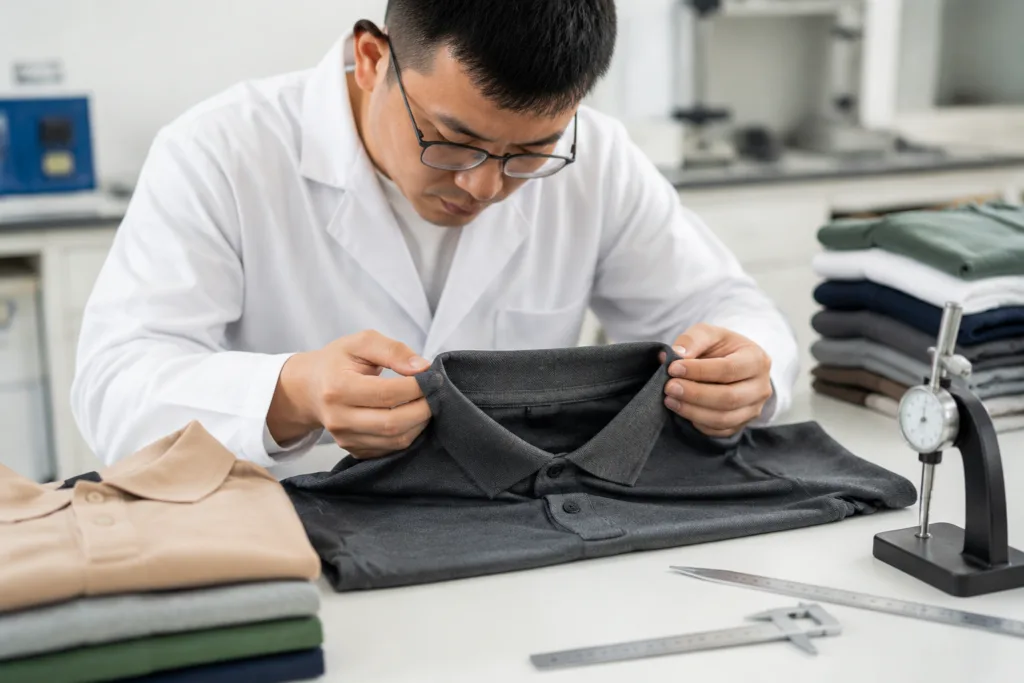
Wash testing is where many collar assumptions get corrected. A development sample may appear clean straight off the ironing table, but the collar still needs to be checked after laundering for edge curl, length shrinkage, width shrinkage, seam puckering, point symmetry, and neckline recovery.
Manufacturers should compare before-wash and after-wash measurements, and buyers should ask to see whether the collar and body remain balanced as a system. If the collar shortens too much, the neckline can pull. If it widens or relaxes too much, the collar may lie open and lose shape.
Before mass production, teams should confirm why the PP sample protects production quality. The PP stage is where final collar construction, fabric lot behavior, sewing method, and measurement expectations should align before bulk cutting begins.
How buyers should inspect polo collar samples
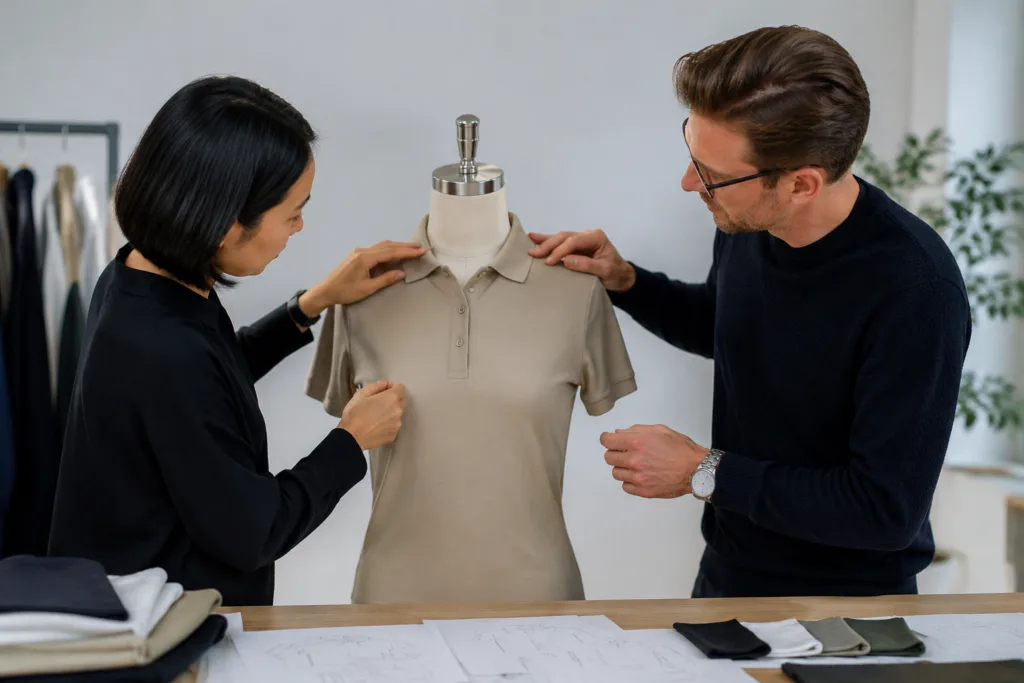
During development and fitting, buyers should inspect collars both on table and on body. A collar can look symmetrical when laid flat but sit unevenly once worn. It helps to review multiple conditions: buttoned, unbuttoned, lightly stretched, and after washing.
- Check whether both collar points match in length and angle.
- Look at the outer edge for early curling or waviness.
- Inspect the neckline seam for puckering or feed imbalance.
- Compare collar hand feel with the intended market position.
- Review post-wash recovery rather than only pre-wash appearance.
- Confirm the collar sits correctly on the neck when worn.
If a brand plans frequent repeat orders, the sample stage is also the right time to record collar specs and approval references in a way that can be used consistently later.
Key collar specifications to confirm before approving mass production
Brands should avoid approving polos based on general comments such as “collar looks good.” A better approach is to lock specific points into the approval package.
| Specification area | What to confirm | Why it matters |
|---|---|---|
| Collar type | Rib, self-fabric, or flat knit | Defines structure and appearance target |
| Material composition | Fiber blend and yarn type | Affects shrinkage, recovery, and feel |
| Knit density | Tightness and firmness standard | Influences shape retention |
| Measurement | Finished length, width, point shape | Controls fit consistency |
| Attachment method | Seam construction and stitch type | Reduces neckline distortion risk |
| Wash result | Post-wash tolerance and appearance | Verifies real performance |
Common mistakes brands make when they judge custom polo quality too late
One common mistake is focusing heavily on body fabric hand feel while treating the collar as a standard component. Another is approving a showroom sample without wash testing the exact collar construction that will be used in bulk. Brands also run into problems when they change yarn, color, or collar vendor late in development without rechecking shrinkage balance.
Some buyers discover collar deformation only during final inspection, when the practical options are limited. At that stage, a visual defect may actually reflect an earlier technical decision that was never locked clearly in the sample or PP stage.
A stronger process is to treat the collar as a high-risk component from the beginning, especially for schoolwear, uniforms, teamwear, and golf polos where repeated laundering is expected.
Conclusion
Poor collar performance is rarely random. Curling, shrinking, stretching, and shape loss usually come from a chain of technical decisions involving yarn, knit density, fabric weight, finishing, seam tension, and wash control. For brands, improving polo shirt collar quality starts with asking more detailed questions before bulk production, not after problems appear in packed goods.
When collar standards are defined early, tested in realistic wash conditions, and confirmed through sample approvals, buyers gain a more reliable path to consistent polo quality. That approach reduces avoidable risk and helps the finished garment hold its intended shape and market value.
FAQ
Why do polo shirt collars curl after washing?
Polo shirt collars usually curl after washing because of imbalance in knit structure, yarn recovery, finishing, or shrinkage between the collar and the body fabric. Edge curling often becomes worse when the collar is too loose, poorly stabilized, or sewn under uneven tension.
Which collar type is more stable for polos?
No single collar type is always more stable, because performance depends on material, knit density, and construction quality. A well-made rib or flat knit collar often offers better structure than a weak self-fabric collar, but the approved wash result matters more than the collar category alone.
Can higher GSM automatically improve polo shirt collar quality?
Higher GSM can help a collar feel firmer, but it does not automatically solve quality issues. If the yarn, shrinkage balance, or sewing method is poor, a heavier collar can still twist, pucker, or mismatch with the body fabric.
What should buyers check on a polo collar sample?
Buyers should check collar symmetry, edge flatness, seam appearance, hand feel, on-body shape, and post-wash recovery. It is also important to compare the collar and body fabric together to see whether they remain balanced after laundering.
Why is the PP sample important for collar approval?
The PP sample helps confirm that the final collar material, sewing method, and garment measurements match what will be used in bulk production. It is one of the last chances to catch shrinkage, shape, or construction issues before large-scale cutting and sewing begin.
How can brands reduce collar deformation risk in bulk polo production?
Brands can reduce risk by locking clear collar specifications, reviewing washed samples, confirming acceptable tolerance levels, and checking that collar and body fabrics behave consistently together. Early technical alignment with the manufacturer is usually more effective than trying to correct collar issues during final inspection.