
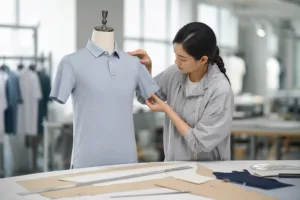
Golf polos sit in a narrow space between sportswear, uniform apparel, and brand merchandise. Buyers often assume they can be developed like standard polos, but on-course use places more pressure on mobility, heat management, collar stability, and logo execution. That is why small production choices can change whether a shirt feels easy through a full swing or distracting by the back nine.
When teams, clubs, and private label brands compare a golf polo shirt manufacturer, the useful question is not only price or decoration capacity. It is whether the supplier understands how fabric behavior, pattern balance, and finishing details work together in actual play. That sourcing lens makes it easier to avoid polos that look correct on a spec sheet but underperform once athletes start moving.
Why golf polo shirts are not the same as regular polos
A regular casual polo is often designed around everyday wear, simple branding, and basic fit expectations. A golf polo has to perform under repeated shoulder rotation, outdoor exposure, and long wear periods where moisture buildup and collar collapse become noticeable.
From a manufacturing perspective, that changes the development process. Fit allowances, side seam shape, sleeve pitch, placket depth, hem coverage, fabric recovery, and trim weight all matter more in golf than in a fashion-basic polo. Buyers sourcing for clubs or retail need to review these points early, because they affect both sample approval and bulk consistency.
Shoulder mobility: how pattern design and sleeve opening affect swing range
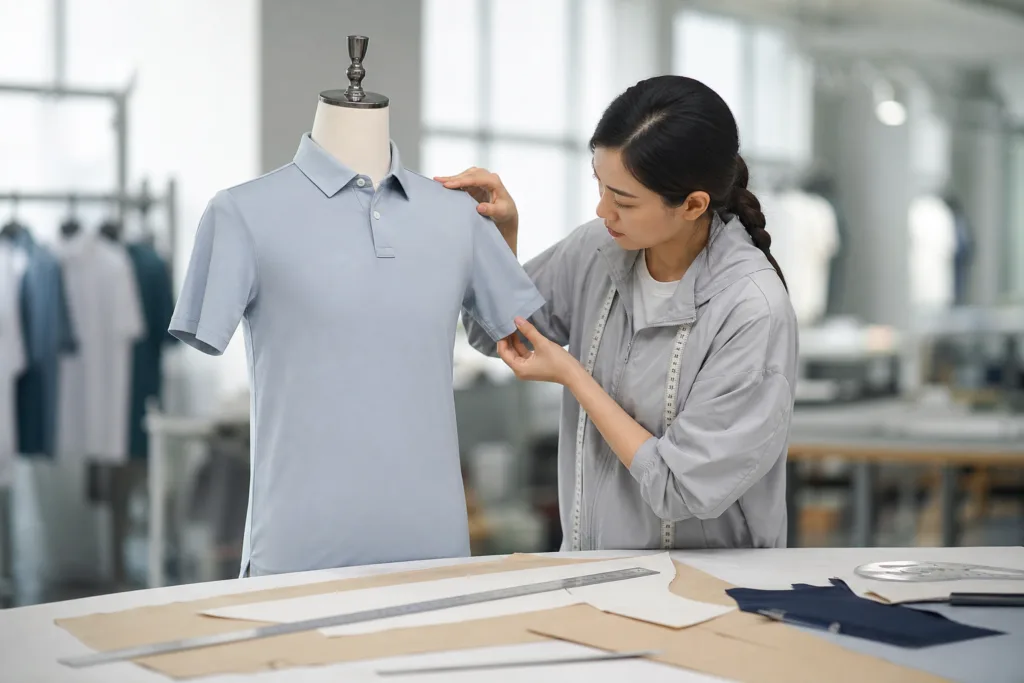
Mobility starts with the pattern, not only with stretch fabric. If the shoulder width is too narrow, the armhole is cut too high without enough balance, or the sleeve opening is too tight, the shirt can pull across the upper back during rotation. Even when the fabric stretches, the wearer may still feel resistance at the top of the swing.
Well-developed golf polos usually account for rotational movement through upper-body ease, back width, and sleeve shaping. The goal is not a loose silhouette but a pattern that follows the body without locking the shoulder. This matters especially for buyers serving club teams or tournament programs where a single fit must work across a broad size range.
Another detail buyers sometimes miss is front opening behavior. A placket that sits too stiffly or collapses awkwardly can affect how the upper chest area moves and recovers during wear. Reviewing polo placket options and movement comfort can help clarify how front construction supports both function and appearance.
What to review in a sample
- Raise both arms and rotate through a mock swing to check back tension.
- Watch whether the hem pulls out excessively during extension.
- Check if the sleeve opening grips the bicep when the arm bends.
- Assess whether the shoulder seam sits in a stable position after repeated movement.
Stretch fabric choices: how fiber blend and elastane content impact performance
Stretch is one of the first features buyers request, but stretch alone does not guarantee comfort. The real question is how the fiber blend behaves over time: how much the fabric extends, how quickly it recovers, whether it bags at the elbow or chest, and whether the hand feel still suits golf rather than gym wear.
Common golf polo developments use polyester-rich blends, polyester-spandex constructions, or blends that introduce cotton for a softer hand. Each choice changes moisture behavior, print clarity, recovery, and perceived quality. Higher elastane content can improve movement, but too much may increase cost, complicate dyeing, or create a clingy feel that does not match the intended market position.
For many buyers, the smarter process is to compare fabric options by use case instead of assuming one formula fits all. This is especially important when choosing performance fabric for golf polos that need to balance stretch, appearance, and repeat production reliability.
| Fabric direction | Typical benefit | Buyer trade-off |
|---|---|---|
| Polyester with elastane | Good stretch and moisture management | Can feel more technical than premium lifestyle golf polos |
| Poly-cotton blend | Softer hand and familiar polo appearance | Usually less efficient at drying during play |
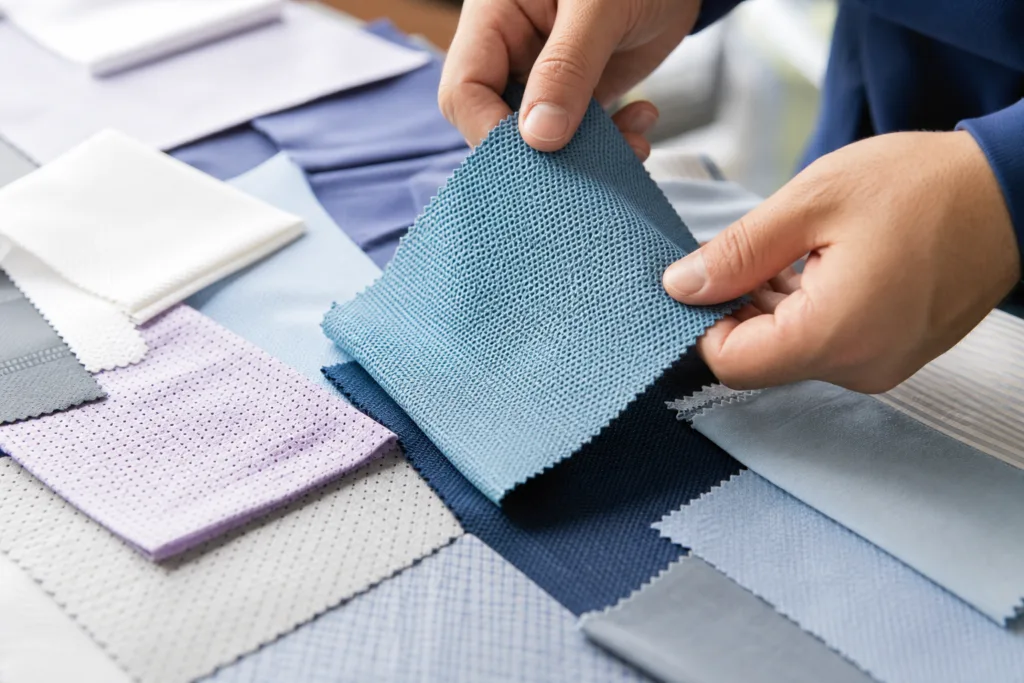
| Textured performance knit | Better airflow and visual depth | May affect logo decoration method and cost |
Moisture-wicking and breathability: fabric structure, finishing, and ventilation details
Buyers often use moisture-wicking as a general term, but manufacturers need a more precise brief. Wicking performance depends on the fiber content, yarn structure, knit construction, and any finishing applied after knitting. Two fabrics can feel similar in hand yet behave very differently when exposed to sweat and sun.
Breathability is also not the same as wicking. A fabric may move moisture reasonably well but still feel warm if the knit is too dense for the intended climate. Mesh-like structures, subtle texturing, or engineered ventilation panels can improve airflow, but they may also change opacity, decoration limits, and the shirt’s overall visual style.
At Ninghow Apparel, this is typically where buyer priorities need to become specific. A golf club ordering event polos may prefer a cleaner, more uniform face fabric, while a retail brand may accept a more technical texture if the performance benefit is obvious to the end customer.
Questions worth asking a supplier
- Is the fabric naturally moisture-managing, or does it rely mainly on finishing?
- Will the surface texture affect embroidery or heat-applied logos?
- How does the fabric feel after repeated washing?
- Is the chosen knit better suited to humid weather, dry heat, or mixed use?
Is UV protection necessary for golf apparel? When it matters and how to specify it
UV protection is not mandatory for every golf polo project, but it becomes more relevant when the shirts are intended for prolonged outdoor wear, warm-weather play, junior programs, resort merchandise, or performance-focused retail. In those use cases, buyers may want the fabric spec to include a clear UV-related requirement instead of assuming it comes automatically with any synthetic knit.
From a sourcing standpoint, the practical step is to decide whether UV performance is a core selling feature or simply a supporting benefit. If it is core, ask for that requirement during fabric selection and sample review, not after style approval. Late changes can force a fabric swap, affect color continuity, or delay bulk production.
Collar construction: stability, comfort, and appearance in outdoor play
The collar is one of the fastest ways a golf polo can start looking tired. In outdoor play, exposure to sweat, washing, sunlight, and repeated wear can make a weak collar roll, twist, or lose edge definition. That affects not only appearance but also comfort around the neck.
Collar performance depends on the knit structure, interlining choice if used, collar point proportion, and the relationship between collar weight and body fabric. A collar that is too soft can collapse; one that is too rigid may feel formal and uncomfortable in heat. Buyers comparing suppliers should review how polo collars hold shape outdoors because collar quality is often where low-cost shortcuts become visible first.
Useful collar checks during development
- Lay the collar flat after washing to see whether the points stay balanced.
- Check how the collar sits when the top button is open.
- Compare collar recovery after packing and folding.
- Confirm the collar scale matches the target market, from club uniform to retail styling.
Hem length and tuck-in design: balancing movement, coverage, and dress code needs
Golf polos often need to work both tucked and untucked, depending on dress code, age group, and market positioning. A hem that is too short may pull free during a swing, while a hem that is too long can bunch unattractively or feel oversized on shorter wearers.
Manufacturers usually address this through front-back length balance, side vent design, curve shape, and grading logic across sizes. For clubs and tournaments, a slightly longer back hem often improves coverage and keeps the shirt more stable during play. For retail brands targeting casual crossover wear, the hem may need a more flexible appearance off the course.
Logo placement on golf polos: performance impact, visibility, and decoration limits
Branding on golf polos has to work with movement and comfort, not just visibility. A chest logo that is too large or dense can stiffen the fabric in a high-motion area. A sleeve logo may look clean in a mockup but distort if placed too close to the armhole or on a highly stretchy panel.
Decoration choices should be reviewed alongside garment construction. Embroidery, print, transfer, and patch methods all interact differently with knit stretch, drape, and recovery. Buyers developing sponsor, club, or retail programs should think carefully about logo placement on embroidered polo shirts so branding remains visible without creating discomfort or puckering.
Common logo zones include the left chest, sleeve, upper back, and placket-adjacent positions, but each has limits. If the shirt uses textured knits or lightweight performance fabric, decoration testing becomes even more important before bulk approval.
Recommended customization priorities for golf clubs, tournaments, and retail brands
Different buyers should not prioritize the same details in the same order. A club ordering member polos may value dress-code compliance, crest visibility, and easy reordering. A tournament buyer may care more about broad size coverage, event timelines, and stable logo execution. A retail golf brand is more likely to focus on fabric hand feel, fit identity, and product differentiation.
That is why a good development brief separates must-haves from nice-to-haves. In many cases, the most important custom priorities are fabric behavior, fit consistency, collar quality, decoration compatibility, and color continuity. Once those are stable, additional styling details become easier to manage without adding avoidable production risk.
How to evaluate a golf polo shirt manufacturer for performance-focused production
A supplier may offer custom polos, but that does not automatically mean they can develop a golf polo that performs well across fit sets, wash cycles, and repeat orders. Buyers should evaluate whether the manufacturer asks the right technical questions: intended wearer, climate, logo method, target price, expected hand feel, and whether the shirt is meant for tournament uniforms, pro shop merchandise, or a private label retail line.
It is also useful to review how the supplier handles sampling, fabric recommendation, tolerance control, and size grading. A capable manufacturer should be able to explain why a certain knit, collar construction, or hem shape is appropriate for the project instead of simply accepting any request without challenge.
From a practical sourcing standpoint, the strongest partner is usually the one that connects performance expectations to development decisions early. That includes identifying when a logo treatment may limit stretch, when a fabric texture may complicate decoration, or when a club’s reorder needs call for simpler, more repeatable specifications.
Conclusion
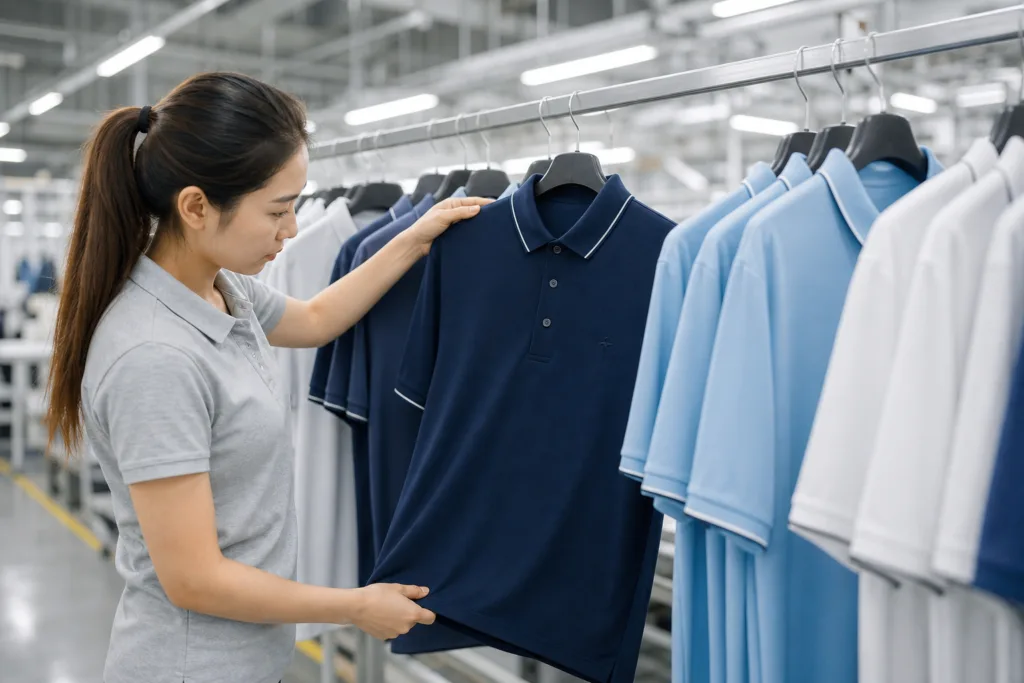
Golf polos succeed when movement, climate comfort, presentation, and branding all work together. For buyers, the key is to treat the polo as performance apparel with uniform and merchandising requirements layered on top. That shifts supplier evaluation away from simple price comparison and toward pattern quality, fabric suitability, collar stability, and production consistency.
The more clearly these details are defined during sourcing and sample development, the easier it becomes to approve a shirt that feels right on the course and remains dependable in repeat production.
FAQ
What makes a golf polo different from a regular polo?
A golf polo is usually developed with more attention to shoulder movement, moisture control, collar stability, and hem coverage so it performs better during active outdoor wear.
How much stretch should a golf polo shirt have?
The right amount depends on fit and fabric structure, but buyers should look for enough stretch to support a full swing without creating a clingy feel or poor recovery after wear.
Do all golf polos need UV protection?
No, but it matters more for products intended for long outdoor use, warm climates, junior programs, or performance-focused retail positioning.
Is embroidery always suitable for golf polo logos?
Not always, because dense embroidery can stiffen lightweight or stretchy fabric, so the logo size, placement, and fabric type should be reviewed together.
Why is collar construction so important in golf polos?
The collar is highly visible during wear, and weak construction can lead to rolling, twisting, or loss of shape after washing and outdoor use.
What should buyers ask a golf polo shirt manufacturer during sampling?
Buyers should ask about fabric behavior, pattern support for swing movement, collar and placket construction, decoration limits, grading logic, and how the supplier checks consistency before bulk production.