
T-shirt side seam twisting is the visible rotation of a garment body after sewing, washing, or wearing. Instead of remaining vertically aligned, the side seam moves toward the front or back, the hem becomes skewed, and the shirt appears to torque around the body. For custom apparel buyers, the defect matters because it can affect fit, print alignment, perceived quality, and customer returns.
The right way to manage the risk is to treat twisting as a production-control issue rather than a sewing fault alone. Custom t-shirt manufacturing support can help buyers connect fabric selection, pattern engineering, sample testing, and bulk inspection into one control plan. That broader view is useful because a shirt may look acceptable before washing and still show significant seam rotation after relaxation or laundering.
What T-Shirt Twisting, Skewing, and Garment Torque Actually Mean
These terms describe related but slightly different conditions. Side-seam twisting is the rotation of a seam away from its intended position. Skewing is the diagonal distortion of knitted courses or wales across the fabric panel. Garment torque is the overall tendency of the finished shirt to rotate because different parts of the fabric or construction release tension unevenly.
A shirt can have more than one problem at the same time. For example, fabric skew may cause the side seam to move forward, while an uneven hem or an incorrectly balanced pattern makes the garment look even more distorted. A useful inspection starts by separating the fabric condition from the sewing and pattern condition.
- Side-seam rotation: the seam no longer follows the intended side-body line.
- Hem skew: the bottom edge slopes or shifts when the shirt is laid flat.
- Fabric skew: knitted courses or printed artwork run diagonally instead of perpendicular to the garment edge.
- Garment torque: the complete body rotates or spirals after tension is released.
Why Side-Seam Rotation Often Shows Up After Washing
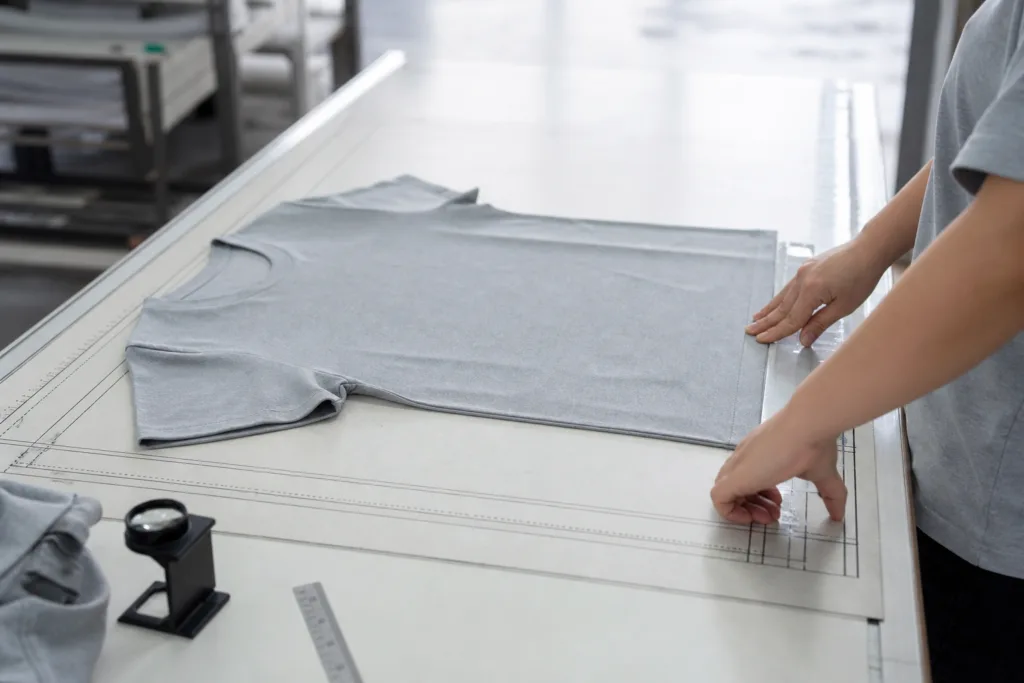
Washing exposes stresses that may remain hidden in a newly finished garment. Knitted fabric contains loops, yarn tension, moisture history, and mechanical distortion from finishing. When the shirt is wetted, agitated, dried, and relaxed, those forces can change. If the front and back panels do not recover evenly, the side seam can migrate.
Heat and tumble action can make the movement more visible, but washing does not necessarily create the original defect. It often reveals an imbalance that was already present in the fabric or garment. This is why a pre-wash inspection alone is insufficient for fabrics and constructions with known torque risk.
Wash testing should use a defined method and comparable conditions. The buyer and supplier should agree on fabric composition, wash temperature, drying method, measurement points, and the time allowed for the garment to rest before evaluation. A casual home wash can provide a warning, but it is not a reliable replacement for an agreed inspection method.
Main Manufacturing Causes
Fabric knitting direction
During knitting and finishing, yarn tension can cause the fabric structure to lean. If the fabric is cut while the courses are skewed, the panels may carry that distortion into the garment. The side seam can then appear rotated even when the sewing operation is consistent.
Cutting accuracy
Cutting cannot correct fabric that has been laid with excessive skew or insufficient relaxation. Panel grain, notches, side-body shape, and matching points must be controlled. A small angular error in both front and back panels can become obvious when the panels are sewn together.
Relaxation time
Fabric may change dimension after it is unrolled from a roll or exposed to steam and moisture. Cutting immediately after spreading can produce panels that later contract or rotate. The appropriate relaxation period depends on the fabric, finishing route, roll condition, and factory process, so it should be confirmed during development rather than assumed.
Sewing tension and handling
Excessive differential feed, uneven thread tension, incorrect presser-foot pressure, or aggressive handling can stretch one side of a seam. A seam that is technically closed may still pull the body off balance. Operators and inspectors should look for puckering, wavy seams, uneven stitch density, and different seam lengths as clues.
How Fabric Structure and Yarn Behavior Affect T-Shirt Skewing
Single jersey is comfortable and efficient for T-shirts, but its looped structure can be sensitive to yarn twist, knitting tension, finishing, and fabric weight. Fiber type also influences recovery and dimensional change. Cotton, blends, and synthetic-rich fabrics may respond differently to moisture, heat, and mechanical finishing.
Higher stretch does not automatically mean higher twisting risk, and heavier fabric does not automatically eliminate it. The important question is whether the fabric remains dimensionally balanced after relaxation and the intended wash process. Buyers should evaluate the actual fabric lot or approved bulk standard, not only a composition label or a supplier’s generic swatch.
Artwork can make skew easier to see. Horizontal stripes, engineered graphics, chest placement marks, and all-over prints provide visual reference lines that reveal small rotations. For plain garments, use the side seam, hem, sleeve opening, and center-front or center-back line as reference points during inspection.
Are Tubular T-Shirts More Prone to Twisting Than Side-Seam Styles?
Tubular and side-seamed constructions distribute fabric and sewing variables differently. A tubular body has no sewn side seam, but the knitted tube can still rotate, causing the body, print, or hem to shift. A side-seamed shirt gives inspectors a clear reference line, yet it introduces panel matching, seam allowance, and sewing-tension variables.
Construction alone does not determine the outcome. Fabric balance, pattern shape, spreading, cutting, finishing, and wash behavior all matter. Buyers comparing construction options should understand the practical differences in side-seamed vs tubular T-shirts before selecting a style for a private label or custom program.
For a design with side graphics, precise side placement, or strong expectations for repeatable fit, the construction should be judged together with the artwork and measurement specification. A low-risk decision for one blank-style program may not be suitable for a fashion-fit garment with complex panels.
How to Measure Twisting and Skewing in QC
Inspection should begin with the garment washed or conditioned according to the agreed test method, then rested on a flat surface without stretching. Align the center front and center back, smooth the garment naturally, and record where each side seam falls relative to the intended side-body position.
| Inspection point | Practical method | What it can reveal |
|---|---|---|
| Side seam | Lay the shirt flat and compare the seam with the underarm and hem reference | Rotation, uneven panel shape, or sewing imbalance |
| Hem edge | Check whether the bottom edge remains level after the body is aligned | Panel skew, torque, or uneven hemming |
| Artwork or stripe | Compare horizontal and vertical elements with the garment center | Fabric skew and body rotation |
| Measurement points | Measure before and after washing using fixed points | Dimensional change that may amplify distortion |
Do not judge a twisted garment only while it is being held by the shoulders. Hanging can hide or exaggerate the condition. Flat inspection, worn evaluation, and post-wash comparison each provide different information.
Record direction as well as amount. If most garments rotate toward the same side, the issue may point to a fabric or pattern process. If rotation varies randomly, sewing handling, panel matching, or inconsistent cutting may deserve closer investigation. A broader garment quality defect checklist can help inspectors distinguish torque from related problems such as puckering, measurement failure, or uneven hems.
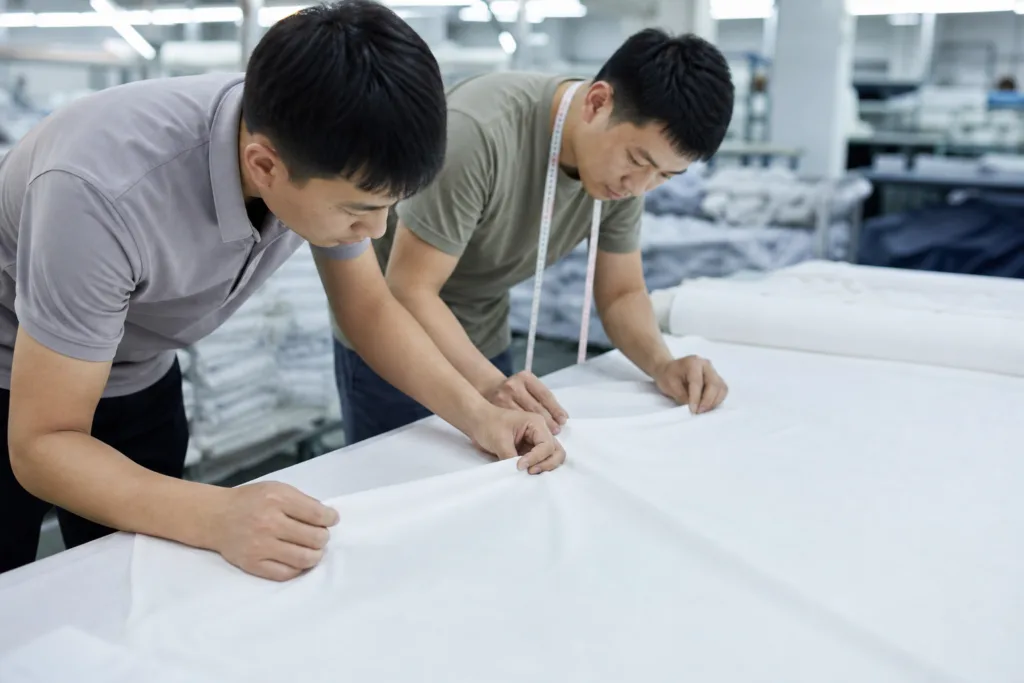
How to Spot Twisting Risk During the Sample Stage
The sample stage is the least expensive point at which to investigate torque. Ask for a sample made with the intended fabric, construction, trims, print method, and sewing details. A substitute fabric can be useful for an early silhouette review, but it cannot prove bulk dimensional stability.
Inspect the sample before and after the planned wash process. Check the side seam, hem, sleeve balance, neckline, artwork placement, and overall drape. Photograph the garment flat with the center line and side seams visible. These records make it easier to compare revisions and prevent a discussion from relying on memory.
Sample approval should include measurable comments. Instead of writing “avoid twisting,” specify the inspection condition, reference points, acceptable appearance, and action required if the result is outside the agreed limit. The apparel sample approval process should connect these observations to the approved construction and bulk-production standard.
Fabric Pre-Treatment, Relaxation, and Cutting Controls
Risk reduction begins before the fabric reaches the cutting table. Depending on the material and product requirements, controls may include fabric inspection on arrival, roll relaxation, conditioning, compacting, washing, or other agreed pre-treatment. The objective is to stabilize the fabric enough that the pattern can be cut against a representative state.
- Inspect fabric rolls for width variation, visible skew, barré, holes, and inconsistent finishing.
- Allow fabric to relax according to its behavior and the factory’s validated process.
- Check the spread for alignment, tension, end loss, and distortion between plies.
- Use pattern grainlines, notches, and matching points that make rotation easier to detect.
- Verify that cutting equipment and marker placement do not pull or distort the fabric.
- Keep approved fabric, pattern, and wash references available for production and inspection teams.
Pre-treatment is not a universal cure. It may reduce later movement, but it cannot compensate for unsuitable fabric, incorrect pattern balance, or poor sewing control. The correct process should be validated on development samples and then carried into the bulk specification.
Buyer Inspection Tips: Judging Whether Twisting Is Acceptable
Acceptability depends on the product brief, fabric behavior, visual effect, measurement tolerance, and customer expectation. A small shift may be less noticeable on a loose plain T-shirt than on a close-fitting striped style. That does not mean buyers should approve by appearance alone; the standard should be clear enough for different inspectors to reach similar conclusions.
Inspect representative pieces from different cartons, sizes, colorways, and production periods. Check both washed and unwashed states when the order is sensitive to dimensional change. A single flat sample can miss variation caused by different rolls, cutting bundles, or sewing operators.
Use a written tolerance that explains how the garment is positioned and measured. The phrase “minimal twisting” leaves too much room for interpretation. A practical apparel quality tolerance reference can help buyers define visual and dimensional limits without treating every minor variation as a production failure.
Reducing Twisting Risk Through Specification and Communication
Supplier communication is more effective when it describes the defect in observable terms. Include photographs, arrows showing the direction of rotation, measurements from fixed points, wash conditions, and the percentage of inspected pieces affected. State whether the concern is side-seam position, hem angle, print alignment, or all three.
Before bulk production, align on the fabric, construction, pattern version, seam allowance, stitch type, finishing route, wash test, and inspection method. Changes to fabric weight, yarn blend, body width, side-seam position, or print placement can alter the risk even when the product name stays the same.
At Ninghow Apparel, a manufacturer perspective means reviewing torque as a chain of connected variables: fabric behavior, pattern balance, cutting, sewing, finishing, and inspection. This approach helps a buyer decide whether to adjust the fabric, revise the pattern, change construction, add a process control, or accept a clearly defined residual variation.
Common Defects That Can Be Confused With Twisting
Not every uneven-looking T-shirt has side-seam rotation. Separate diagnosis prevents the wrong corrective action.
- Uneven hem: the bottom edge is sewn at different heights even when the side seam is correctly positioned.
- Wavy seam: stretching during overlock or coverstitching creates ripples without rotating the entire body.
- Pattern imbalance: front and back panels have different lengths, widths, or armhole shapes.
- Uneven shrinkage: one area changes more than another after washing, producing a distorted silhouette.
- Print or embroidery misplacement: the decoration is off-center while the garment body remains balanced.
- Neckline or shoulder distortion: handling or stabilizer issues affect the upper body and can make the shirt appear twisted.
Inspect the garment from several reference points before assigning a root cause. A side seam that moves but a level hem may suggest a different issue from a shirt whose seam, artwork, and hem all rotate together.
A Simple Buyer Checklist for Preventing Side-Seam Rotation
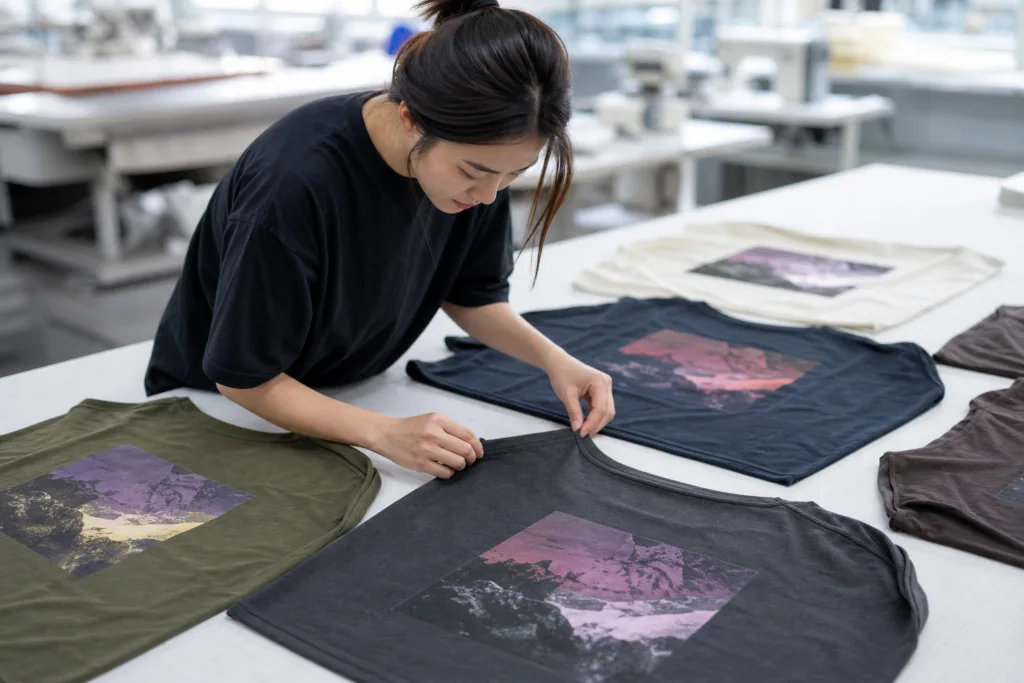
- Confirm fabric composition, weight, structure, finish, and approved bulk source.
- Review fabric skew and dimensional stability before pattern cutting.
- Allow sufficient relaxation time and document the process.
- Approve the actual construction and intended fabric, not only a visual prototype.
- Wash-test samples using agreed conditions before bulk approval.
- Record side-seam, hem, artwork, and center-line references in the inspection standard.
- Define acceptable visual and dimensional tolerances in writing.
- Inspect pieces from multiple rolls, sizes, colors, and cartons.
- Use photographs and measurements when reporting a defect to the supplier.
- Investigate fabric, cutting, sewing, finishing, and pattern causes together.
Preventing t-shirt side seam twisting is mainly a matter of controlling fabric state, garment geometry, and verification timing. When buyers check the risk during sampling, define the measurement method, and communicate the approved standard clearly, they give the production team a workable basis for reducing torque and making consistent decisions in bulk.
Frequently Asked Questions
What causes t-shirt side seam twisting?
T-shirt side seam twisting can result from fabric skew, yarn and knitting tension, insufficient relaxation, inaccurate cutting, uneven sewing tension, pattern imbalance, or dimensional changes during washing. Several causes may occur together, so the garment should be inspected from fabric through finishing.
Can washing permanently fix or remove side-seam twisting?
Washing usually does not fix twisting; it often reveals or increases movement that was already present. A controlled wash test can show the likely final condition, but correcting the root cause normally requires changes to fabric control, relaxation, cutting, pattern balance, sewing, or finishing.
Are tubular T-shirts always more likely to twist?
No. Tubular bodies and side-seamed bodies carry different risks. Tubular shirts can rotate because the knitted tube or artwork shifts, while side-seamed shirts can show panel, cutting, or sewing imbalance. Fabric behavior and process control are more important than construction type alone.
How should buyers measure T-shirt twisting?
Lay the garment flat after the agreed wash or conditioning method, align the center front and back without stretching, and compare the side seam, hem, artwork, and other fixed reference points with the approved pattern. Record both the direction and amount of rotation.
When should twisting be checked during product development?
Check it during the sample stage and again during pre-production approval using the intended fabric, construction, decoration, and wash method. Recheck in bulk because different fabric rolls, cutting bundles, and sewing conditions can create variation that a single sample does not show.
What should a buyer include in a twisting-related quality specification?
The specification should identify the fabric and construction, inspection condition, garment positioning method, reference points, measurement procedure, acceptable tolerance, wash conditions, and corrective-action process. Photos showing acceptable and unacceptable examples can make the standard easier to apply consistently.