
Hoodie print durability is one of the most common problem areas in decorated apparel programs because hoodies put more stress on prints than many buyers expect. Heavier fabrics, brushed surfaces, stretch during wear, thicker seams, and repeated washing can all change how a print behaves once a sample moves into bulk production.
For buyers comparing decoration methods or reviewing development samples, it helps to assess print performance in the same context as garment construction and end use. If you are planning a custom fleece or streetwear program, this hoodie print durability guidance for custom production fits naturally into the wider decisions around fabric selection, print method, and production control. A durable print is rarely the result of ink choice alone; it usually comes from the right match between fabric, artwork, curing, and realistic testing standards.
Why hoodie prints are harder to control than T-shirt prints
Hoodies create a tougher environment for print durability than lightweight jerseys. The fabric is usually thicker, the surface may be brushed or uneven, and the garment often stretches and rebounds more aggressively during wear. That means a print that looks acceptable on a flat sample table can still crack, distort, or lose adhesion after washing and use.
Large front graphics also behave differently on hoodies because the print often sits across a chest panel that flexes, folds, and rubs more than buyers assume. Add thicker ink deposits, puff effects, or dense solids, and the durability risk rises quickly if testing is not done early.
How fabric construction affects hoodie print durability
Fleece and brushed surfaces
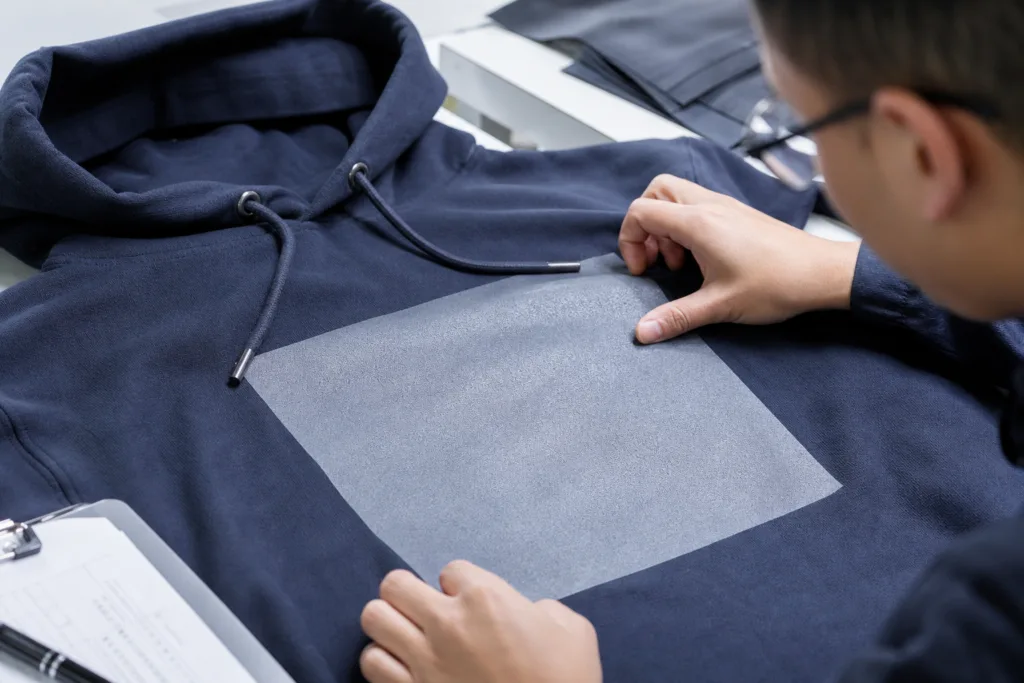
Brushed interiors and some soft-touch face finishes can influence how stable the print base really is. If the outer surface has loose fibers, uneven texture, or poor dimensional stability, the print film may not sit as consistently as it would on a smoother fabric.
Thickness and heat behavior
Hoodie fabrics do not always heat evenly during printing and curing. Thicker materials may require tighter process control because the surface temperature, dwell time, and actual ink cure can vary across garment panels. A print that is under-cured in only part of the design may pass visual inspection and still fail after a few wash cycles.
Stretch and recovery
Cotton-rich fleece, poly-cotton blends, and fabrics with elastane content all move differently. If the garment stretches but the print film cannot recover with it, cracking becomes more likely. This is one reason buyers should pair print evaluation with testing hoodie fabric quality before bulk production, since surface stability and fabric behavior often affect the final print result as much as the print process itself.
Common hoodie print failures buyers should recognize
Cracking
Cracking usually appears when the ink film is too rigid for the garment movement, when cure is not balanced, or when thick solids are printed on a surface that stretches repeatedly. Fine hairline cracks may be acceptable in some vintage aesthetics, but uncontrolled cracking on a standard commercial hoodie is usually a failure sign.
Peeling and adhesion loss
Peeling often starts at corners, edges, or dense graphic sections. It may come from poor adhesion, contamination on the fabric surface, incompatible underbase choices, or wash stress exposing a weak bond. Buyers should look closely at print edges rather than only reviewing the center of the graphic.
Sticking and blocking
Some prints feel dry on first inspection but become tacky when folded, stacked, or exposed to heat after packing. This can cause surfaces to stick together, mark adjacent fabric, or pull at raised print layers. The risk is higher with thick inks, special effects, and incomplete curing.
Puff print collapse
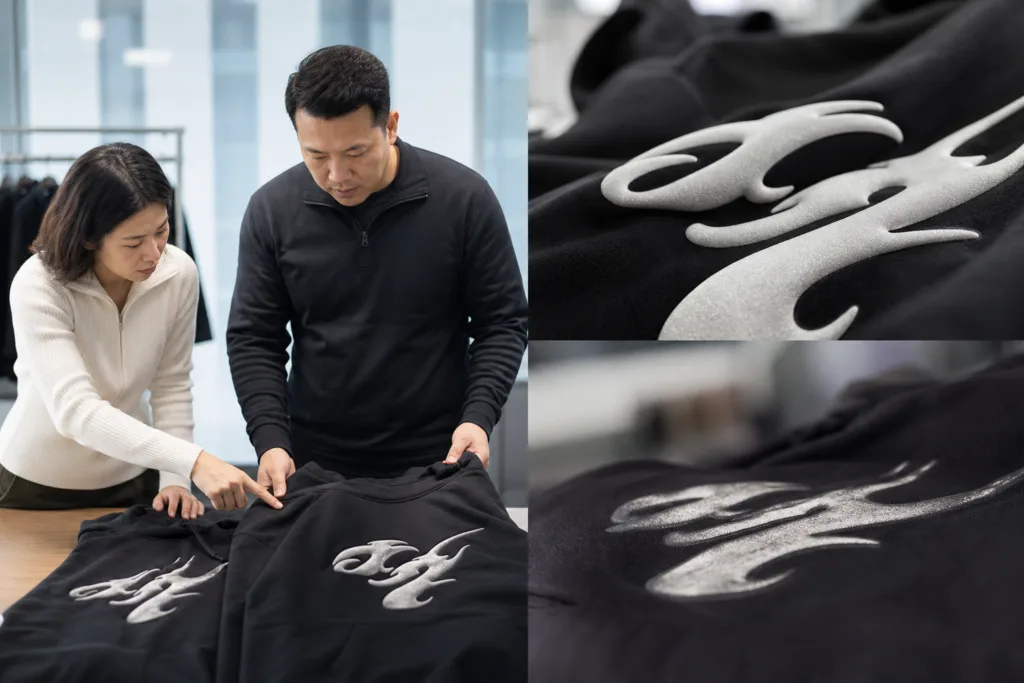
Puff print can look strong at sample review and then flatten after washing if the ink build, expansion behavior, or curing balance is off. A puff effect is not only about initial height. It must hold enough structure after wash and wear to stay visually intentional rather than looking deflated or inconsistent.
Why puff print needs stricter evaluation
Puff print on hoodies is especially sensitive because the garment base is heavier and more mobile than a basic tee. If the ink deposit is too low, the effect may be weak. If it is too high or uneven, the print may crack, collapse, or feel brittle after curing and washing.
From a manufacturer perspective, puff print quality depends on four linked factors: controlled ink build, stable fabric behavior, proper curing, and realistic wash testing. At Ninghow Apparel, this is why puff print approval should never rely on visual appearance alone. The sample needs to be checked after handling, wash exposure, and light stretching so the buyer can judge whether the raised effect is stable enough for bulk production.
Key durability tests for hoodies
Wash test
The wash test is the most important practical check because many print failures only appear after laundering. Test the hoodie under the care method expected for actual customers, then inspect cracking, peeling, edge lifting, surface roughness, tackiness, color change, and puff height retention. One wash is useful for screening, but multiple cycles give a better view of whether the print is production-ready.
Stretch test
Lightly stretch the printed area by hand in multiple directions, especially across the widest part of the graphic. This helps reveal whether the print film is too rigid for the fabric movement. The goal is not to force garment damage, but to simulate normal wear stress and identify early crack lines or poor recovery.
Abrasion test
Rub the print surface with consistent pressure using a clean soft cloth or a controlled internal method. This can expose weak surface cure, excessive tackiness, poor bonding, or premature wear on raised effects. Abrasion matters on hoodies because chest prints frequently contact bags, jackets, desks, and repeated arm movement.
Peel and edge adhesion checks
Examine corners, fine lines, and edges after washing and cooling. These areas tend to fail first. A print may appear stable from a front view but still show early adhesion loss where the ink film transitions into the fabric surface.
These tests become more reliable when they are built into the apparel sample approval process instead of being left to final production review. Testing after the sample stage gives buyers time to change the print method, adjust artwork density, or revise quality standards before the order becomes expensive to correct.
How to identify the real cause of failure
When hoodie print durability fails, the visible defect is not always the root cause. Buyers should separate the symptom from the process problem.
- Cracking after stretch: often linked to rigid ink film, excessive deposit, poor cure balance, or fabric stretch beyond the print system’s tolerance.
- Peeling at edges: often linked to adhesion weakness, surface contamination, under-cure, or unsuitable application method.
- Puff collapse after wash: often linked to unstable ink expansion, poor cure control, or fabric movement flattening the structure.
- Surface sticking: often linked to incomplete cure or excessive ink build.
- Uneven durability across pieces: often linked to inconsistent print application, temperature variation, or unstable garment panels.
For bulk orders, one useful step is to compare approved samples with early production pieces through TOP sample checks before bulk print approval. That comparison helps determine whether the failure is built into the approved construction or introduced by production inconsistency.
Durability risks in large-area prints and thick ink layers
The more ink coverage a hoodie carries, the greater the chance of durability problems. Large solid blocks across the chest can reduce flexibility, trap stress during folding, and create hard edges that begin to crack after wear. Heavy prints may also feel acceptable in a showroom but become uncomfortable or unstable after repeated washing.
Thick ink layers can be necessary for some effects, especially puff or specialty finishes, but they need disciplined control. Buyers should ask whether the artwork can be adjusted to reduce unnecessary solid mass, improve flexibility, or separate decorative impact from high-risk construction choices.
How to approve print quality at the sample stage
Sample approval should not stop at color and placement. Buyers should review the print on the actual hoodie fabric, test it after washing, check stretch behavior, and define what is acceptable versus unacceptable before confirming production.
A practical sample approval routine usually includes:
- visual inspection before wash
- care-label-based wash testing
- post-wash review of cracking, lifting, hand feel, and puff retention
- light stretch assessment
- edge and corner inspection
- comparison with artwork intent and brand quality level
This is also the stage for setting apparel quality tolerance for print durability. If a buyer does not define acceptable crack level, texture change, or puff height variation during sampling, disputes become much harder to resolve once bulk goods are finished.
Bulk production QC checklist for hoodie print durability
After sample approval, print durability still needs production control. A useful QC checklist for hoodies should include:
- fabric lot consistency and surface condition
- approved artwork version and print placement confirmation
- ink type and print method matching the approved sample
- curing process control and line consistency
- random wash checks during production when needed
- inspection of print edges, tackiness, cracking, and raised-effect uniformity
- review of packing method if thick or puff prints may stick in bulk cartons
Buyers should not assume a passed development sample guarantees passed bulk performance. Production variation in fabric, temperature, pressure, and handling can change the final result if controls are too loose.
How to write durability standards into the PO, tech pack, or production agreement
Clear written standards reduce misunderstanding. Instead of using vague wording like “good print quality,” define the expected test method and acceptance result in plain commercial language.
Useful points to include are:
- print method or approved equivalent
- approved fabric reference
- wash test basis and number of cycles
- acceptable cracking level after test
- no peeling, no major edge lifting, or no blocking after cooling and folding
- puff effect retention expectation where relevant
- approval reference sample for comparison
When these points are tied to the PO and tech pack, both buyer and factory have a clearer standard for execution and inspection.
Questions buyers should ask before confirming hoodie printing
- Is this print method suitable for the exact hoodie fabric and GSM?
- How will you test cracking and wash resistance before bulk production?
- What is the risk level for large solid areas or thick puff sections?
- Will the approved sample and bulk order use the same fabric, print process, and curing conditions?
- What failure signs would make you recommend changing artwork or print method?
- How will top-of-production pieces be checked against the approved sample?
These questions help move the discussion from decoration preference to production reliability. That shift is often what prevents costly rework, claim disputes, and inconsistent bulk outcomes.
Conclusion
Hoodie print durability depends on the interaction between fabric construction, print method, ink build, curing control, and realistic testing. Buyers who only approve appearance often miss the early warning signs of cracking, peeling, sticking, or puff collapse.
The safer approach is to test the print on the actual hoodie, define acceptable failure limits during sampling, and carry those standards into top-of-production and bulk QC. In most cases, better durability decisions come from clearer approval logic rather than from choosing the most complex print effect.
FAQ
How many wash tests should a hoodie print sample go through?
At minimum, a sample should be checked after one realistic wash cycle, but multiple cycles are better when the print is large, thick, or includes puff effects because some failures appear only after repeated laundering.
Is slight cracking always a print defect?
Not always, because some vintage or distressed looks may allow controlled surface cracking, but for standard commercial hoodies any cracking should be defined in advance and reviewed against the approved sample.
Why does puff print look good before wash but flatten later?
Puff print can collapse after washing if the ink build, curing balance, or fabric movement is not stable enough to hold the raised structure through laundering and wear.
What area of a hoodie print usually fails first?
Edges, corners, and dense solid sections often fail first because they carry more stress during folding, stretching, washing, and rubbing than the center of the print.
Should buyers test print durability on the actual hoodie fabric?
Yes, because a print result on a different fabric or test panel may not reflect how the final hoodie surface, thickness, stretch, and brushing affect adhesion and crack resistance.
What is the best way to reduce bulk print failure risk?
Approve a washed sample on the final fabric, define clear acceptance standards in the tech pack or PO, and compare top-of-production pieces against the approved reference before full bulk output continues.