
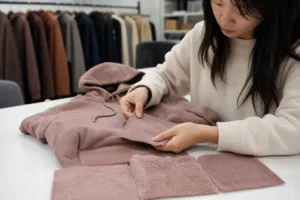
Hoodie fabric can look stable when it is fresh off the roll, but performance problems often appear only after washing, drying, brushing, packing, and repeated wear. For buyers, that is why fabric approval should never rely on hand-feel alone. When evaluating hoodie fabric pilling, shedding, and shrinkage risk, the practical goal is to test whether the fleece can stay commercially acceptable through development and bulk production, not just whether the sample looks good on day one.
That is especially important when working with brushed fleece, cotton-poly blends, or soft-touch interiors that are designed for comfort but may react differently once the garment is laundered. If your project involves private label hoodies, working with an experienced hoodie manufacturer can help you review fabric structure, finishing, and wash-performance expectations before bulk commitments are made. The key is to move from appearance-based approval to test-based approval early enough to prevent avoidable production risk.
Why hoodie fabric problems often appear after washing and wear
Many hoodie issues are hidden during initial sample review because fresh fleece surfaces are clean, full, and visually even. After washing, tumble friction, body abrasion, and repeated contact with bags or outerwear, weak surface fibers start to loosen. That is when pilling, lint release, surface roughness, and dimensional change become easier to detect.
In manufacturing, this matters because a hoodie can pass a first visual inspection but still fail in real use. A buyer may approve color, shape, and softness, only to find that the garment sheds heavily in the first wash or shrinks beyond the expected measurement tolerance. Testing must therefore simulate actual use conditions closely enough to reveal delayed fabric behavior.
What hoodie fabric pilling means and why fleece hoodies are especially vulnerable
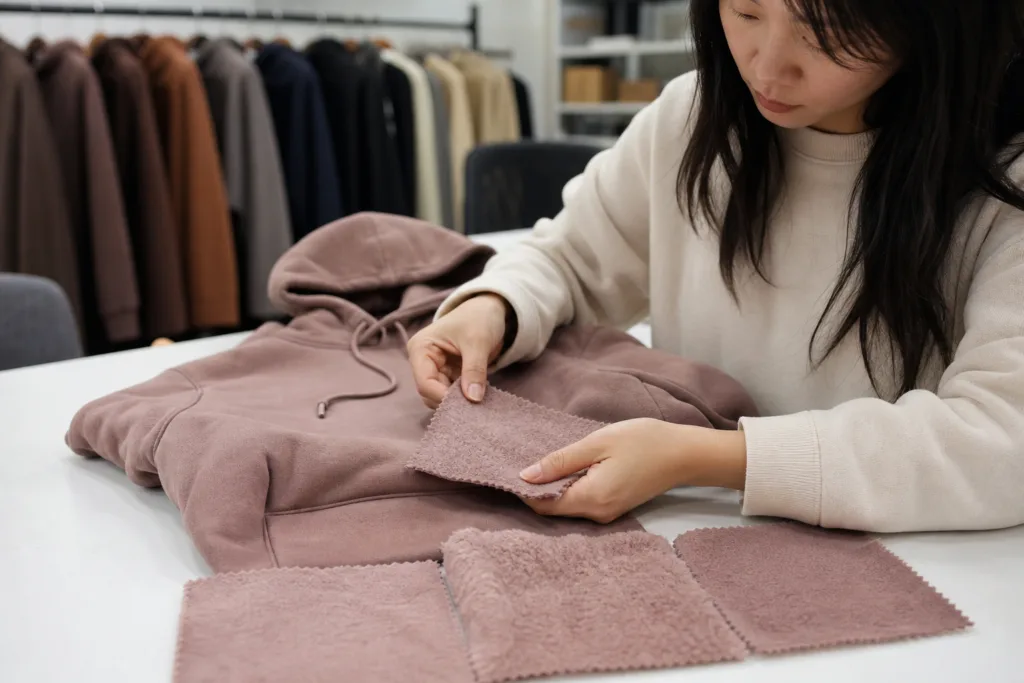
Hoodie fabric pilling refers to the formation of small fiber balls on the fabric surface after friction. Fleece hoodies are more vulnerable than many flat-face fabrics because the brushed or raised surface contains loose fiber ends. When these fibers are pulled upward and twisted together through abrasion, pills become visible on high-contact areas such as cuffs, side seams, pockets, underarms, and the body front.
Pilling risk is not limited to cheap fabric. Even soft and premium-looking fleece can pill if the fiber blend, yarn strength, brushing depth, and finishing process are not matched properly to the garment use case. A fashion hoodie with a very soft hand-feel may be more sensitive than a denser teamwear hoodie intended for frequent washing.
Main causes of pilling: fiber type, yarn construction, fabric surface, and abrasion
Fiber type and blend behavior
Different fibers behave differently under abrasion. Polyester adds durability, but when pills form, they can remain attached to the surface longer because the fibers are strong. Cotton may break away more easily, yet a cotton-rich brushed surface can still fuzz significantly if the yarn quality is inconsistent. Blends must be judged not only by softness and cost, but by how they react after repeated wear cycles.
Yarn construction quality
Lower yarn quality, uneven spinning, and weak twist can leave more loose ends on the fabric surface. Those loose ends are the raw material for pilling. Compact, cleaner yarns generally give better stability, while overly hairy yarns increase the chance of fuzzing and visual wear.
Fabric surface and brushing intensity
Brushing improves warmth and comfort, but aggressive brushing can raise too many fibers to the surface. If that raised layer is not controlled well, the hoodie may feel excellent in sampling and then perform poorly after laundering. This is one reason sample testing needs to compare pre-wash and post-wash appearance side by side rather than relying only on a single approval sample.
In development reviews, buyers often connect weight with quality, but weight alone is not enough. Understanding how GSM affects garment performance helps put pilling risk into better context, because a heavier fleece can still pill if surface construction and finishing are unstable, while a lighter fabric may perform acceptably if yarn and finishing are controlled properly.
Abrasion in actual use
The most realistic pilling assessment considers where the hoodie will be worn. Everyday casual hoodies face backpack rubbing, office chair contact, and repeated sleeve friction. Uniform, campus, or promotional programs may add frequent laundering and rougher handling. A fabric that performs adequately in one channel may not be suitable in another.
Shedding and lint loss: how fleece quality and brushing affect performance
Shedding is related to pilling but should be evaluated separately. A hoodie may not show obvious pills at first, yet still release excessive lint from the inner fleece. This often appears during wear as fiber transfer onto base layers, or during washing as visible lint accumulation inside the machine or on darker companion garments.
Common causes include shallow fiber anchoring, overly aggressive brushing, loose internal fleece structure, poor singeing or finishing control, and unstable fiber blends. Black, navy, and other dark shades often make lint transfer easier to notice, so color choice can affect how serious the problem appears to the end customer.
A practical way to check shedding is to compare three stages: fresh sample, washed sample, and rubbed sample. Use a dark contrasting fabric or lint-sensitive surface, rub the hoodie interior several times with moderate pressure, then inspect for visible transfer. This is not a lab-grade test on its own, but it is a useful buyer-level screening method before moving deeper into approval.
Hoodie shrinkage test methods: washing, drying, and measuring dimensional change
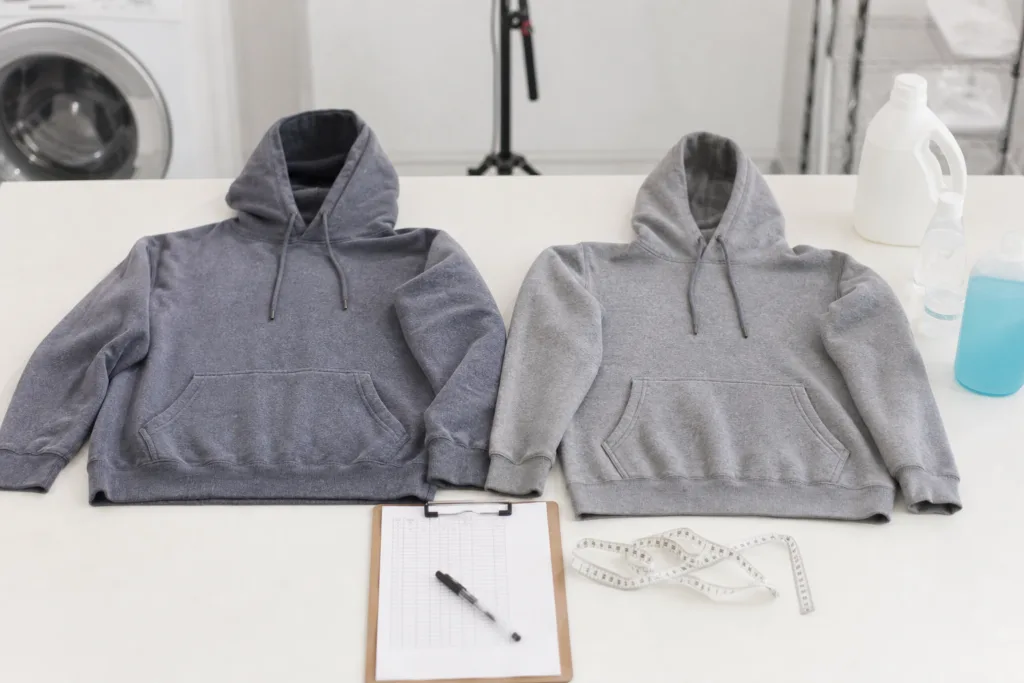
Shrinkage should always be tested using a defined method before bulk production. The basic process is simple: mark measurement points, record original dimensions, wash and dry under the intended care conditions, let the garment relax, then remeasure the same points. Key areas usually include body length, chest width, sleeve length, rib openings, and hood dimensions if shape retention is important.
When teams need a clearer framework for recording results, it helps to review how shrinkage testing is documented before bulk production because the same discipline applies to hoodies: consistent measuring points, repeatable care conditions, and side-by-side result comparison. Without that structure, two teams can wash the same sample and still reach different conclusions.
How to run a practical hoodie shrinkage check
- Measure the sample before wash on a flat surface.
- Record fabric composition, GSM, and finishing notes.
- Wash using the intended care method, not an arbitrary one.
- Dry using the expected consumer or commercial condition.
- Allow the garment to stabilize before final measurement.
- Calculate percentage change by measurement point.
Testing should reflect the actual product promise. If the hoodie care label will allow tumble drying, tumble drying must be included in approval testing. If the garment is sold as garment-washed or pre-shrunk, those claims should be supported by repeatable sample results, not assumptions.
How GSM, yarn quality, fiber content, and finishing processes influence performance
GSM and fabric density
Higher GSM can improve body, warmth, and perceived substance, but it does not automatically solve pilling or shrinkage. A dense heavyweight hoodie may still shed from the fleece side if the brushing process is too open. Conversely, a midweight fleece with tighter knitting and cleaner yarn can remain more stable over time.
Yarn quality and fiber length
Longer, cleaner fibers and better yarn consistency usually reduce loose surface hairiness. That improves the chance of a cleaner finish after washing. Lower-grade yarns may look acceptable at first yet produce more fuzz and pills after repeated abrasion.
Fiber content and blend trade-offs
Cotton-rich fabrics may appeal to brands looking for a natural hand-feel, while polyester blends often support shape retention and durability. But both directions involve trade-offs. Cotton can shrink more if finishing is not controlled. Polyester can hold pills more visibly once they form. The right balance depends on target price, softness expectations, and end-use frequency.
Finishing processes
Compacting, pre-shrinking, brushing, sueding, and heat-setting all influence final performance. These processes should be judged as a system rather than individually. At Ninghow Apparel, hoodie development decisions typically look at how material selection, finishing method, and wash expectations interact, because a soft hand-feel without stability is not a complete quality result.
What to test during the sample stage
The sample stage is where most preventable quality failures should be found. A buyer does not need every possible lab test for every hoodie program, but the core approval process should be strong enough to reveal commercial risk before fabric booking and bulk cutting.
Wash testing
Wash at least one sample under the intended care condition and compare it against the unwashed control. Review shrinkage, color appearance, fleece texture, seam distortion, rib recovery, and print or embroidery interaction if applicable.
Abrasion and pilling checks
Use repeat rubbing on high-contact zones such as cuffs, sleeve underarm, side body, and pocket edge. If formal testing is available, include a recognized pilling or abrasion method through a lab. If not, basic controlled rubbing plus wash comparison can still identify obvious risk patterns.
Hand-feel change
A fabric can become harsher, thinner, flatter, or excessively fuzzy after washing. These changes matter because customer complaints often begin with “it doesn’t feel the same anymore.” Teams should document pre-wash and post-wash hand-feel with notes and photos, not memory alone.
Appearance comparison
Lay washed and unwashed garments side by side under consistent lighting. Check surface fuzz, lint release, spirality, skew, shade change, and shape retention. This should be a formal step in the apparel sample approval process, especially for brushed fleece programs where visual changes are easier to miss during informal review.
How to define acceptable performance ranges before bulk production
Many sourcing delays happen because buyers and factories agree to “good quality” in general terms but do not define what that means for pilling, shedding, and shrinkage. Approval is stronger when both sides set acceptable ranges before production starts.
That usually means confirming expected wash result, maximum dimensional change, acceptable surface change, and whether minor lint release is commercially acceptable or considered a defect. These standards should match product positioning. A premium private label hoodie and a price-sensitive promotional hoodie may require different thresholds.
It also helps to align test results with agreed apparel quality tolerance standards so decisions are made against documented expectations rather than subjective opinion. This reduces avoidable disputes during PP sample review, inline inspection, and final shipment approval.
A pre-production fabric approval checklist for hoodie buyers and sourcing teams
- Confirm exact fiber content and intended GSM range.
- Record whether the face and back are brushed, sueded, compacted, or pre-shrunk.
- Review the hoodie after at least one controlled wash test.
- Measure body, sleeve, rib, and hood dimensions before and after wash.
- Compare unwashed and washed appearance under the same lighting.
- Check lint transfer on dark and light companion fabrics.
- Rub high-friction zones to screen for early pilling.
- Approve hand-feel after wash, not only before wash.
- Confirm acceptable performance ranges in writing.
- Use the approved sample as the reference for bulk production.
This checklist is most useful when it is completed before raw material commitment becomes difficult to change. Once bulk fabric is dyed, cut, or sewn, quality corrections are slower and more expensive.
How to reduce risk in production planning
The safest approach is to treat hoodie fabric approval as a process, not a single event. Start with material review, then sample testing, then revised sample confirmation if needed, then PP approval tied to the final fabric and finishing route. If the fabric mill, brushing level, or composition changes, the approval logic should be reopened rather than assumed unchanged.
For sourcing teams, the strongest control point is not the final inspection table. It is the stage where fabric behavior is still visible and still correctable. That means documenting wash method, measuring standards, comparison photos, and approval comments in a way production teams can follow consistently.
Conclusion

Hoodie buyers rarely face problems because fabric looked bad at the beginning. Problems usually happen because fleece looked good before it was tested realistically. To manage hoodie fabric pilling, shedding, and shrinkage risk, focus on repeatable wash checks, abrasion review, post-wash hand-feel, dimensional measurement, and written approval standards before bulk production starts.
When those controls are built into development, sourcing decisions become clearer. Buyers can compare fabric options more objectively, align expectations with suppliers earlier, and reduce the chance of expensive surprises after production is underway.
FAQ
How can I check hoodie fabric pilling before bulk production?
Wash one sample, keep one unwashed control, and compare high-friction areas after rubbing and laundering. This helps reveal whether the fleece surface becomes fuzzy or starts forming pills before bulk approval.
Why do some fleece hoodies shed so much lint?
Heavy shedding usually comes from loose surface fibers, aggressive brushing, weak fiber anchoring, or unstable finishing. The problem is often more visible after the first wash and on darker garments or layers worn underneath.
What shrinkage level is acceptable for hoodies?
There is no single universal number because acceptable shrinkage depends on product positioning, fabric type, and agreed quality standards. The important point is to define the acceptable range before bulk production and test against that agreed method.
Does higher GSM mean less pilling?
No. A heavier hoodie may feel more substantial, but pilling depends more on fiber blend, yarn quality, surface hairiness, and finishing control than on fabric weight alone.
Should I approve a hoodie sample before washing it?
You can review appearance and construction before washing, but final fabric approval should include at least one controlled wash test. Many fleece issues only become visible after laundering and handling.
What is the most important sample-stage control for fleece hoodies?
The most important control is side-by-side comparison of washed and unwashed samples using the same measurement points and review criteria. That gives buyers a clearer basis for approving fabric stability before production.