
Custom t-shirt packaging is not a small finishing detail. For apparel buyers, it affects presentation, carton efficiency, picking speed, retail readiness, return handling, and even how easily end customers understand size and style at first glance. The right setup depends less on decoration alone and more on where the shirts are going, how they will be handled, and what your team needs after production is complete.
That is why packaging decisions should be discussed at the same time as garment development, labeling, and packing method. Buyers evaluating custom T-shirt manufacturing and packaging support usually get better results when they align folding method, individual bagging, barcode placement, carton assortment, and brand presentation before bulk production starts. This reduces avoidable repacking, improves fulfillment flow, and helps the factory build a packaging plan that matches the final sales channel.
Why Custom T-Shirt Packaging Matters for Different Order Types
A T-shirt order for e-commerce needs a different packaging logic than an event giveaway or a retail store launch. E-commerce buyers often prioritize wrinkle control, clean presentation, and easy return processing. Retail buyers typically need SKU visibility, labeling accuracy, and shelf or hanger readiness. Event orders usually focus on quick distribution and simplified size sorting. Corporate programs often require department-level separation, employee name sorting, or split delivery to multiple locations.
From a manufacturing perspective, packaging should be treated as part of the product specification, not an afterthought. Packaging choices change material usage, packing labor, carton configuration, and inspection points. They can also affect MOQ flexibility when custom printed elements, branded inserts, or multiple SKU-specific labels are involved.
E-commerce Packaging: Wrinkle Control, Unboxing Experience, and Return Label Considerations
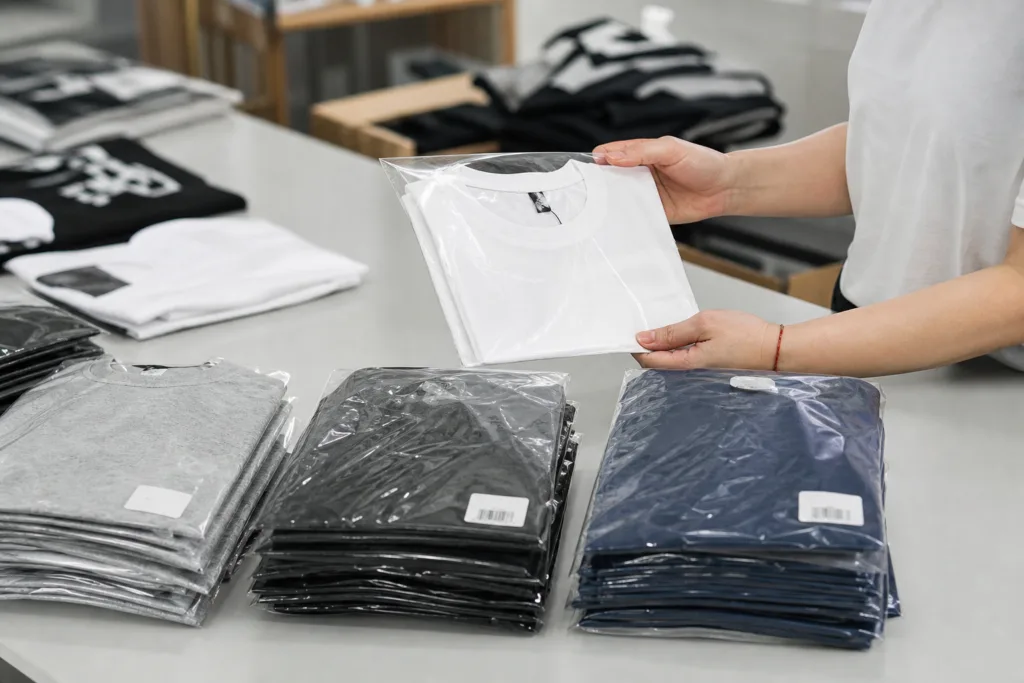
For e-commerce, custom t-shirt packaging should protect the garment while keeping unit cost and parcel weight under control. A typical setup may include a consistent fold, individual polybag or recyclable bag, size sticker, barcode, and branded insert if the order value supports it. The best option depends on whether the brand sells basics, premium fashion tees, promotional merchandise, or subscription-style products.
Wrinkle management matters because online customers judge product quality as soon as they open the package. Thin jersey T-shirts can shift in transit if folding is loose or bag size is too large. Better presentation often comes from matching the fold width to the bag dimensions and keeping the garment stable without excessive packaging material.
Brands building a private label T-shirt line planning process should define packaging early, especially if they want consistent branded inserts, neck label presentation, fold standards, and barcode placement across multiple styles. That creates a more repeatable fulfillment system once the assortment grows.
Return handling is another practical point. If your business expects exchanges or returns, use packaging that can be reopened or resealed without damaging the garment. If your fulfillment partner applies return labels later, leave a clear external area for that label and avoid decorative elements that interfere with scanning or address placement.
Retail Packaging: Hang Tags, Barcodes, Size Stickers, and Individual Polybags
Retail packaging needs to support display, receiving, and stockroom control. For many buyers, that means each T-shirt must arrive with a clear size sticker, scannable barcode, correct hang tag attachment, and neat folding or hanger presentation depending on the selling format. In some retail programs, individual polybags remain necessary for transport protection even if the garments are removed before floor placement.
Accuracy is critical because retail teams often receive many SKUs at once. Incorrect barcode mapping or inconsistent sticker placement creates downstream problems in allocation and replenishment. When packaging is specified well, store staff can process inventory faster and spend less time manually checking cartons.
If the shirts are being sold in different environments, how end use changes T-shirt packaging needs becomes an important planning question. A folded tee for a boutique, a hanger-ready tee for a chain store, and a bundled event tee may all use the same garment but require different outer presentation and carton logic.
Retail buyers should also confirm whether tags, stickers, and barcodes are supplied by the factory, provided by the buyer, or approved from factory-generated artwork. That affects proofing steps and can influence lead time if packaging components are customized.
Event Packaging: Fast Distribution, Easy Size Identification, and Bulk Handling
Event orders are usually judged by speed and simplicity. Staff may need to hand out hundreds or thousands of shirts in a short window, often in temporary spaces where stock control is limited. In that case, custom t-shirt packaging should make size identification obvious and reduce handling friction.
For many event projects, the most practical setup is not the most decorative one. Clear external size stickers, grouped carton assortments, and straightforward folding often matter more than premium inserts or complex branded wraps. If volunteers or event staff are distributing shirts, packaging should help them identify sizes immediately without opening each unit.
Carton sorting becomes especially important when multiple attendee groups, colorways, or shirt types are involved. Buyers should coordinate bulk T-shirt size ratio planning with the packaging plan so each carton reflects actual distribution needs rather than a generic factory assortment. This reduces leftover sizes and speeds up on-site issue.
For some runs, bundling by size rather than individually bagging every shirt may be more efficient. For others, individual packaging is still useful because it keeps garments clean and improves handout accuracy. The right choice depends on event scale, venue conditions, and whether garments are pre-assigned or picked on demand.
Corporate Order Packaging: Department Sorting, Employee Name Packing, and Distributed Delivery
Corporate apparel programs often need more organization than standard bulk orders. Shirts may be packed by department, office location, team name, or individual employee. In these cases, packaging is part of fulfillment logic, not just product presentation.
A well-built corporate packing plan can include department labels, employee name stickers, branch-specific carton marks, or separate line sheets by destination. This is especially useful when the buyer wants to minimize internal sorting after delivery. Even simple changes, such as grouping cartons by office or size curve, can save significant handling time for the client team.
When reviewing these requirements with Ninghow Apparel or another manufacturer, buyers should define whether the factory is only producing and packing, or also sorting according to a distribution matrix supplied by the customer. The more customized the packing sequence becomes, the more important it is to confirm data accuracy before bulk packing starts.
Distributed delivery programs also require clarity on shipping marks, carton numbering, and packing lists. If each location receives a different mix, carton labels must be readable and consistent so goods can be routed correctly without opening cartons for verification.
Sustainable Packaging Options for T-Shirt Orders
Sustainability goals should be balanced with practical use conditions. Some buyers want to reduce virgin plastic, remove unnecessary inserts, use recycled packaging materials, or shift to simpler folds that lower material consumption. These can be sensible improvements if they still protect the shirts and support the sales channel.
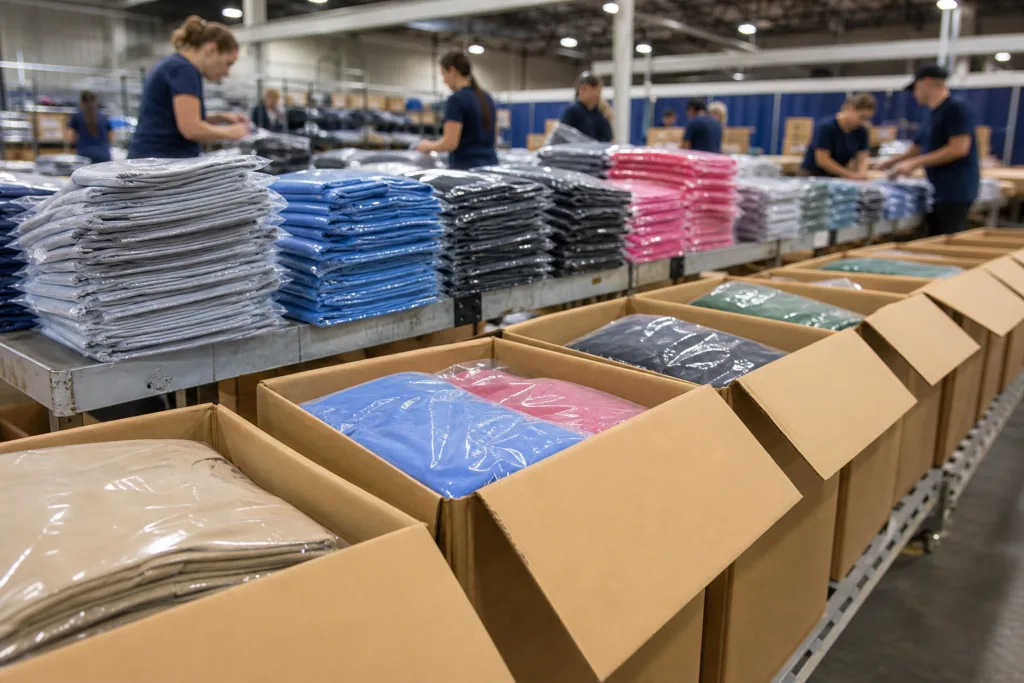
For e-commerce, reduced-material packaging works best when the bag still protects against dust, moisture, and transit friction. For retail, removing too many protective layers may create presentation problems before goods reach the sales floor. For events, simple packaging can often be a strong fit because speed matters more than elaborate unboxing.
Buyers should ask not only whether a material is recyclable, but also whether it performs well in storage, transport, and handling. Sustainable packaging should still match garment color sensitivity, fabric finish, folding stability, and brand presentation requirements.
How Packaging Choices Affect Unit Price, MOQ, and Production Lead Time
Packaging affects cost in several ways: material cost per unit, labor time per piece, setup complexity, artwork approval, and carton efficiency. A plain fold in a standard clear bag is usually easier to execute than a custom printed bag with insert card, tissue wrap, branded seal, and SKU-specific outer label. Each added component can increase handling time and create another approval point.
MOQ can also shift when custom packaging materials are printed separately. A buyer may have a modest T-shirt quantity but still face packaging minimums for branded bags, custom stickers, or inserts. That does not always make custom packaging impractical, but it does mean buyers should compare the value of branding against the order scale and reorder plan.
This is one reason a clear factory brief matters. Buyers who understand how to prepare a detailed apparel RFQ tend to avoid delays caused by missing fold specs, unclear barcode rules, or late packaging artwork changes. Good RFQ detail helps the supplier quote labor, materials, and lead time more accurately from the start.
Lead time is often affected less by the final folding step and more by packaging preparation. If tags, stickers, inserts, or printed bags need approval, those components should be confirmed early enough to avoid holding completed garments in the factory while waiting for packaging materials.
What Packaging Details Should Be Included in the Purchase Order
A strong purchase order should define packaging in operational terms, not vague preferences. Instead of simply writing “individual bag,” buyers should specify the bag type, sealing method, print requirement, size sticker location, barcode format, fold direction, insert requirements, and carton packing ratio. If any carton should be assorted by size or color in a special way, that needs to be written clearly.
Useful packaging details to include are:
- individual packing requirement or bundle packing method
- bag material and whether it is plain, printed, or recycled-content
- garment folding standard
- hang tag placement and attachment method
- barcode content and label placement
- size sticker wording, color coding, or position
- carton assortment by size, color, department, or location
- shipping marks and carton numbering format
- special inserts, return cards, or promotional cards
- whether extra spare labels, tags, or bags are required
If the order is complex, a packing diagram or photo reference is often better than a text-only note. That reduces interpretation risk and gives the factory and QC team a visual standard to follow during final packing inspection.
How Private Label and Branded T-Shirt Packaging Are Usually Managed
Private label packaging usually works best when the buyer separates must-have elements from nice-to-have upgrades. Must-have items may include neck label presentation, barcode labels, size stickers, and carton marks. Nice-to-have items might include printed tissue, insert cards, sleeves, or premium outer bags. This keeps the project commercially realistic while still supporting brand identity.
In practice, the best packaging plan is the one that matches the sales channel and reorder pattern. A startup online brand may need clean, repeatable, low-complexity packaging. A retail program may need stricter SKU labeling and display readiness. A large corporate order may need highly organized sorting with minimal decorative cost.
From a manufacturer perspective, early alignment on artwork, labeling, fold standard, and carton logic usually makes private label packaging smoother than last-minute changes after production is already underway.
Choosing the Best Packaging Setup for Your Sales Channel and Order Purpose

The best custom t-shirt packaging is the one that supports how the shirts will actually be sold, shipped, handed out, or distributed. E-commerce buyers should prioritize protection, neat presentation, and return readiness. Retail buyers should focus on barcode accuracy, shelf or hanger readiness, and SKU visibility. Event buyers should optimize speed, size recognition, and simple handling. Corporate buyers should plan around sorting logic and delivery efficiency.
Before approving packaging, ask a few practical questions: Who opens the package first? How quickly must they identify size or SKU? Will goods be reshipped individually, stocked in a store, or handed out in bulk? Is branded presentation central to the order, or is operational efficiency more important? Those answers usually point to the right packaging level more clearly than design preference alone.
When packaging is planned as part of sourcing instead of as a last-minute add-on, buyers usually get better consistency, fewer fulfillment issues, and a more accurate view of total project cost.
FAQ
What is the most practical custom t-shirt packaging option for e-commerce?
A neat individual bag with a stable fold, visible size or SKU identifier, and enough protection for parcel shipping is usually the most practical choice for e-commerce.
Do retail T-shirt orders always need individual polybags?
No. Some retail programs require individual polybags for transport and receiving, while others prefer hanger-ready or floor-ready presentation with different packing standards.
How can event T-shirt packaging speed up distribution?
Clear size stickers, simple folding, and cartons sorted by size or attendee group help staff hand out shirts faster without opening every unit.
Can corporate T-shirt orders be packed by employee or department?
Yes, if the factory receives a clear sorting list and packing rules in advance, shirts can often be organized by employee, team, location, or department.
Does custom t-shirt packaging increase MOQ?
It can, especially when custom printed bags, inserts, or labels have their own material minimums even if the garment quantity itself is moderate.
What packaging details should buyers confirm before bulk production?
Buyers should confirm bag type, fold method, labels, barcode placement, size stickers, carton assortment, shipping marks, and any branded inserts before bulk packing begins.