
Choosing between performance polo shirts and cotton polos is not a small fabric decision when you are planning a custom order. The right option affects wearer comfort, logo appearance, repeat order consistency, wash performance, and whether the final product actually fits the use case you are buying for.
For buyers comparing fabric options, it helps to start with the production side rather than just the feel of the garment. A reliable custom polo shirt supplier for your order should be able to explain how fabric choice changes decoration methods, lead times, MOQ logic, and long-term appearance after use. That is where the difference between cotton and performance polos becomes much clearer.
What really separates performance polo shirts from cotton polo shirts in custom production
In manufacturing terms, the biggest difference is not simply that one feels more natural and the other feels more technical. Performance polo shirts are usually selected for function-driven programs where moisture management, shape retention, and lower-maintenance wear matter. Cotton polos are usually selected for softness, a familiar handfeel, and a more classic casual presentation.
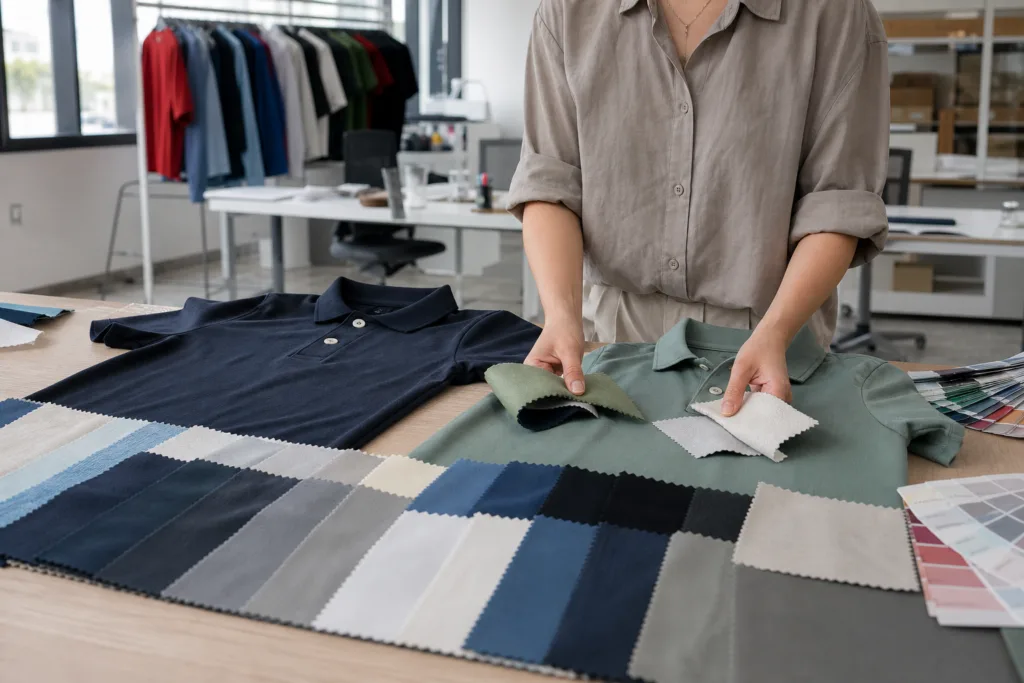
That difference affects the full order path. Fabric weight, knit structure, dye behavior, trim selection, and logo application all need to match the base material. Buyers who are still choosing the best fabric for custom polos should compare the end-use setting first, because a fabric that feels good on a hanger may not be the one that performs well in daily staff wear, golf use, or retail resale.
Side-by-side comparison of key buying factors
| Factor | Performance polo shirts | Cotton polo shirts |
|---|---|---|
| Handfeel | Smoother, cooler, more technical | Softer, more natural, more familiar |
| Breathability | Often strong when knit for airflow | Can feel breathable, but depends on weight and knit |
| Moisture handling | Usually better at moving sweat away from the body | Absorbs moisture more readily |
| Wrinkle resistance | Generally better | Usually wrinkles more easily |
| Drying speed | Typically faster | Typically slower |
| Durability in repeated uniform use | Often more stable in active programs | Can look worn sooner depending on construction |
| Brand image | Sport, golf, active, modern uniform | Classic, casual, lifestyle, heritage feel |
| Decoration sensitivity | Needs method matching to fabric type | Usually more forgiving for several decoration methods |
From a buyer perspective, performance fabric tends to win when the garment has to work hard. Cotton often wins when the main priority is touch, natural fiber preference, or a more traditional visual identity.
Handfeel and wearer perception
If your audience expects softness and a less technical touch, cotton may create a better first impression. It tends to feel more familiar in hospitality, lifestyle, and casual corporate settings.
Performance polos feel cleaner and more functional. For programs where the wearer expects movement, heat management, or a golf-inspired look, that technical feel is usually a benefit rather than a drawback.
Breathability and moisture-wicking
Many buyers use these terms interchangeably, but they are not the same in practice. Cotton can feel airy, yet it usually holds more moisture once absorbed. Performance fabrics are often chosen because they move moisture and dry faster, which matters more in outdoor work, events, and active programs than in air-conditioned office use.
Wrinkle resistance and durability
For uniforms that are worn, washed, packed, and reused often, performance fabrics usually offer a more stable appearance. Cotton can still work well, but buyers should expect more visible creasing and potentially faster visual aging if the garment is used heavily.
Which option works better for corporate uniforms and staff apparel
For front-desk teams, office staff, retail associates, and service employees, the choice depends on brand image and care expectations. Cotton polos support a more relaxed and approachable look. They can also feel better for indoor staff who are not working in heat or motion-heavy conditions.
Performance polo shirts are often the stronger option when staff need a more polished appearance through long shifts. They generally resist wrinkles better, recover shape more reliably, and are easier for wearers who do not want high-maintenance garments.
A manufacturer will usually ask practical questions here: Is the team indoors or outdoors? Are employees washing garments frequently? Is the program image classic or modern? Those answers matter more than broad claims about one fabric always being better.
Which option works better for golf, sports, and activewear programs
For golf events, sports teams, outdoor promotions, and movement-based uniforms, performance fabrics usually fit the brief more naturally. Buyers in these categories are less concerned with a traditional cotton handfeel and more concerned with lightweight wear, lower sweat retention, and shape retention after use.
This is why many buyers reviewing golf polo manufacturing details end up prioritizing fabric performance, collar recovery, and print compatibility over fiber familiarity. In active programs, appearance after several rounds of wear can matter as much as the first fit sample.
Cotton polos can still work for clubs or school programs where the polo is mainly a presentation piece rather than an activity garment. But if the wearer is moving, sweating, traveling, or playing in warm conditions, performance polos usually offer fewer functional compromises.
Which option is better for retail brands building a product line
Retail is less about a universal winner and more about brand positioning. Cotton polos often suit brands aiming for timeless basics, lifestyle wear, or a softer everyday product. Performance polos fit better for modern golf collections, athleisure capsules, corporate crossover apparel, or travel-friendly basics.
Product line planning also changes the sourcing logic. Cotton can support a simpler story when the customer values natural feel. Performance fabric may support stronger differentiation if the brand wants technical benefits, easy care, and category expansion into activewear-adjacent products.
At Ninghow Apparel, this decision usually comes down to whether the buyer is building around tactile comfort, function, or channel fit. A wholesale uniform buyer and a private label brand may both order polos, but they often need very different fabric outcomes.
Logo decoration compatibility buyers should check first
The fabric choice affects how well your logo method performs over time. This is especially important for polos because collars, plackets, and chest placement make branding highly visible.
Embroidery
Embroidery works well on both cotton and performance polos, but stabilization matters. Performance fabrics can show puckering, needle marks, or distortion if the fabric weight and backing are not matched properly. Buyers comparing embroidered logo polo considerations should focus on knit density, logo stitch count, and sample approval rather than assuming one embroidery setup works across all polo fabrics.
Screen printing and heat transfer
Cotton is often more forgiving for standard screen printing. Performance fabrics may require more careful temperature control, ink selection, or transfer testing to avoid issues like dye migration, sheen change, or poor adhesion.
If your order depends on bold graphics rather than a small chest logo, performance fabric is not automatically a problem, but it does need more controlled testing during development. That is why sampling matters more on performance polos with large-print branding.
Other branding methods
For woven labels, neck printing, zipper additions, contrast panels, and custom trims, both cotton and performance polos can work well. The better choice depends on the category goal. Cotton supports a classic product story, while performance often supports more technical styling details.
Cost, MOQ, and lead time differences buyers should expect
Cost differences between cotton and performance polos are not only about fiber price. They also come from knit complexity, finishing requirements, color consistency, decoration method, and packaging expectations.
Performance polos can cost more when they involve specialized fabric, extra testing, or more cautious logo application. Cotton polos can also become expensive if they use heavier fabric, garment-wash styling, upgraded trims, or stricter appearance standards. Buyers should look beyond the unit price and review the hidden costs that affect polo pricing before choosing a direction.
MOQ can shift depending on whether the fabric is stocked, custom dyed, or developed specifically for the order. Lead time can also move if performance fabrics require additional lab dips, strike-offs, or decoration trials. In short, the simpler-looking option is not always the lower-risk production option.
Wash performance and long-term appearance after repeated use
Repeated laundering often reveals the real difference between cotton and performance polos. Cotton may soften nicely over time, but it can also fade, shrink, lose shape, or show placket and collar fatigue sooner depending on the fabric construction.
Performance polos often hold their silhouette better and dry faster after washing. However, buyers should still evaluate pilling tendency, snag resistance, and decoration durability, especially for lower-weight knits or highly synthetic blends.
The right question is not which fabric survives washing in theory. It is which fabric keeps the look your program needs after the number of wash cycles your users will realistically put it through.
How to choose the right fabric based on your order goal
If comfort and natural feel come first
Choose cotton when the wearer experience is centered on softness, familiarity, and casual comfort. This is common in lifestyle polos, hospitality settings, and brand programs where technical performance is not the main selling point.
If polished daily wear matters most
Choose performance polo shirts when easy care, wrinkle resistance, and a cleaner all-day appearance matter more than natural fiber preference. This usually suits uniforms, events, golf, and active staff use.
If branding is the priority
Choose the fabric that matches the logo method, not just the garment category. Embroidery may work beautifully on both, but large prints or transfers may narrow the better option depending on the knit and finish.
If budget control is the priority
Do not assume cotton is always cheaper. Ask for costing based on actual specs, because decoration, weight, dyeing, and minimums can change the result more than the broad fabric label.
Decision matrix: cotton polo vs performance polo by scenario
| Scenario | Better fit | Why |
|---|---|---|
| Indoor corporate uniform | Either, depending on brand image | Cotton for softness, performance for easier care |
| Outdoor staff uniform | Performance polo shirts | Better moisture handling and lower-maintenance wear |
| Golf event apparel | Performance polo shirts | Better match for movement and heat |
| Casual retail basics | Cotton polos | Stronger natural handfeel and classic identity |
| Athleisure or golf retail line | Performance polo shirts | Technical story and easier care support the category |
| Embroidery-focused staff polo | Either with testing | Fabric stability matters more than label alone |
| Large printed promo polo | Often cotton | Can be more forgiving for standard printing workflows |
| Frequent wash uniform program | Performance polo shirts | Often keeps shape and presentation longer |
Final recommendation
Performance polo shirts are usually the stronger choice when the order needs moisture management, lower maintenance, better wrinkle resistance, and a more modern uniform or golf-ready appearance. Cotton polos are often the better fit when softness, natural feel, classic styling, and casual brand positioning matter more than technical function.
For most buyers, the right answer comes from matching fabric to the real job of the garment: who wears it, how often it is washed, how it is branded, and what image it needs to support. A good custom polo decision is not about choosing the more popular fabric. It is about choosing the fabric that will still make sense after production, decoration, delivery, and repeated use.
FAQ
Are performance polo shirts always better for custom uniforms?
No. Performance polo shirts are usually better for active, outdoor, or easy-care uniform programs, while cotton can be a better fit for indoor teams, softer handfeel, or a more classic brand image.
Do cotton polo shirts work well for embroidered logos?
Yes. Cotton polos often handle embroidery well, but the final result still depends on fabric weight, knit stability, logo size, and proper backing during sampling.
Are performance polo shirts harder to print on?
They can be. Performance fabrics often need more careful testing for screen printing or heat transfer because temperature, adhesion, and dye behavior can affect the final result.
Which polo fabric is usually better for golf apparel?
Performance fabrics are usually the stronger choice for golf apparel because they are better aligned with movement, moisture control, and lower-maintenance wear during repeated use.
Is cotton always the cheaper option for bulk polo orders?
No. Cotton is not always cheaper because total cost also depends on fabric weight, dyeing, trims, logo method, minimums, and finishing requirements.
How should buyers choose between cotton and performance polos?
Start with the end use, then compare care expectations, branding method, wearer comfort, and budget. The right choice is the fabric that fits the actual program, not just the sample feel.