

A hoodie can look simple at first glance, but pre-shipment inspection is rarely simple. Compared with lighter knit products, hoodies combine heavier fabric, layered construction, rib components, pockets, trims, and often decoration, which means small issues can hide until garments are packed and ready to leave the factory. A practical hoodie defect checklist helps buyers catch appearance, measurement, labeling, and function problems before they turn into returns, chargebacks, or costly rework after arrival.
For sourcing teams reviewing bulk production, it helps to compare finished goods against a broader hoodie manufacturer quality checklist rather than checking only measurements or decoration. That approach makes it easier to verify whether the hood, pocket, zipper, ribbing, fabric surface, and packing condition all match the approved standard. When buyers use a structured checklist before shipment, approval decisions become faster, clearer, and easier to defend internally.
Why hoodie inspection is more complex than T-shirt inspection
A T-shirt inspection often focuses on fabric appearance, print quality, measurements, labeling, and sewing consistency. A hoodie adds more risk points because the garment is heavier, has more panels, and is expected to perform in use. The hood must sit correctly, the pocket must not distort the front body, the cuffs and hem must recover after stretch, and zip-up styles must open and close smoothly without waviness.
Buyers should also remember that hoodie defects are often interaction defects rather than single-point defects. For example, a heavy hood can pull the neckline, a poorly balanced pocket can twist the front, and uneven rib tension can affect body shape after packing. That is why hoodie inspection should follow a component-by-component sequence instead of relying only on random visual review.
How to use this hoodie defect checklist before shipment

Use the checklist in three stages. First, review approved references such as the tech pack, graded spec, color standard, PP sample comments, print placement approval, and packaging instructions. Second, inspect bulk units under consistent lighting and on a flat table, hanger, and fit form when available. Third, separate findings into three action groups: acceptable, reworkable, and shipment-blocking.
For better consistency, buyers should inspect both an overall sample set and individual size points. Start with visual appearance, then construction, then function, then measurements, and finish with labels and packaging. If the order includes multiple colors, washes, or decoration methods, inspect each group separately rather than assuming one approved carton represents all goods.
Hood construction checks
Symmetry and shape
The hood should look balanced when laid flat and when worn on a form. Check whether left and right sides are symmetrical, whether the center seam runs straight, and whether the hood opening keeps a clean curve instead of collapsing inward. If one side is longer, fuller, or higher than the other, the problem may come from panel cutting, sewing mismatch, or uneven topstitch tension.
Buyers dealing with repeated hood construction and shape issues should compare bulk units directly with the approved sample, not only with the measurement chart. A hood may measure within tolerance and still fail visually if the shape stands poorly, pulls backward, or collapses at the opening.
Drawstring and eyelet checks
Check that drawstrings match the approved length, color, tip finish, and insertion method. Eyelets should be evenly placed, firmly attached, and free from rust marks, scratches, or fabric tearing around the opening. Drawcords should slide smoothly and not bunch the hood opening excessively when adjusted.
- Flag drawstrings with inconsistent length between sides
- Check for twisted or frayed cord ends
- Confirm eyelets are aligned at the same height
- Look for skipped stitching around channel openings
- Make sure bartacks or reinforcement stitches are secure
Kangaroo pocket checks
Kangaroo pockets often create visible defects even when the rest of the hoodie is acceptable. Inspect pocket placement against the approved sample and confirm the pocket sits level across the front body. A pocket that is too high, too low, or slanted can make the whole garment look off-grade.
Check for sagging at the pocket opening, distortion at the corners, and puckering where the pocket joins the body. Heavier brushed fleece or French terry can exaggerate these issues after washing or packing pressure. Also inspect whether the left and right opening widths match and whether the top edge rolls or stretches unevenly.
- Confirm the pocket is centered on the body
- Check opening symmetry from left to right
- Look for corner stress, loose stitching, or seam grin
- Inspect the pocket bag shape for drag or bubbling
- Review topstitch consistency and thread tension
Zipper checks for zip-up hoodies
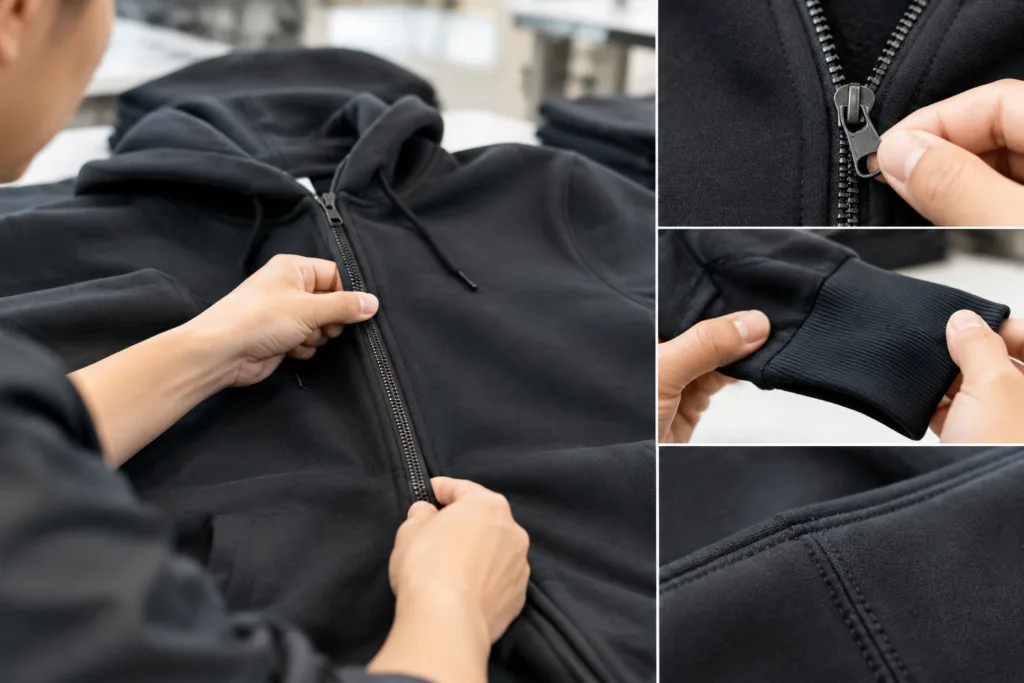
Zippers need both visual and functional approval. Start by hanging the garment and checking whether the front zipper line runs straight. Then open and close the zipper several times to test resistance, snagging, slider stability, and top-stop security. A zipper can pass a quick appearance check yet still fail in wear if the tape is under tension or the placket has been sewn unevenly.
When reviewing zipper alignment and wave defects, inspect the garment both zipped and unzipped because waviness is not always visible in one position. Pay special attention to matching hem seam points, pocket seam alignment, neckline finish, and whether the zipper area ripples after packing compression.
- Check for zipper waviness along the front opening
- Test smooth operation through the full length
- Inspect bottom stop, top stop, and slider attachment
- Confirm left and right fronts align when zipped
- Look for fabric catching in the zipper teeth
Ribbing checks at cuffs and hem
Rib components affect fit retention and garment balance. Cuffs and hem should stretch and recover without feeling loose, over-tight, or uneven between sides. Twisting is a common issue, especially when rib grain is off or sewing tension is uneven. Lay sleeves together and compare cuff height, circumference, and seam position.
At the bottom hem, check whether the rib sits flat and whether body fabric blouses evenly above it. If one side pulls or flips, the issue may come from rib ratio, attachment tension, or body panel imbalance. For heavyweight hoodies, poor rib recovery often becomes more obvious after steaming, packing, and handling, so inspect samples taken from different cartons rather than a single top carton only.
Print and embroidery checks
Decoration defects on hoodies are more noticeable because thicker fabric can affect bonding, stitch tension, and placement stability. Check logo placement against the approved location from edges, seams, and neckline points. On fleece surfaces, inspect whether prints sit cleanly or bridge over texture unevenly.
For branded programs, print and embroidery durability checks should include both appearance and construction review. Buyers should flag cracking, poor edge definition, off-center placement, embroidery puckering, thread trims left on the surface, and backing show-through that affects presentation.
- Confirm print placement and angle
- Inspect for cracking, lifting, or incomplete coverage
- Check embroidery density and edge cleanliness
- Look for puckering around stitched logos
- Compare decoration color against the approved standard
Fabric checks
Fabric issues can turn an otherwise acceptable hoodie into a return risk. Inspect face and back surfaces for stains, holes, barre, slubs, needle damage, lint buildup, and inconsistent brushing. Dark colors should be checked carefully for press marks, shine, and shade variation between panels, especially hood parts and sleeves cut from different lays.
Many teams use fabric pilling and surface quality testing as a reference point because surface defects often become visible only after handling or abrasion. Even if bulk goods are not lab-tested at inspection, buyers can still assess practical warning signs such as loose fibers, excessive lint shedding, rough hand feel, and visible pilling at underarm or side seam friction zones.
| Fabric check point | What to inspect | Why it matters |
|---|---|---|
| Shade consistency | Panel-to-panel and lot-to-lot color match | Prevents mixed-carton complaints |
| Surface cleanliness | Stains, oil marks, dust, lint, and press shine | Affects sellable appearance |
| Surface integrity | Holes, snags, slubs, needle cuts | Reduces durability and grade quality |
| Brushing consistency | Even fleece or terry finish | Protects hand feel and appearance |
| Pilling risk signs | Loose fibers and abrasion areas | Signals potential wear complaints |
Measurement points to verify before shipment
Hoodie measurement review should go beyond chest and body length. Because hoodie fit is influenced by multiple attached components, buyers should check key points that affect both size accuracy and visual balance. A garment can technically pass chest tolerance while still fitting poorly due to hood depth, sleeve length, cuff opening, or bottom rib width.
Measure at least the following points against the approved graded spec:
- Chest width
- Body length from high point shoulder
- Shoulder width
- Sleeve length
- Bicep width
- Cuff opening
- Bottom opening at rib
- Hood height and hood opening
- Pocket height and width where applicable
- Front length balance for zip-up hoodies
If size grading looks inconsistent across the inspected sample set, stop treating the issue as isolated. In our manufacturing reviews at Ninghow Apparel, size problems usually need root-cause checking at cutting, bundling, or sewing stage rather than simple carton sorting. Buyers should request measurement summaries by size to see whether the issue is random or systematic.
Labeling and packaging checks
Label and packaging defects are easy to underestimate because they do not always affect garment wear, but they can still create compliance, retail, or fulfillment problems. Confirm the care label content, brand label, size label, country of origin marking where required, barcode or hangtag details, and carton marks against the approved packing list and artwork files.
Then inspect the final packed presentation. Hoodies should be folded consistently, free from trapped lint, and packed in clean undamaged polybags with the correct stickers or size marks. Check that the zipper pull, drawcord tips, and decoration are protected from transfer marks or pressure damage inside the bag.
- Verify size labels match garment measurements
- Check care labels are sewn securely and legibly
- Confirm hangtags use approved artwork and attachment method
- Inspect folding consistency across cartons
- Reject dirty, torn, or poorly sealed polybags
Common custom hoodie defects buyers should flag
During pre-shipment inspection, buyers should clearly separate cosmetic tolerance issues from defects that affect use, brand presentation, or repeatability. The following defects commonly justify escalation:
- Uneven hood shape or visibly mismatched hood panels
- Pocket misalignment that changes front appearance
- Zipper waviness, snagging, or poor front balance
- Loose or weak ribbing with poor recovery
- Decoration cracking, puckering, or incorrect placement
- Shade variation between sleeves, hood, and body
- Measurement failures outside approved tolerance
- Incorrect labels, hangtags, or carton assortment
- Stains, holes, broken stitches, or seam opening
A useful rule is to ask whether the defect is visible to the end customer, repeatable across units, or likely to worsen in wear or retail handling. If the answer is yes to any of those, the defect deserves formal recording and supplier response before shipment approval.
A final hoodie QC checklist for shipment approval
Before approving shipment, buyers can use this condensed checklist:
- Approved sample, tech pack, and packing standard are on hand
- Color and fabric appearance are consistent across inspected units
- Hood shape, symmetry, and drawcord details are correct
- Pocket placement and sewing are balanced and clean
- Zippers operate smoothly and fronts align properly
- Cuffs and bottom rib recover well and do not twist
- Prints or embroidery match approved placement and appearance
- All key measurements fall within tolerance
- Labels, tags, folding, and polybags match instructions
- Defects are recorded by severity and by occurrence pattern
This type of final review works best when the team signs off by defect category, not by general impression. A hoodie may feel acceptable overall while still carrying one shipment-blocking issue such as wrong labels, unstable zippers, or repeated measurement failure in a major size.
When to request rework, replacement, or shipment hold
Request rework when defects are correctable without harming garment quality, such as loose thread trimming, folding correction, label replacement, or minor repacking. Request replacement when the defect cannot be reliably repaired to approved standard, such as severe shade mismatch, irreversible print damage, or major measurement failure. A shipment hold is appropriate when the defect pattern suggests systemic risk and the true scope is still unclear.
Do not focus only on defect count. Also assess where the defect appears, how visible it is, whether it affects core sizes, and whether the problem indicates broader process instability. A small number of defects in a repeated high-visibility area can justify holding shipment faster than a larger number of minor hidden faults.
Inspection summary format for internal QC teams
For internal use, keep the report simple enough for sourcing, quality, and merchandising teams to read quickly. A practical summary usually includes style number, color, order quantity, inspected quantity, size range checked, defect photos, measurement findings, packaging findings, and final action recommendation. It should also separate critical, major, and minor issues in plain operational language.
If multiple teams review the same order, use one standardized terminology list for recurring issues such as hood asymmetry, zipper wave, pocket skew, rib twist, decoration crack, shade variation, and label mismatch. Consistent wording makes supplier communication faster and reduces debate over whether two inspectors are describing the same problem.
Conclusion

A strong hoodie defect checklist helps buyers inspect beyond surface appearance and make clearer shipment decisions. The most useful approach is to review the hoodie as a system: hood, pocket, zipper, ribbing, decoration, fabric, measurements, and packaging all interact. When inspection is structured this way, brands and sourcing teams can reduce avoidable claims, protect fit and presentation, and escalate issues before goods leave the factory.
FAQ
What is the most common issue found in a hoodie defect checklist?
The most common issues are usually hood asymmetry, pocket misalignment, zipper waviness on zip-up styles, rib recovery problems, and decoration placement errors because these defects are highly visible and affect overall garment presentation.
How many hoodies should buyers inspect before shipment?
The inspection quantity depends on the order size, inspection method, and agreed quality standard, but buyers should always review enough units across sizes, colors, and cartons to identify whether defects are isolated or repeated.
Should buyers inspect hoodies on a table or on a hanger?
Both are useful because a flat table helps with measurements and symmetry checks, while a hanger or fit form makes it easier to spot zipper waviness, hood collapse, body balance, and how the garment hangs in real use.
When does a hoodie defect require a shipment hold?
A shipment hold is appropriate when defects are repeated, highly visible, outside approved tolerance, or likely to create customer complaints, especially if the root cause appears systemic and the full defect scope is not yet confirmed.
Why are hoodie measurements harder to verify than T-shirt measurements?
Hoodies have more construction variables, including heavy fabric, ribbing, hoods, pockets, and zippers, so fit can be affected by component interaction even when one or two basic body measurements seem acceptable.
Can minor packaging errors matter in hoodie inspection?
Yes, minor packaging errors can still create retail, fulfillment, or customer experience issues, especially when they involve wrong size stickers, missing labels, damaged polybags, inconsistent folding, or decoration transfer during packing.