
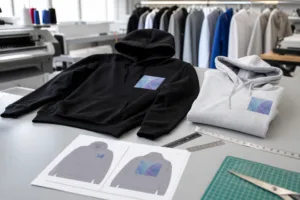
Hoodie logo placement affects more than appearance. It influences branding visibility, decoration quality, sampling accuracy, and whether the design can be repeated consistently in bulk production. For apparel brands, the right placement choice often comes from balancing creative intent with real garment construction limits.
That is why early placement decisions should be made with manufacturing in mind, not only from a flat digital mockup. If your team is still comparing feasible branding locations, reviewing custom hoodie logo placement support alongside style development can help connect design ideas with practical production methods, size limits, and factory-ready specs. A clearer placement plan at this stage usually reduces revisions later.
Why hoodie logo placement matters
A logo on a hoodie needs to work across three levels at the same time: visual branding, garment usability, and production repeatability. A placement that looks strong in a concept file may become risky once seams, pocket openings, hood panels, rib hems, and fabric stretch are considered.
From a buyer perspective, placement decisions also affect cost-performance. Simpler, more stable locations are usually easier to sample and scale. More complex areas may still be worth using, but they require better technical communication and more approval checks before bulk production.
The main factors that shape placement decisions
Garment style and construction
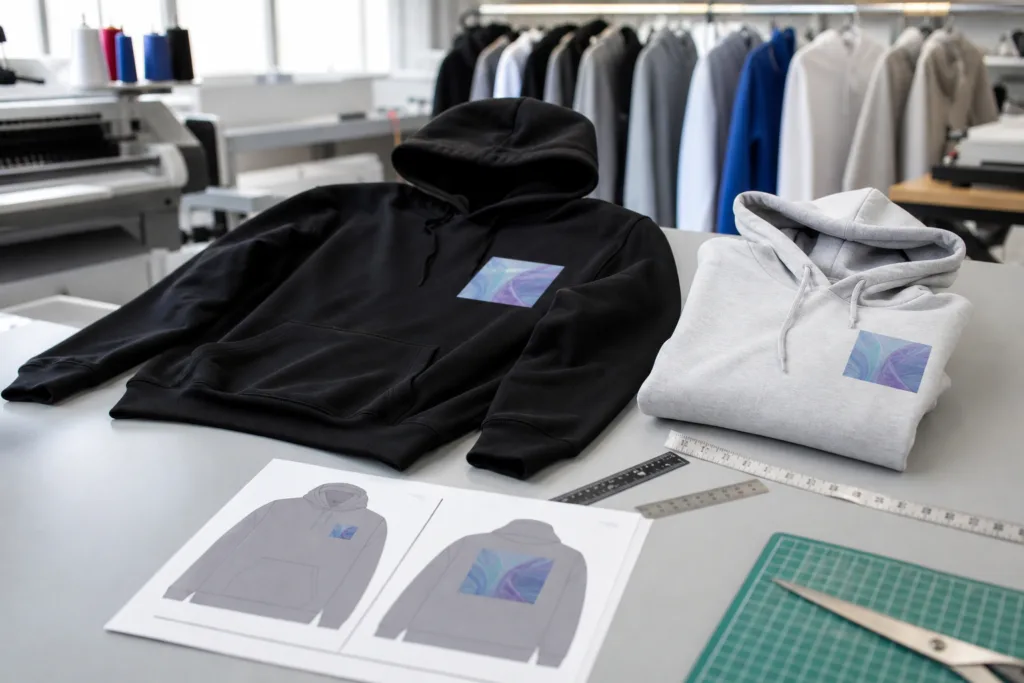
Pullover hoodies, zip hoodies, oversized fits, cropped styles, and heavyweight fleece programs all create different decoration conditions. A center chest print works well on many pullovers, but the same artwork may not suit a full-zip style because the zipper interrupts the print area. Drop shoulders and oversized silhouettes can also change where a logo appears once worn.
Logo size and brand role
Small logos are usually safer on chest, sleeve, or hem positions. Large artwork is more often placed on the back or center front where the surface is less restricted. Brands should also decide whether the logo is meant to be subtle, signature, or dominant. That choice should guide placement before decoration method is finalized.
Decoration method
Embroidery, screen print, puff print, and other applications each respond differently to seams, thickness, and surface curvature. Before approving a visual concept, it helps to understand basic artwork file preparation for production because clean files and clear scale references reduce preventable sizing and position errors.
Target audience and wear context
A performance-focused or teamwear-inspired hoodie may benefit from visible placements like center chest or upper back. A minimalist premium line may work better with a small left chest logo, sleeve mark, or hem detail. Placement should support how the customer notices the garment in real use, not just how it looks on a product page.
Left chest vs center chest
When left chest works best
Left chest placement is often chosen for subtle branding, retail-friendly basics, schoolwear, club apparel, and private label programs where a clean look matters. It suits small logos, badges, monograms, and compact embroidery well. It also tends to be easier to repeat consistently across size ranges.
The main advantage is balance. It gives branding presence without dominating the garment. It is also generally less affected by size scaling than a center chest logo.
When center chest works best
Center chest placement is better when the logo is meant to be more visible from a distance or when the brand identity relies on a direct front-facing statement. It is common for bold screen prints, puff prints, and graphic wordmarks.
However, center chest requires careful vertical positioning. If placed too high, it can crowd the neckline and drawstrings. If placed too low, it may feel visually heavy or run into pocket areas on some styles. The available surface also changes across pullover and zip-front constructions.
Back print placement
Back placement provides the largest uninterrupted branding area on most hoodies, which is why it is often used for statement graphics, event apparel, streetwear branding, and team-driven identity. Large logos and multi-element artwork usually perform better here than on sleeves or chest.
Even so, size and position should be chosen carefully. A very high back print can conflict visually with the hood when worn down. A very low print may fall into the movement zone of the body and feel awkward on smaller sizes. The best position depends on hood depth, shoulder shape, and the intended viewing distance.
In manufacturing, large back artwork needs extra attention to registration, flattening, and consistency across garment sizes. Heavy fleece or brushed interiors can also influence how sharply the decoration appears on the outside.
Sleeve logo placement
Sleeve logos can create a premium or athletic look, especially for secondary branding, slogans, or narrow graphic elements. They are useful when the front and back need to stay clean but the garment still needs branded detail.
The challenge is that sleeves are narrow, curved, and often affected by seam twist or pattern variation. Artwork that looks centered on a flat sleeve panel may shift visually once sewn and worn. This makes sleeve placement less forgiving than chest or back placement.
Best use cases for sleeves
- Small repeat logos
- Vertical text or slim graphics
- Secondary brand marks
- Collection identifiers near cuff-to-elbow zones
Keep in mind that sleeve artwork should avoid seam-heavy areas and should be tested on the actual sample size, not just on a spec drawing.
Hood logo placement
Hood placement is visually distinctive and can help a hoodie feel more directional or premium. It often works as a secondary branding position rather than the main logo area. For some brands, a hood logo is valuable because it remains visible from the side or back even when the front design is minimal.
Technically, it is one of the more difficult areas to decorate. Hood panels are shaped, sewn, and sometimes double-layered. Drawstring channels, center seams, and fabric thickness can all interfere with symmetry and print stability. Buyers reviewing hood construction issues that can affect logo placement often realize that a strong hood graphic depends as much on panel build as on artwork design.
If using hood placement, approve it through sampling with the hood both flat and worn. A centered logo on a laid-flat hood may look off once the hood is on the body.
Pocket and hem logo placement
Pocket and hem placements can make a hoodie feel more considered and brand-specific, especially for subtle private label programs. These locations are often used for small logos, woven-look branding effects, compact embroidery, or understated prints.
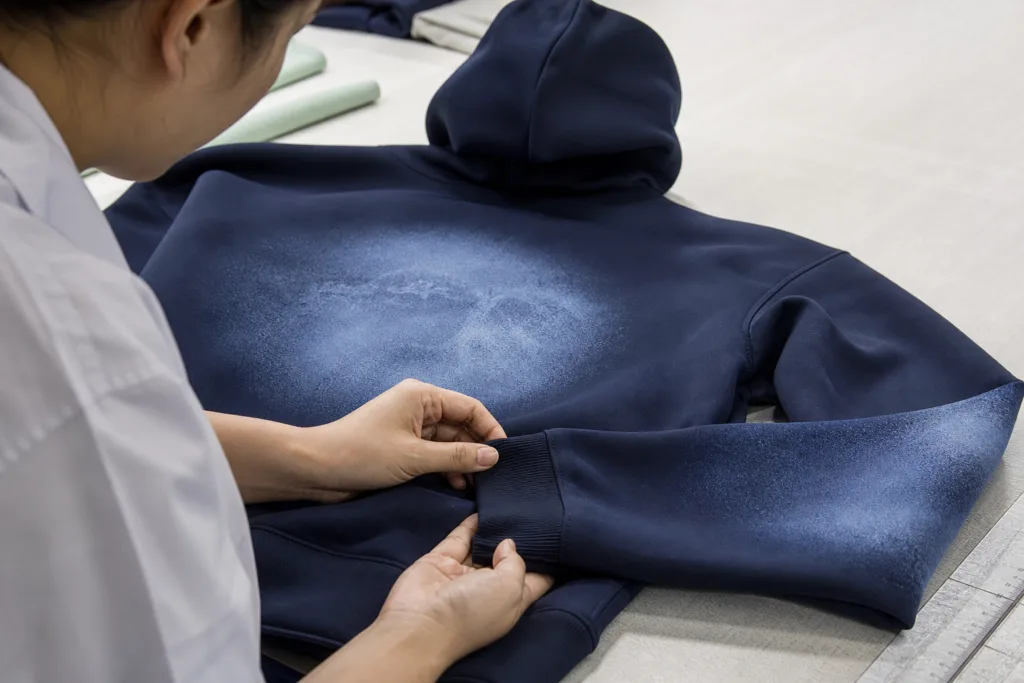
They also create special risks. Pocket openings distort the available surface, hems can curl or stretch, and rib transitions change how accurately decoration can be aligned. If your design includes front pouch details, reviewing how hoodie pocket design affects decoration placement can help prevent a logo from landing too close to pocket stitching, openings, or seam tension points.
When pocket placement works
Pocket placement can succeed with small artwork positioned above, beside, or carefully on the pocket body when the construction allows a stable area. It is usually better for accent branding than for primary logos.
When hem placement works
Hem placement suits small, refined branding and can support a premium or minimalist look. It should be kept away from thick rib joins and any area likely to fold during wear or packing.
How decoration method changes what is feasible
Embroidery
Embroidery works well for left chest, sleeve accents, and some hem applications. It adds texture and a premium look, but dense stitching on thick fleece can pull the fabric or lose detail if the logo is too small or too complex. It is usually less suitable for very large back placements due to weight, stiffness, and cost.
Screen print
Screen print is versatile and commonly used for center chest and back graphics. It handles larger branding areas well, but flat printing surfaces are important. Seams, pockets, and uneven thickness can reduce consistency.
Puff print
Puff print adds dimension and strong visual impact, but it is more sensitive to pressure balance, fabric texture, and exact placement. It often performs better on cleaner, flatter zones than on curved or seam-interrupted areas.
At Ninghow Apparel, placement recommendations usually depend on matching the artwork style with the hoodie construction first, then choosing the decoration process that can repeat cleanly in production.
How seams, ribbing, drawstrings, and curved surfaces affect accuracy
Factories can place artwork accurately only within the limits created by the garment. Seams interrupt print paths. Ribbed hems resist perfectly flat decoration. Drawstrings visually crowd top-front placements. Curved sleeves and shaped hoods change how centered graphics appear after sewing.
This is why measurements from neckline, shoulder seam, pocket top edge, or side seam should be specified clearly. A mockup alone is not enough. The same artwork can sit very differently depending on panel dimensions and sewing tolerances.
Common placement mistakes that lead to poor results
- Choosing placement from a flat concept image without considering garment construction
- Scaling the logo too large for the available decoration area
- Ignoring how placement changes across size ranges
- Putting artwork too close to pockets, seams, zippers, or ribbing
- Using hood or sleeve placements without sampling on the real garment
- Submitting vague instructions like “centered” without measurement references
- Using detailed logos in methods or positions that cannot hold fine detail well
Most of these issues are avoidable when placement is treated as a technical production decision, not just a styling choice.
How to confirm placement during sampling
The safest time to fix placement errors is during sampling, before bulk markers, print setups, and factory scheduling are locked. Buyers should review not only whether the logo looks good, but whether it is aligned, proportional, and consistent with the approved design intent.
A practical way to do this is to build placement review into the apparel sample approval process so logo size, distance from reference points, and method-specific quality are checked together instead of separately. That reduces the chance of approving a sample that looks acceptable visually but is hard to repeat in volume.
When reviewing a sample, check the garment flat, on a hanger, and worn if possible. Some placements only reveal their problems once the hoodie is on the body.
How to prepare a clear placement spec sheet or mockup
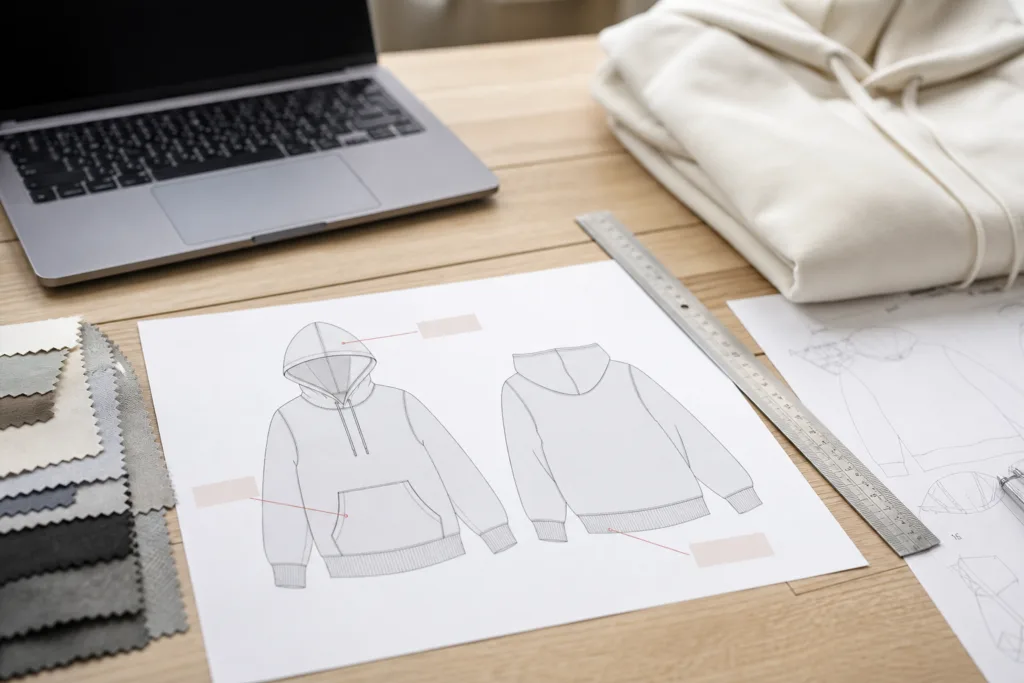
A factory-ready placement sheet should show more than logo position on a front and back sketch. It should include the logo dimensions, decoration method, color references, and exact measurement points from stable garment landmarks.
Useful details to include
- Garment style name and version
- Logo name or file name
- Decoration method for each placement
- Width and height of the logo
- Distance from neckline, shoulder seam, pocket edge, cuff, or hem
- Whether the placement is centered on the panel or offset
- Size scaling instructions if the placement changes by garment size
- Reference image showing expected appearance when worn
Simple, consistent artwork documentation prevents many avoidable delays. Even if the design is small, production teams still need precise references.
Recommended checklist before submitting hoodie logo placement details
| Checklist Item | Why It Matters |
|---|---|
| Confirm garment style and construction | Placement feasibility changes between pullovers, zip hoodies, oversized fits, and heavyweight builds |
| Choose the logo role | Primary branding and secondary branding usually need different locations |
| Match placement to decoration method | Not every area suits embroidery, screen print, or puff print equally well |
| Measure from fixed reference points | Reduces interpretation errors at the factory |
| Check seam and pocket interference | Prevents distorted or unstable decoration results |
| Approve placement on a real sample | Confirms the logo looks right both flat and worn |
| Keep artwork files organized | Avoids size, scale, and output confusion during production setup |
For most brands, the strongest placement choice is the one that supports the brand image and can be repeated reliably across the whole order. A bold concept only works commercially if the factory can execute it cleanly and consistently.
Good hoodie logo placement decisions come from connecting design intent with garment structure, decoration limits, and sampling discipline. When those pieces are aligned early, production usually moves faster and with fewer avoidable corrections.
Frequently Asked Questions
What is the safest hoodie logo placement for first-time production?
Left chest and upper back are usually the safest choices because they offer relatively stable decoration areas and are easier to repeat consistently across bulk production.
Is center chest better than left chest for branding?
Center chest is better for bold visibility, while left chest is better for subtle branding, cleaner styling, and smaller logos such as embroidery or compact marks.
Are sleeve logos harder to produce accurately?
Yes, sleeve logos are generally harder because sleeves are narrow, curved, and affected by seams and garment shape, so alignment needs more sampling attention.
Why can hood logo placement be risky?
Hood placement is riskier because hood panels may include seams, drawstring channels, thicker layers, and curved construction that can affect centering and decoration quality.
Can a logo be placed on or near a hoodie pocket?
Yes, but pocket placement should be treated carefully because openings, stitching, and surface tension can distort prints or embroidery if the artwork is too large or too close to seams.
What should a factory receive to confirm logo placement correctly?
A factory should receive clear artwork files, logo dimensions, decoration method, measurement references from stable garment points, and a visual mockup or approved sample reference.