

Understanding the Difference: Trading Company vs. Factory
When sourcing apparel or any manufactured goods, knowing whether you are talking to a trading company or a direct factory can dramatically affect your pricing, lead time, and product consistency. Many buyers search for ‘trading company vs manufacturer, direct factory, middleman’ to find out how to spot the difference—and avoid costly sourcing errors. Yet, in China and across Asia, many suppliers blur these lines for business reasons. This article breaks down practical methods to identify who is who, using not just theory but lessons from real factory floors.
Why the Distinction Matters in Sourcing

Choosing between a trading company, a direct factory, or a middleman impacts your bottom line, transparency, and supply chain confidence. Factories usually offer lower costs and better control, while trading companies can simplify communications and broaden your sourcing options. But how do you know who you’re really dealing with? Your project’s cost, quality, and timing depend on getting this right.
The Three Roles: Trading Company, Factory, and Middleman Explained
Let’s clarify the common industry roles:
- Direct Factory: Owns production lines, employs workers, and controls quality/output.
- Trading Company: A reseller or broker sourcing goods from factories, usually with broad product offerings.
- Middleman: A less transparent broker, sometimes operating under the same name as trading companies but with zero direct relationships to makers.
Main Identity Clues: Company Registration & Business Scope
If you have a supplier’s business license (营业执照) or can request one, check the business scope section. Direct factories will list manufacturing, processing, or production as a main activity—with clear industrial codes for the industry (e.g., garments, textiles). Trading companies emphasize import/export, sales, and distribution. Some companies have both, but pay attention to the order and primary revenue code.
Location Matters: Registered Address vs. Operational Site
Where does the company operate day-to-day? Direct factories are almost always located in industrial parks, near freight lines, or inside clusters of similar manufacturing buildings. Their business license shows a real industrial address, not a downtown office tower or serviced workspace. Trading companies tend to rent offices in city centers or business districts. Confirm both their registered address (official paperwork) and actual address (where production happens!) before making a deal.
Factory Audits: On-Site Checks & Credible Certifications
No single document replaces a site visit or third-party audit. If suppliers invite you to tour “their” factory but the nameplate at the door doesn’t match their business card, that’s a major warning sign. Ask for production photos, videos, and audit certificates such as BSCI, Sedex, or ISO. Genuine factories have these readily available, often on display in the workshop.
Product Specialization: Narrow vs. Broad Offerings
Factories are specialists. For example, Ninghow Apparel manufactures items like hoodies, polos, and shorts but is cautious to avoid claiming expertise outside their production core. Trading companies often offer everything from T-shirts to umbrellas to electronics. If a supplier’s catalog is impossibly broad, they’re likely not a direct maker. For specific product sourcing, check specialized pages like polo shirt supplier or shorts manufacturers to see real manufacturing content.
MOQ, Lead Time, and Customization Flexibility
Direct factories set Minimum Order Quantities (MOQ) based on their production efficiency. They offer solid answers on lead times and are clear about technical limits (e.g., dyeing, stitching, sizing options). Trading companies often defer answers ‘after checking’ with their supplier network. If a supplier is slow to respond regarding MOQ flexibility, you can learn strategic negotiation steps from guides like How to Negotiate Lower MOQs with Clothing Manufacturers.
Sample Policy and Development Capability
Factories typically offer detailed sample development, pattern adjustments, and prototype tweaks. Trading companies might only send available samples or take longer to provide customizations. If a supplier cannot explain pattern alterations, grading logic, or the development sample timeline, they likely outsource such work.
Pricing Structure: Direct vs. Layered Margins
Trading companies and middlemen add extra margins above the factory price. Their quotes can be vague (“all-in,” “ex-warehouse,” “FOB port”) and may shift after you ask in-depth technical questions. A factory’s price sheet is more detailed—it spells out what’s included and which features may add to cost. For real examples of cost structure, delve into resources like Tiered Pricing: The Clear Path to Smarter Apparel Cost Breaks.
Order Tracking, Quality Control, and Problem Solving
When production gets stuck or a shipment is delayed, direct factories respond quickly—they can trace issues on the floor and offer real solutions. Trading companies may take longer, passing information back and forth. If you want insights into how proper QC is handled by manufacturers, you’ll find apparel manufacturing quality control best practices particularly useful.
Language and Communication Style
Expect direct, sometimes blunt, product advice from genuine factory representatives. Trading companies tend to use more ‘account management’ language, and may avoid technical detail or redirect technical questions.
Website and Marketing Material: Real Shop-Floor Photos vs. Stock Images
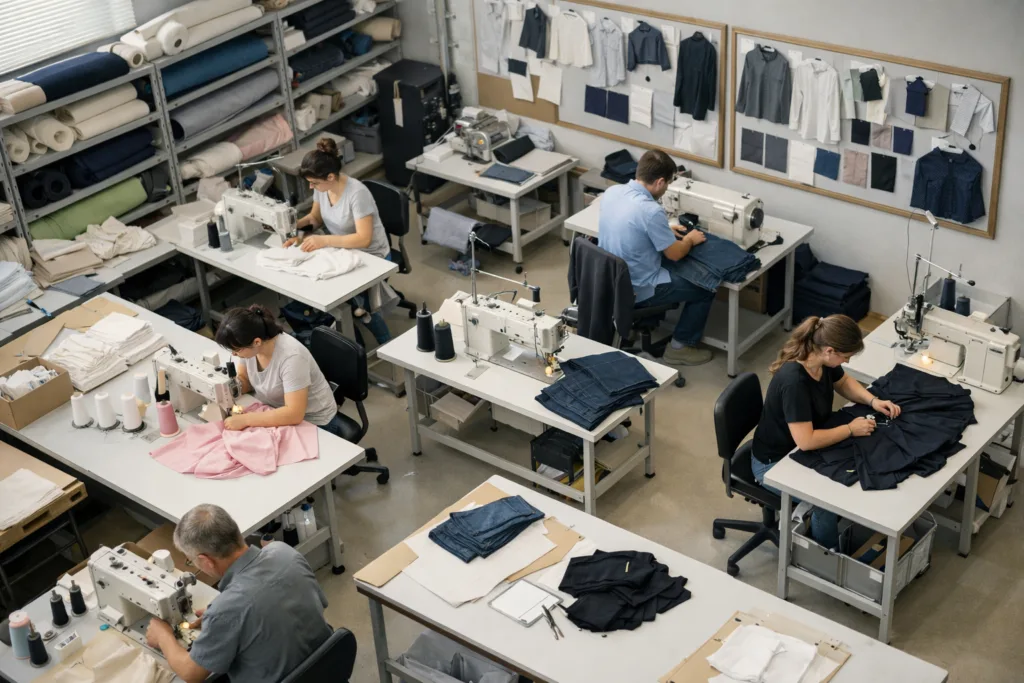
Direct factories proudly display real production, with images of staff, machinery, and actual workshops. Trading companies use generic office photos, fancy graphics, or collage-style product catalogs with inconsistent samples. Look for clear, focused product pages describing technical know-how, such as tank tops manufacturer pages, that display factory equipment and in-production images.
Red Flag Checklist: Dodging Sourcing Scams On Platforms
Many Alibaba or B2B platform ‘gold suppliers’ are trading companies or middlemen in disguise. Warning signs include: unable or unwilling to provide a real factory address, avoidance of production-related questions, and providing business licenses showing only trade/distribution. For more on suspect supplier behavior, see Spot the Red Flags Before You Get Scammed.
Third-Party Verifications: CCC, BSCI, Amfori, Sedex, and ISO
Certified factories readily share up-to-date certificates with you. Trading companies may show outdated or borrowed scans, or certificates with mismatched company names and addresses. Always verify documents independently with issuing organizations.
Business Licence Analysis: Sample Breakdown
When viewing a Chinese business license, focus on the company’s scope section. Words and codes like ‘manufacturing’ (制造), ‘processing’ (加工), and the presence of an industrial zone address suggest direct factory status. ‘International trade,’ ‘import/export,’ or a city-center office raise the trading company flag.
Case Study Snapshot: Office Tour vs. Factory Visit
Consider a situation where a buyer is given a tour of a shining office, but the real manufacturing happens miles away—or not at all! Noting the location discrepancy is a classic sign. Direct factories offer factory floor tours, not just boardroom meetings.
Direct Factory: Strengths and Weaknesses
Strengths: Transparent process, better cost control, higher customization ability, and production oversight. Weaknesses: Sometimes less responsive to complicated small orders or require higher MOQs.
Trading Company: Strengths and Weaknesses
Strengths: Simpler for complex, multi-product sourcing; often better foreign language skills; handles logistics/documentation. Weaknesses: Higher cost, less control over production changes, sometimes slower communication on technical problems.
Table: Trading Company vs. Factory Comparison
| Factor | Direct Factory | Trading Company |
|---|---|---|
| Business Scope (License) | Manufacturing, Processing | Trading, Import/Export |
| Location | Industrial Area | Downtown/Business District |
| Product Range | Narrow/Deep specialization | Wide/Varied |
| Sample Development | In-house | Outsourced |
| MOQ | Clear, explains rationale | Varies, less transparent |
| Certificates | Factory-matched, valid | Sometimes generic/mismatched |
| Problem-solving | On-the-spot solutions | Delayed by info relay |
Ninghow Apparel: A Factory-First Perspective
From the production side, Ninghow Apparel sees firsthand how critical fit, fabric selection, and sample handling are to a brand’s success. Overly broad catalogs and office locations far from industrial parks often mean your project is handled by trading layers. Using real production photos, precise MOQ explanations, and clear sample policies are standard practice for factories who value stable, repeat business relationships. This directness reduces surprises for both parties.
Dealing with ‘Hybrid’ Companies: Combined Trading-Manufacturing Models
Some larger entities run both factory sites and a trading division, serving international buyers more efficiently. Scrutinize which entity owns the means of production for your specific order, and always confirm with documentation plus on-site checks where possible.
Drafting Your Supplier Verification Checklist
- Request the business license; confirm scope and address match the story.
- Use Google Maps/Baidu to check office/factory location (write-offices rarely manufacture goods).
- Challenge with technical development questions: watch for quick, specific answers.
- Ask for in-progress order images, videos, or QC reports.
- Request valid certificates with your company name and year.
- Reject “factory photos” using only sample rooms or generic office settings.
What About ODM, OEM, and Private Label?
Factoring in apparel models: OEM (Original Equipment Manufacturer) factories work from your supplied designs; ODM (Original Design Manufacturer) factories offer in-house design options and branding; true private label manufacturing means you control the branding and design while production remains in capable workshop hands. For specialized OEM/ODM guidance, see trusted sources like clothing manufacturers private label.
Trading Company vs. Factory: How to Spot the Difference
Summing up, check business scope, site location, development speed, and communication for clues. Keep in mind, reliable factories invest in traceable, transparent processes—while trading companies excel in customer management and broad sourcing. Choose the right partner and protect your project integrity.
Conclusion: Making the Right Choice for Your Sourcing Needs

Deciding between a trading company, a direct factory, or a middleman isn’t just about price—it’s about control, reliability, and the overall supply chain relationship. Use concrete identity checks like business scope and address, practical on-site evidence, and professional communication cues to guide your selection. With these strategies, you’ll navigate sourcing decisions with confidence and clarity.
Frequently Asked Questions
How can I verify if a supplier is a factory or trading company?
Request and review the business license for clear terms like ‘manufacturing’ and industrial addresses. Always match paperwork to one or more on-site visits for confirmation.
Why do some suppliers combine factory and trading licenses?
Larger companies may run both operations for flexibility. Clarify which division handles your order and confirm with documentation and site checks.
What are the risks of buying from a middleman?
Middlemen can mask production issues, inflate costs, and increase miscommunication, resulting in delays, quality problems, or lost money in worst cases.
Does a high MOQ always mean a company is a factory?
Not always, but factories usually set MOQs based on batch efficiency. Trading companies might propose lower MOQ but can’t control production constraints directly.
Are factories always cheaper than trading companies?
Usually, yes, but trading companies can sometimes leverage bulk buying or logistics to offer competitive rates for simple, standard items—due diligence is crucial.
Why is address verification important in supplier checks?
Industrial addresses usually indicate actual production facilities, while business district or residential locations point to trading operations, not factories.